 Azzam Bilal Chamdy
The landscape of travel discovery is undergoing a seismic shift. For decades, hotel marketing was defined by Search Engine Optimization (SEO)—a battle for the top blue link on a results page. Today, that battleground has evolved. As travelers increasingly turn to AI-driven assistants like ChatGPT, Perplexity, and Google AI Overviews to plan their trips, the objective has shifted from earning a click to securing a citation. This is the era of Hotel Generative Engine Optimization (GEO).
What Is Hotel Generative Engine Optimization?
Hotel GEO is the strategic discipline of ensuring a property is retrievable, quotable, and trustworthy to AI systems. Unlike traditional SEO, which aims to drive traffic directly to a website via search engine result pages (SERPs), GEO aims to position a hotel as a verified, expert-recommended source within a synthesized AI answer.
Where SEO earns you a rank, GEO earns you a mention. Because generative engines answer complex queries by synthesizing data from various sources, visibility is no longer just about keywords; it is about providing the precise, verifiable information that AI models require to formulate a high-confidence recommendation.
The Chronology of the Shift: From Keywords to Conversations
The formalization of GEO as a discipline stems from intensive research by experts from institutions including IIT Delhi, Princeton, Georgia Tech, and the Allen Institute for AI. Their seminal work, presented at the KDD 2024 conference, identified that generative engines operate on a "retrieve-then-generate" loop.
- The Retrieval Phase: The AI identifies high-authority, relevant sources from its index.
- The Synthesis Phase: The AI converts those sources into a coherent, cited answer.
In the past, hotel marketers asked: "Do we rank for ’boutique hotel in Barcelona’?" Today, the question has become more nuanced: "Would an AI system include us when a traveler asks for a quiet hotel in Barcelona with balconies, an allergy-friendly breakfast, and easy airport access?"

This shift represents a fundamental change in how travelers interact with the internet. According to Google CEO Sundar Pichai, AI Overviews now serves over 2.5 billion monthly active users. This massive scale means that if a property is not "visible" to an AI, it is effectively invisible to a significant, high-intent segment of the modern travel market.
Supporting Data and the "Click" Paradox
The economic implications of this transition are quantifiable. Research from the Pew Research Center indicates a clear "click-through" decline: users are significantly less likely to click on traditional links when an AI summary provides the necessary information upfront. In instances where an AI summary appears, click rates drop from 15% to approximately 8%.
This "zero-click" future makes GEO an existential necessity. If the AI provides the answer—and the booking link—directly within the chat interface, your hotel must be the source being cited.
However, the data also highlights a vital nuance: trust. Expedia Group’s AI Trust Gap report (March 2026) reveals that 68% of travelers still prefer booking via a trusted travel brand rather than a generic chatbot. This suggests that while AI is the discovery engine, the hotel’s own website remains the conversion destination. The goal of GEO is not to replace your website, but to ensure the AI uses your website as the ultimate, trusted source of truth.
The Hotel GEO Stack: A Five-Layer Framework
To master GEO, hoteliers must move away from scattered tactics and adopt a structured, five-layer approach. Each layer builds upon the foundation of the one beneath it.
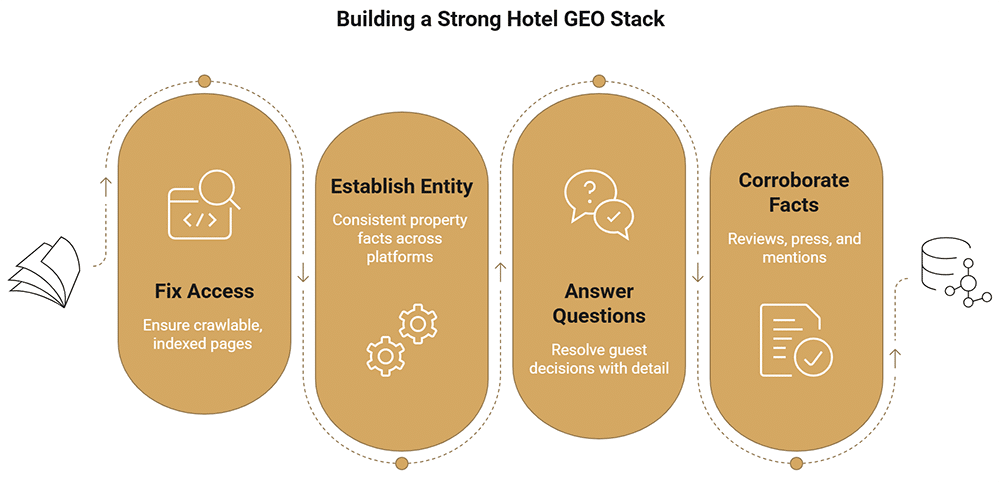
1. Access: The Technical Foundation
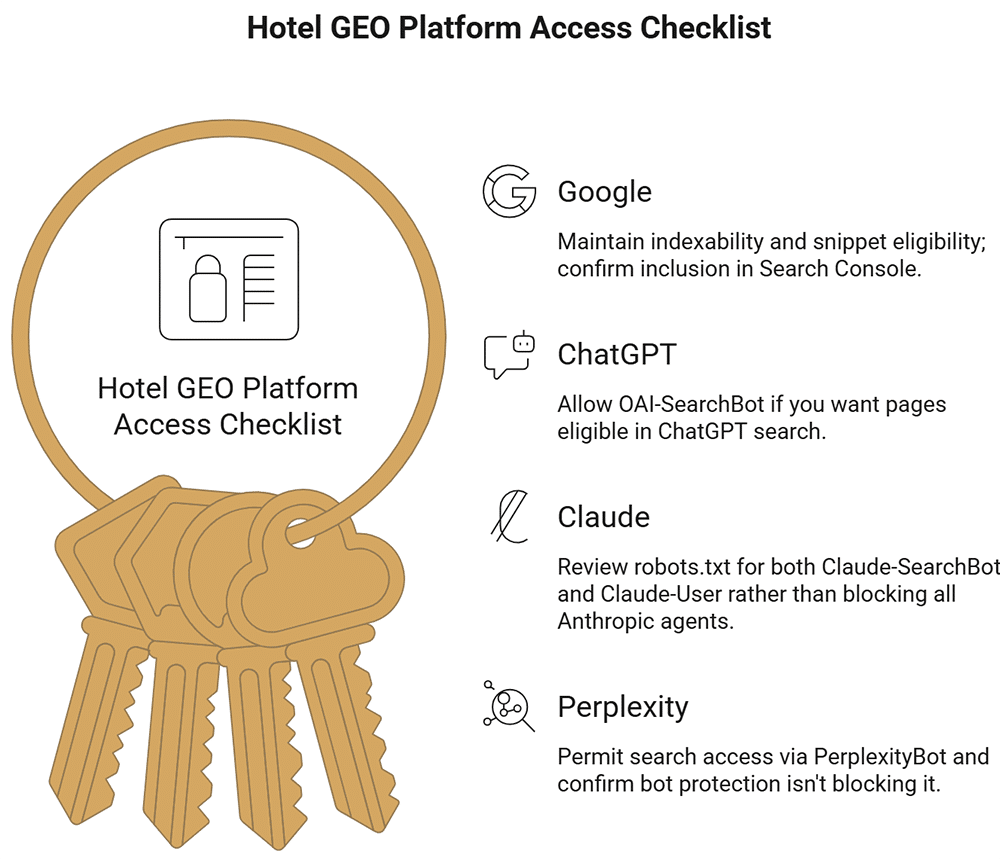
If an AI cannot crawl your site, it cannot cite you. Ensure that your robots.txt files, firewall settings, and crawl permissions are optimized. Use Google Search Console to confirm your site is healthy and accessible to crawlers.
2. Entity: The Factual Backbone
Consistency is the currency of AI. Your property name, address, amenities, and policies must be identical across your website, Google Business Profile, and OTA listings. Mismatches create "hallucination risks" for AI, leading the engine to doubt your data.
3. Answer: Intent-Driven Content
Rewrite your most important pages to solve specific guest problems. Instead of generic marketing copy, use "answer-shaped" content. If a guest asks about airport shuttles, have a page that explicitly details the shuttle schedule, cost, and booking process.
4. Corroboration: Social Proof and Media
AI models look for corroboration. Your website claims you have "quiet rooms," but do your reviews back that up? Actively respond to reviews with factual, dated details. Pitch local stories to press outlets, as high-authority mentions provide the validation AI systems crave.
5. Measurement: AI Performance Tracking
Monitor your AI Appearance Rate (AAR). While platforms like Bing Webmaster Tools provide AI performance reports, others require manual testing. Build a 20-prompt panel—a set of questions representing your core market—and test them monthly across ChatGPT, Perplexity, and Gemini to track your visibility trends.

Implications for Independent Hoteliers
For the independent hotelier, the rise of GEO might feel daunting, but it actually favors the agile. You do not need a massive enterprise team to win at GEO. You need operational discipline.
The "AI Trust Gap" identified by Xavi Amatriain, Chief AI and Data Officer at Expedia Group, highlights that travelers view AI as a tool for planning, but they remain cautious about the actual transaction. This provides a competitive advantage for independent hotels: if your website is the most accurate, reliable, and user-friendly source of information, you will win the booking once the AI leads the guest to you.
Strategic Limitations and Reality Checks
It is crucial to understand what Hotel GEO cannot do. It cannot force an AI to recommend you, nor can it guarantee a booking. Current research confirms that while GEO increases the probability of retrieval, the underlying algorithms remain "black boxes" that are constantly updated.
Furthermore, Google has explicitly warned against "over-optimizing" for AI. There is no need for "AI-only" markup or artificially segmented content. The best GEO strategy is simply the best content strategy: be accurate, be helpful, and be consistent.
Conclusion: The New Commercial Standard
Hotel GEO is not a fad; it is the natural evolution of digital presence. As the travel journey becomes increasingly synthesized, a hotel’s ability to "speak" to AI engines becomes as important as its ability to speak to human guests.
By treating your digital footprint as a unified, factual, and highly accessible database, you ensure that when a traveler asks an AI for the perfect place to stay, your property is not just a candidate—it is the authoritative answer. The hotels that win in 2026 and beyond will be those that view AI not as a threat to their distribution, but as a new, powerful channel that rewards transparency, accuracy, and brand consistency.
Start your audit today: check your property facts, fix your technical access, and begin building your prompt panel. The future of discovery has arrived—make sure your hotel is part of the conversation.


 Evan Lee Salim
 Iffa Jayyana