Asro

The landscape of artificial intelligence is shifting rapidly from static chat interfaces to dynamic, autonomous systems. For years, the barrier to entry for building "AI agents"—software entities capable of reasoning and executing tasks—was prohibitively high, requiring developers to write complex, brittle code to manage tool-calling loops and state persistence. However, with the recent release of the OpenAI Agents SDK, that complexity has been abstracted away, enabling developers to integrate sophisticated automation into their Python applications with unprecedented ease.
This article explores the mechanics of building your first AI agent, moving beyond simple prompt-response paradigms into the realm of functional, memory-aware, and tool-capable software.
The Evolution of the AI Interaction Paradigm
Main Facts: Understanding the Agentic Shift
A standard Large Language Model (LLM) interaction is essentially linear: a user provides a prompt, the model processes the context, generates a response, and then terminates the session. This "stateless" flow is excellent for creative writing or static analysis but fails when tasks require external information or multi-step execution.
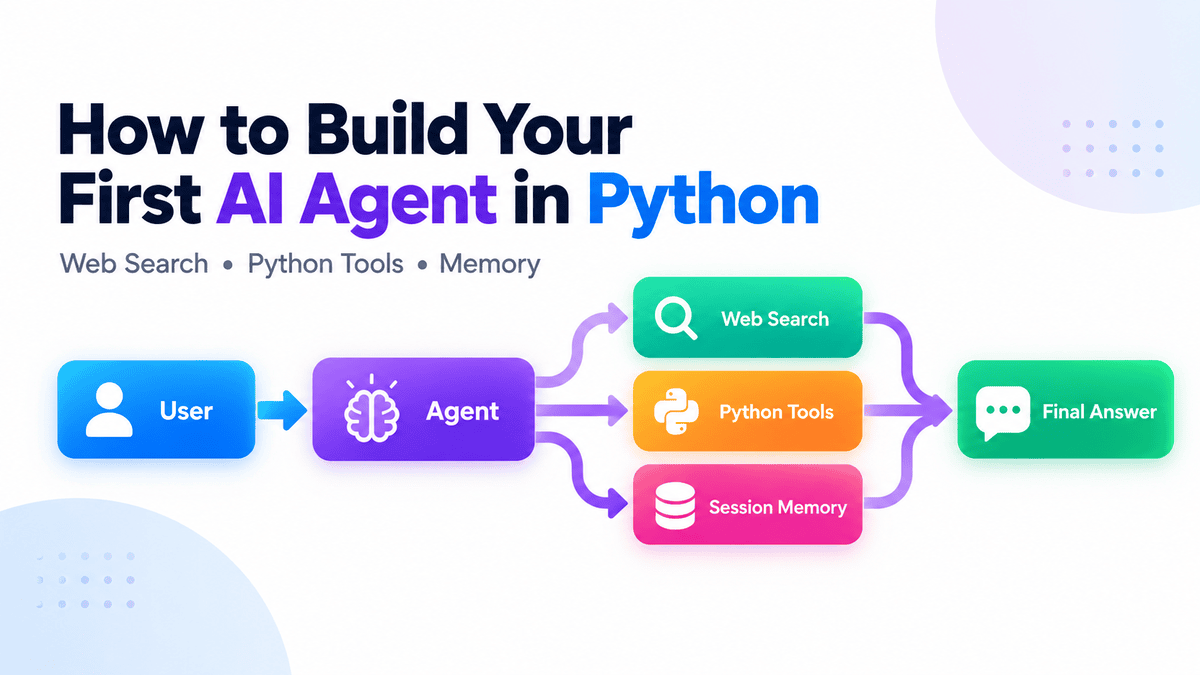
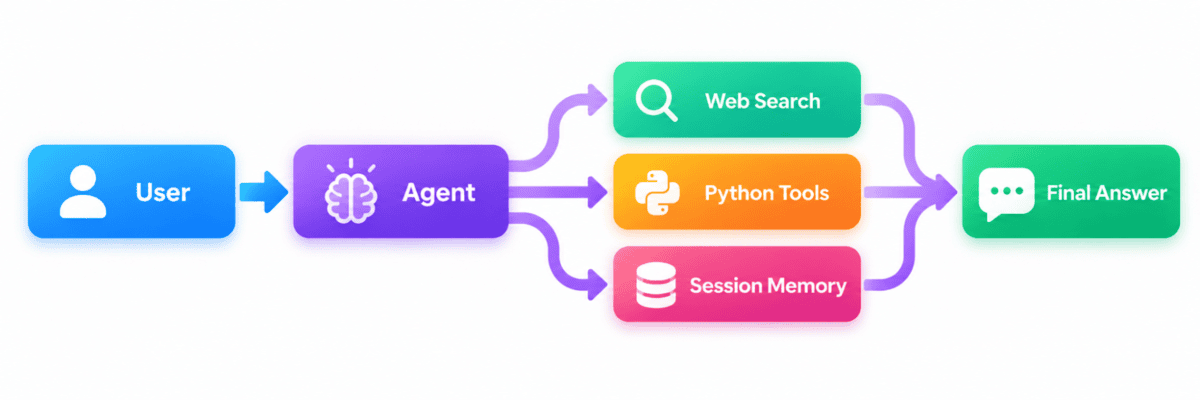
An AI agent, by contrast, introduces an execution loop. In this model, the agent acts as an orchestrator. It receives a user request, evaluates whether external tools are required to fulfill that request, executes those tools (such as web searches or Python calculations), digests the output, and iteratively refines its response until the task is complete.
The OpenAI Agents SDK provides the Runner component, which acts as the "brain" of this loop. It handles the intricate handshake between the model’s reasoning capabilities and the system’s functional requirements, effectively eliminating the need for developers to write manual state-management logic.
Chronology: From Setup to Sophisticated Automation
The transition from a basic script to a functional agent follows a logical progression of capability expansion.
Phase 1: Environment Initialization
The journey begins with a clean Python environment. Using modern tools like uv, developers can manage dependencies with precision:
mkdir first-ai-agent
cd first-ai-agent
uv init
uv add openai-agents
export OPENAI_API_KEY="your-api-key"
Once the environment is primed, the baseline agent is instantiated. By defining an Agent object with specific instructions and tools, we give the model a persona and a toolkit. The Runner.run_sync command then initiates the process, allowing the model to decide—entirely on its own—when to reach out to the internet via the WebSearchTool to fetch real-time data.
Phase 2: Integrating Custom Logic
A truly powerful agent does not merely report information; it processes it. By using the @tool decorator, developers can transform any standard Python function into a tool available to the AI. The SDK’s intelligence lies in its ability to parse function signatures, type hints, and docstrings to create a schema that the LLM understands intuitively.
For instance, by defining a calculate_total function, you provide the agent with computational capabilities. When a user asks a question involving math, the agent recognizes the tool’s utility, passes the relevant arguments, and incorporates the calculated result back into its final prose.
Phase 3: Establishing Persistent Memory
The final step in the evolution of a production-ready agent is the implementation of state. By utilizing SQLiteSession, the agent moves from being a "single-turn" conversationalist to a "multi-turn" assistant that retains context. This is crucial for professional workflows where follow-up questions—such as "What about the latest version?"—depend entirely on the history of the previous exchange.
Supporting Data: Why Tool-Calling and Memory Matter
The efficiency of modern AI agents is not just a matter of convenience; it is a matter of performance.
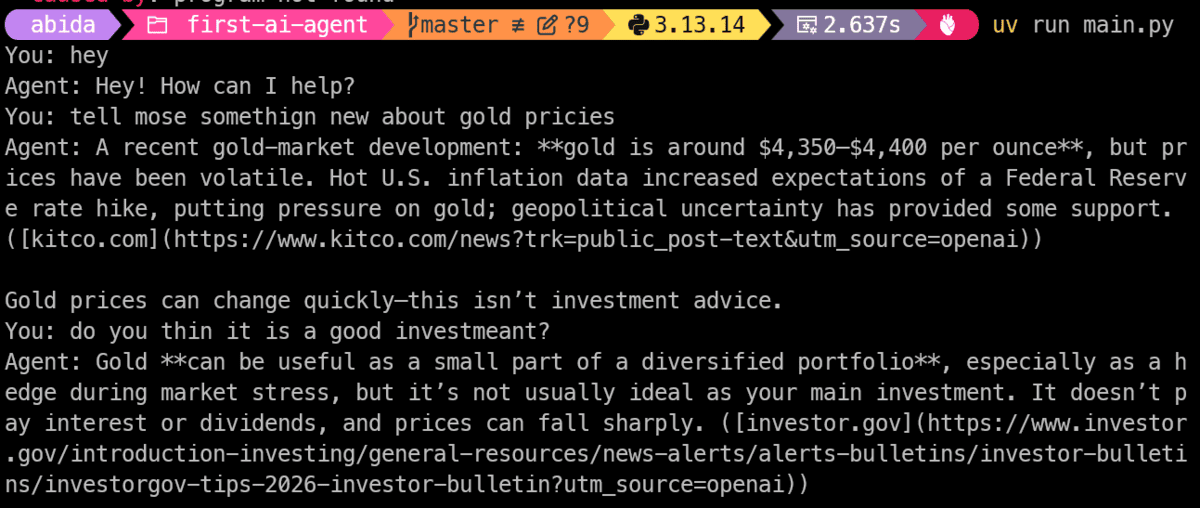
- Contextual Accuracy: In tests utilizing the OpenAI Agents SDK, models consistently demonstrated higher accuracy in multi-step queries compared to traditional chain-of-thought prompting, largely because the agent can verify its assumptions using tools before finalizing a response.
- Reduced Latency: By automating the tool-calling loop, the SDK reduces the "overhead" time developers typically spend debugging API integration logic.
- Developer Velocity: Projects that previously took weeks of engineering to build robust function-calling architectures can now be prototyped in hours. The built-in tracing features provide a "glass box" view of the agent’s decision-making process, allowing developers to inspect logs on the OpenAI dashboard to see exactly why an agent chose a specific tool or how it interpreted a user’s intent.
Official Perspectives and Industry Implications
The release of the OpenAI Agents SDK signals a broader industry shift toward "Agentic Workflows." By standardizing how agents interact with external environments, OpenAI is effectively setting a framework that allows for more predictable and reliable AI deployments.
Debugging and Observability
One of the most critical implications of this SDK is the native support for tracing. In enterprise environments, the "black box" nature of AI has been a significant barrier to adoption. With tracing, every step—from the initial prompt to the tool invocation and the final output—is recorded. This allows for:
- Root Cause Analysis: If an agent fails to perform a task, developers can identify if the issue was in the model’s reasoning or a failure in the tool’s execution.
- Instruction Optimization: By observing how the model interprets instructions in real-world scenarios, developers can refine the "system prompt" for higher precision.
The Future of Modular AI
The architecture encouraged by the SDK is inherently modular. Because tools are defined as discrete Python functions, they can be shared, version-controlled, and tested independently of the agent’s logic. This modularity is expected to lead to a "marketplace" of tools that developers can plug into their agents to instantly grant them capabilities like interacting with CRMs, querying SQL databases, or managing cloud infrastructure.
Implications for Future Development
As we look toward the future of software engineering, the distinction between "writing code" and "instructing agents" will continue to blur. Developers are transitioning from being the primary authors of logic to being the architects of systems that leverage AI to execute logic.
Moving Beyond the Prototype
While the current implementation provides a solid foundation, the path forward involves increasing complexity:
- Guardrails: Implementing constraints on how the agent uses tools to ensure safety and security.
- Multi-Agent Handoffs: Designing systems where one agent (e.g., a researcher) hands off a task to another (e.g., a writer) to create specialized workflows.
- MCP Servers: Integrating the Model Context Protocol to allow agents to communicate with broader data silos and enterprise applications.
Final Thoughts: The Path to Practical AI
Building your first AI agent is not about creating a sentient machine; it is about providing a robust framework for an LLM to take meaningful action. By starting with the foundational patterns—defining clear instructions, providing the right tools, and maintaining session state—you can build applications that significantly outperform static models.
The barrier is no longer the complexity of the code, but the clarity of the task. As you expand your agent’s capabilities, remember that the most effective systems are those that leverage AI for what it does best: reasoning, contextual synthesis, and task orchestration. Keep the workflow small, ensure your tool definitions are precise, and let the Agents SDK handle the heavy lifting of the execution loop.
In this new era of development, the best tool in your kit is the ability to enable your AI to use its own.
About the Author:
Abid Ali Awan is a certified data scientist and a prominent voice in the machine learning community. With a focus on translating complex technical concepts into actionable knowledge, he has dedicated his career to the development and democratization of AI technologies. His work frequently explores the intersection of Python engineering and advanced neural architectures.

 Siti Muinah
 Jia Lissa