
 Reynand Wu
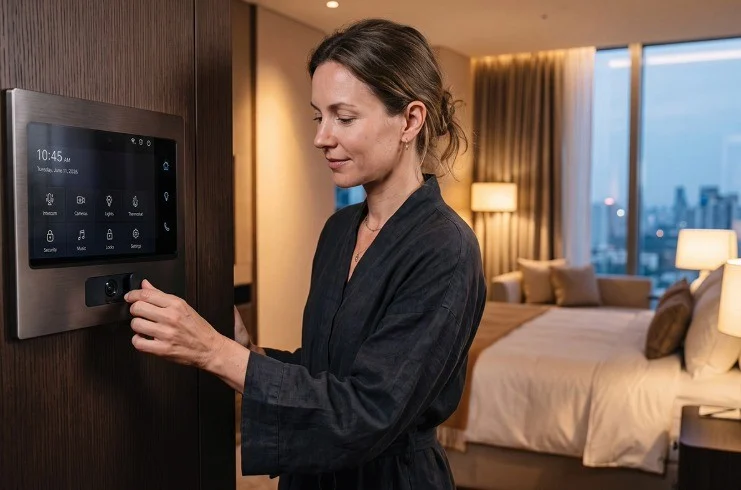
The modern hotel guestroom is undergoing a radical metamorphosis. No longer viewed as a static space defined merely by furniture and amenities, the guestroom is evolving into a dynamic, "smart" ecosystem. This technological shift is moving beyond simple gadgetry, such as standalone smart speakers or basic thermostats, toward a fully integrated infrastructure where room access, WiFi connectivity, climate control, lighting, and service requests communicate in a synchronized, intelligent loop.
For hoteliers, this transition represents a dual opportunity: the ability to achieve significant operational cost savings while simultaneously delivering a hyper-personalized guest experience that mirrors the seamless convenience of a modern smart home.
The Evolution of the Smart Room: From Gadgets to Ecosystems
The contemporary "smart" room is characterized by its ability to act as a unified, responsive environment. As George Winker, Vice President of Sales for North America at Vingcard, explains, the goal is to provide guests with "the same instant responsiveness, convenience, and control that they experience in other parts of their lives."
This integration begins the moment a guest interacts with the property, often before they physically step into the lobby. Modern digital wallet integration allows guests to securely store their room keys on their smartphones. Upon arrival, the digital credential triggers a chain reaction: the door unlocks, and the room-management system—recognizing the authorized entry—initiates a "welcome scene." This may include adjusting lighting to a pre-set mood, setting the thermostat to the guest’s preferred temperature, and opening or closing drapery.
"The big buzzword among chain hotels is ‘scenes,’" notes Amber Smith, senior product leader at Verdant by Copeland. "They want a welcome scene, an exit scene, a night scene, a morning scene, etc." These scenes, while customizable by the hotel, empower the guest to retain control, allowing them to shift the room’s atmosphere with a single tap on an in-room tablet or a mobile app.
Chronology of a Smart Stay
To understand the impact of these integrated systems, it is helpful to look at the lifecycle of a guest’s stay:
- Pre-Arrival: The guest receives a mobile key credential. Security protocols ensure this is securely provisioned to their digital wallet.
- Arrival: The guest taps their device to the lock. The system verifies the arrival and immediately initiates the "Welcome Scene," adjusting climate and lighting.
- Authentication: The guest’s personal devices are authenticated via a one-time secure process, granting them instant, high-speed WiFi access throughout their stay.
- Occupancy: Throughout the stay, the room maintains an "Active" status. If the guest departs for the day, the system detects vacancy and enters an energy-saving mode, reverting to eco-friendly temperatures and turning off non-essential lights.
- Departure: Upon checkout, the mobile credential is automatically deactivated. The room reverts to a "Vacant" state, ready for housekeeping or the next guest.
Supporting Data and Operational Efficiency
The move toward integrated systems is not merely for aesthetic or convenience purposes; it is a data-driven strategy for bottom-line growth.
Energy Management and Cost Control
The most immediate financial benefit of these systems is the mitigation of "energy waste." By utilizing occupancy sensors, hoteliers can prevent rooms from being heated, cooled, or illuminated when empty. This is a significant factor in utility expenditure, particularly for larger, full-service properties.
Furthermore, mobile keys offer a secondary cost-saving mechanism: the reduction of physical keycard restocking fees and the environmental impact of plastic waste.
Data-Driven Maintenance
Beyond energy, the cloud-based nature of modern systems provides deep analytical insights. Amber Smith highlights the importance of this: "We stay connected through the cloud and really focus on data analytics. We know if someone’s in the room, but we also monitor the unit itself—how long it’s been running before occupancy, how long it will continue to run after, and what those preferred set points are."
This predictive maintenance capability allows hotel operators to identify a failing HVAC unit or a malfunctioning lock before the guest reports an issue. By comparing performance data across an entire property portfolio, operators can determine which units are underperforming and optimize them accordingly.

Official Responses and Strategic Perspectives
Industry leaders emphasize that the transition to smart rooms should not be viewed as an "all-or-nothing" investment. While major hotel owners are increasingly seeking a comprehensive "ecosystem" where locks, lights, and thermostats "talk to each other," the technology is inherently modular.
"Most major hotel owners are not just shopping for a thermostat; they’re shopping for an entire ecosystem," Smith notes. "For example, when the guestroom door opens, the smart lock can send a signal to turn on the occupancy sensor for the thermostat. And vice versa; if we don’t get an occupancy sensor signal for a while, we can communicate back to lock the door."
George Winker echoes this sentiment, emphasizing the feasibility of piecemeal integration: "Modular, cloud-based, and wireless technologies allow hotels to begin with the capabilities that provide the greatest value and expand over time. This provides properties and chains with a practical and cost-effective way to adopt technologies at their own pace."
For a luxury resort, this might mean a fully integrated suite of services, including voice-activated drapery and personalized entertainment systems. For a limited-service hotel, it may start with robust, one-time WiFi authentication and occupancy-based energy management—two features that yield the highest immediate return on investment.
The Implications of Implementation
Selecting the Right Infrastructure
The complexity of integration often leads hoteliers to ask whether they need a full Guestroom Management System (GRMS). Winker suggests that a GRMS is the gold standard when a property aims to centralize multiple functions, such as lighting, temperature, drapery, and service requests. However, for smaller properties or those with specific goals, integration can be achieved through existing PMS (Property Management Systems), energy management software, or middleware APIs.
The recommendation for operators is to follow a structured planning phase:
- Define Outcomes: Are you chasing utility savings, guest satisfaction, or staff efficiency?
- Audit Infrastructure: Assess the current network, hardware, and room configuration.
- Plan for Scalability: Ensure that any technology adopted today can communicate with the systems you plan to add tomorrow.
Future-Proofing the Hotel Journey
The implications for the future of hospitality are profound. As AI integration becomes more sophisticated, these systems will move from "reactive" to "predictive."
"Digital access, network connectivity, environmental controls, and operational platforms will increasingly exchange real-time information through secure, cloud-based, and interoperable systems," Winker predicts. "AI will help properties interpret that information to anticipate maintenance needs, optimize energy use, and make permission-based recommendations or adjustments aligned with individual preferences."
The ultimate goal is a seamless, friction-free journey. By leveraging AI to understand guest preferences—such as a preference for a room cooled to exactly 68 degrees or a requirement for specific lighting levels—hotels can deliver a bespoke experience at scale.
Conclusion: The Path Forward
The "smart" guestroom is no longer a futuristic concept; it is the current standard for competitive hospitality. By prioritizing interoperable, cloud-based, and modular solutions, hotel operators can bridge the gap between legacy operations and the expectations of the modern, tech-savvy traveler.
Whether through the immediate impact of energy management or the long-term loyalty gains of personalized room scenes, the investment in integrated technology is proving to be a cornerstone of modern hotel management. As these systems continue to evolve, the properties that succeed will be those that view technology not as an expense, but as a fundamental tool for operational excellence and guest satisfaction.


 Rifan Muazin
 Evan Lee Salim





