
 Asep Darmawan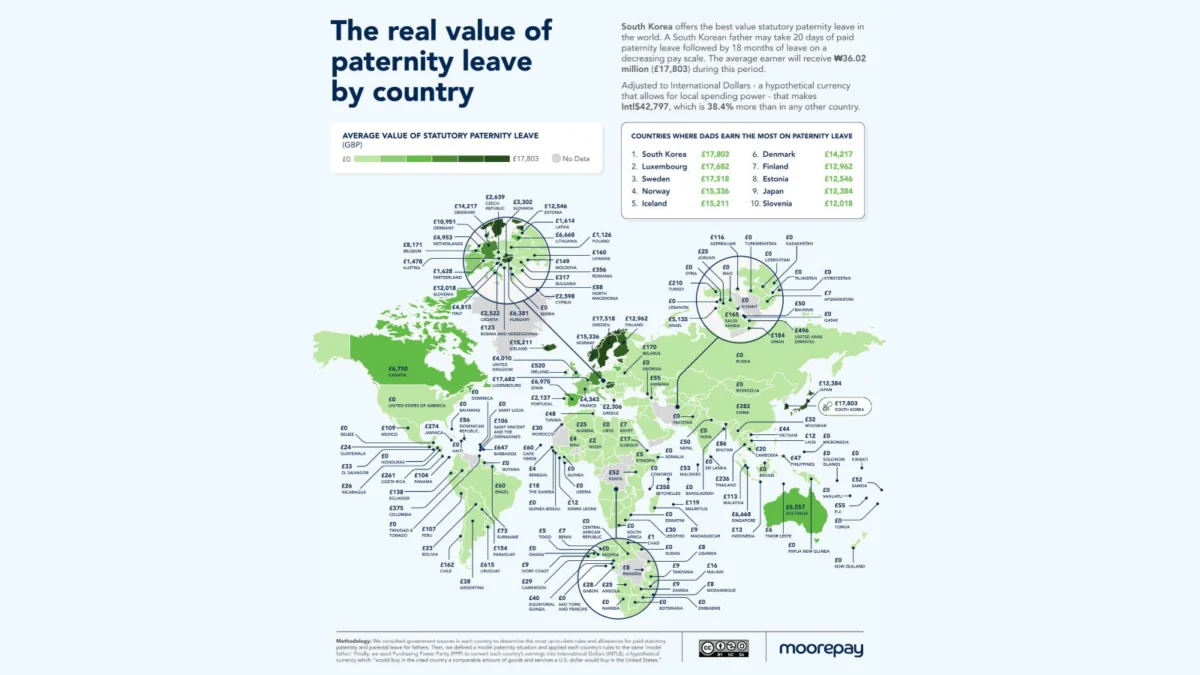
In the modern landscape of global labor, the role of the father is undergoing a profound transformation. No longer viewed solely as the secondary caregiver, the contemporary father is increasingly recognized as a vital pillar in early childhood development. However, a stark disparity remains in how nations facilitate this transition. A comprehensive new study by Moorepay has unveiled a dramatic global divide, with South Korea emerging as the world’s most supportive nation for fathers, while 51 countries continue to offer zero statutory paid paternity leave.
The Vanguard of Parental Support: South Korea’s Generous Model
South Korea has set a new global benchmark for paternity leave, according to Moorepay’s Ultimate Guide to Global Paternity Leave 2026. The study reveals that fathers in South Korea can access over 36 million South Korean Won (KRW)—equivalent to approximately £17,803 GBP or Intl$42,797 in purchasing power—through statutory paid leave provisions.
Beyond the monetary value, the duration of support provided by Seoul is unparalleled. South Korean fathers are eligible for 82 weeks of paid parental leave, a figure that dwarfs the global average. Japan follows in second place with 48 weeks, while Hungary rounds out the top three at 42.1 weeks. When the data is adjusted to account for "full-pay equivalent" leave—a metric that measures how long a parent can stay home while receiving the equivalent of a full salary—South Korea remains at the summit with 43.4 weeks, followed by Estonia (38.2 weeks) and Slovenia (35.0 weeks).
The Global Paternity Leave Chronology: A History of Progress and Stagnation
The movement toward formalizing paternity leave is relatively nascent in the scope of labor history. Throughout the mid-20th century, parental leave was almost exclusively categorized as "maternity leave," reflecting social norms that designated childcare as an exclusively female responsibility.
- 1970s–1980s: Scandinavian nations, led by Sweden, pioneered the concept of "parental leave" rather than just "maternity leave," laying the groundwork for gender-neutral caregiving policies.
- 1990s–2000s: Global organizations, including the ILO (International Labour Organization), began emphasizing that the absence of paternity leave contributes to gender inequality in the workplace, as employers often view women of childbearing age as "higher risk" hires.
- 2010s–Present: Nations like South Korea and Japan, facing significant demographic crises and declining birth rates, have implemented aggressive, high-value paternity leave packages. These policies are now framed not just as labor benefits, but as critical economic and public health interventions.
Despite this progress, the Moorepay study highlights a concerning stagnation in other regions. In the United States, Serbia, and New Zealand, among 51 others, there is no federal statutory paid paternity leave. In these jurisdictions, leave is often dependent on individual employer policies, creating a "lottery" system that favors employees in high-income, white-collar sectors while leaving the broader workforce unsupported.
Methodological Rigor: How the Moorepay Study Was Conducted
To ensure a fair comparison, the researchers at Moorepay established a standardized "model situation." The study assumed a scenario involving a firstborn child, an only child, and two working parents, each earning the average income per capita for their respective nations as defined by World Bank data.
Key Analytical Filters
The study utilized several crucial filters to ensure the data was not skewed by maternity-centric policies:
- Exclusion of Reassigned Leave: If a country’s "paternity" leave was simply maternity leave that the mother could transfer to the father, it was excluded to isolate true, dedicated paternity provisions.
- Concurrent Leave Requirements: If the law mandated that the mother return to work for the father to claim his leave, the benefit was excluded, as it does not represent a model of shared caregiving.
- Cost-of-Living Adjustments: To make a truly global comparison, the team converted local pay figures into International Dollars using Purchasing Power Parity (PPP). This accounts for the fact that a million Won in Seoul has different purchasing power than a comparable sum in London or Helsinki.
Supporting Data: The Top 10 Leaders in Paternity Pay
The following table illustrates the top 10 nations for statutory paternity leave, ranked by the absolute average value in GBP.
| Rank | Country | Average Value (GBP) | Paternity Pay (USD) | Value (Intl Dollars) |
|---|---|---|---|---|
| 1 | South Korea | £17,803 | $23,425 | $42,797 |
| 2 | Luxembourg | £17,682 | $23,266 | $23,324 |
| 3 | Sweden | £17,518 | $23,050 | $25,127 |
| 4 | Norway | £15,336 | $20,179 | $21,812 |
| 5 | Iceland | £15,211 | $20,014 | $16,920 |
| 6 | Denmark | £14,217 | $18,707 | $19,057 |
| 7 | Finland | £12,962 | $17,056 | $18,905 |
| 8 | Estonia | £12,546 | $16,507 | $23,974 |
| 9 | Japan | £12,384 | $16,295 | $27,518 |
| 10 | Slovenia | £12,018 | $15,813 | $24,088 |
Official Responses and the Public Health Perspective
The implications of these findings extend far beyond the balance sheet of human resources departments. The discourse surrounding paternity leave has shifted from a "perk" to a "public health mandate."
Dr. Craig Garfield, a prominent researcher on the intersection of paternity leave and mental health, emphasizes that the benefits of paternal involvement are measurable and significant. "Our findings underscore that paternal leave is not just a workplace benefit; it’s a public health issue that can deeply impact families and children," Dr. Garfield noted.
When fathers are present during the critical early months of a child’s life, the ripple effects are profound:
- For the Mother: Reduced maternal stress and a more equitable distribution of the "mental load" associated with household management.
- For the Child: Stronger emotional bonding, which psychological studies have linked to better cognitive and social outcomes in later childhood.
- For the Father: A significant reduction in the anxiety and feelings of isolation often reported by new fathers. Research indicates that extended leave allows fathers to build a sense of competency in caregiving that persists long after they return to the office.
Implications for the Global Workforce
For multinational corporations and policymakers, the Moorepay study serves as a wake-up call. As the global war for talent intensifies, benefits packages are increasingly viewed through the lens of social responsibility and employee well-being.
1. Retention and Loyalty
Companies that offer paternity leave beyond statutory requirements—or that facilitate the transition back to work—often see higher retention rates. Fathers who feel supported by their employers during life transitions are statistically more likely to exhibit long-term loyalty to the firm.
2. Bridging the Gender Gap
The most effective way to close the gender pay gap is to normalize leave for all genders. When paternity leave is stigmatized or non-existent, the burden of career interruption falls disproportionately on women. By creating robust paternity systems, nations and companies alike can dismantle the "motherhood penalty" that has historically hampered female career progression.
3. The Economic Argument
While critics often cite the short-term cost to employers and the state, the long-term economic argument is compelling. Nations with high paternity leave uptake, such as those in the Nordic bloc, consistently report higher female workforce participation and more resilient household economies.
Conclusion: A Call for Global Standardization
The data provided by Moorepay confirms a sobering reality: where a child is born significantly dictates the level of support their father receives. While South Korea, Luxembourg, and Sweden represent a progressive future, the 51 nations currently providing zero statutory support are failing to acknowledge the essential role fathers play in the fabric of society.
As we look toward 2026 and beyond, the pressure on governments to standardize these benefits will likely grow. The link between paternity leave, mental health, and family stability is now too well-documented to ignore. For HR professionals and policymakers, the path forward is clear: paternity leave is not merely a policy detail—it is the foundation upon which the next generation of healthy, equitable, and sustainable families will be built.
For more information on global leave policies, visit Moorepay’s Ultimate Guide to Global Paternity Leave 2026.

 Asro
Asro
 Nana Wu





