
 Asro
Asro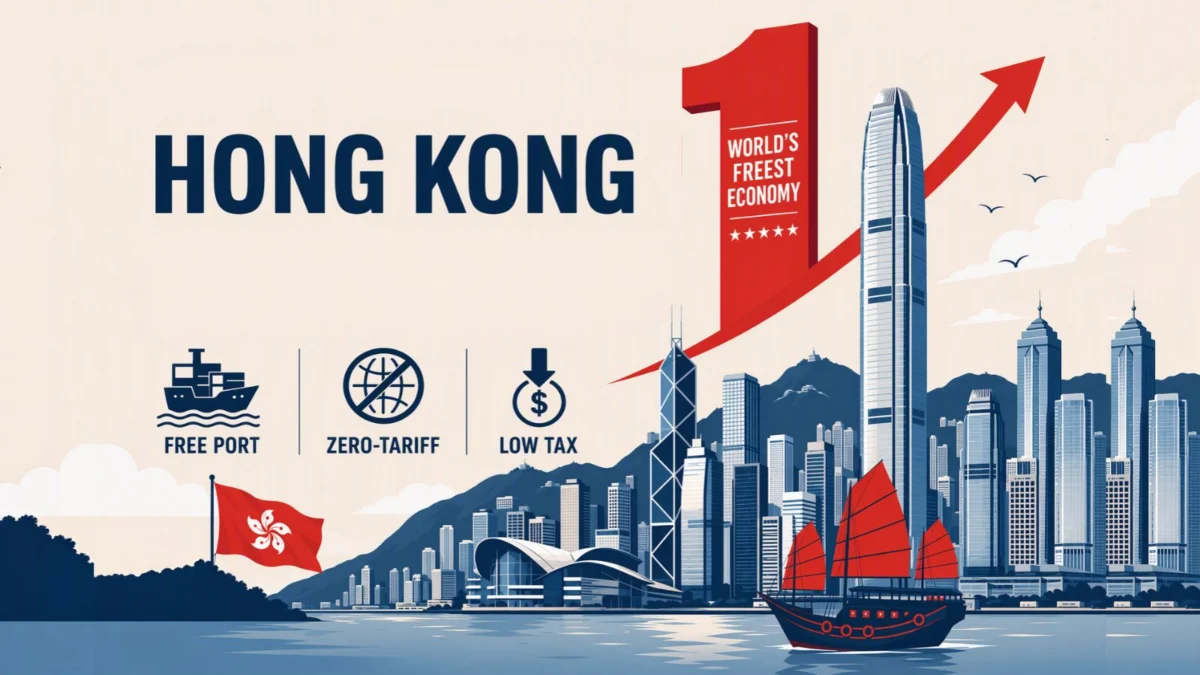
Main Facts: A Resilient Standard for Global Markets
The Economic Freedom of the World 2026 Annual Report, published by the prestigious Fraser Institute, has once again confirmed Hong Kong’s status as the world’s most economically free jurisdiction. This latest assessment underscores the city’s enduring capacity to maintain a robust, market-oriented environment despite shifting geopolitical winds and a volatile global economic landscape.
The report, which serves as a definitive benchmark for policymakers, investors, and business leaders worldwide, evaluates jurisdictions based on 46 specific data points grouped into five core areas: size of government, legal system and property rights, sound money, freedom to trade internationally, and regulation.
Hong Kong’s continued occupancy of the top position is largely attributed to its unwavering adherence to its foundational economic pillars: a zero-tariff policy, a simple and low tax regime, and an unwavering commitment to free-market principles. The city secured the top global ranking in the "Freedom to Trade Internationally" category and maintained a formidable second-place global standing in the "Regulation" category.
The global top five is rounded out by Switzerland in second place, Singapore in third, New Zealand in fourth, and the United States in fifth. Notably, the Asia-Pacific region continues to punch above its weight, with four of its jurisdictions—Hong Kong, Singapore, New Zealand, and Australia—securing spots within the top ten, signaling the region’s pivotal role in driving global economic growth.
Chronology: The Evolution of Economic Freedom
The Fraser Institute’s annual reports have tracked the trajectory of economic liberty for decades, providing a longitudinal look at how policies impact national prosperity.
Historical Context
Economic freedom, as defined by the Fraser Institute, is characterized by personal choice, voluntary exchange, open markets, and the protection of private property. Over the past decade, the top of the rankings has remained highly competitive, with a small cohort of nations consistently rotating through the top five.
The 2026 Shift
While the 2026 report sees a continuation of trends seen in previous years, it also highlights the increased importance of "predictability" in business environments. As global supply chains faced massive disruptions throughout the early 2020s, jurisdictions that maintained "business as usual"—characterized by stable legal frameworks and transparent regulatory environments—saw their scores stabilize or improve. Hong Kong’s retention of the top spot in 2026 is a testament to the institutional inertia of its economic policy, which has resisted the temptation to drift toward protectionism, even as other global economies have adopted more inward-looking strategies.
Supporting Data: Understanding the Methodology
The methodology behind the 2026 report is comprehensive, relying on 46 components to derive a score from zero to 10 for each jurisdiction. The five primary areas of assessment provide a granular view of what makes an economy "free."
The Five Pillars of Assessment:
- Size of Government: Measuring the extent of government spending, taxation, and the presence of state-owned enterprises.
- Legal System and Property Rights: Assessing the security of property rights, the independence of the judiciary, and the impartiality of the courts.
- Sound Money: Evaluating the rate of inflation and the ease of owning foreign currency bank accounts.
- Freedom to Trade Internationally: Looking at tariffs, regulatory trade barriers, and the ease of moving capital.
- Regulation: Analyzing credit market regulations, labor market restrictions, and business regulations.
The 2026 Global Rankings
The diversity of the top ten list demonstrates that economic freedom is not limited to a specific geographic region or political system:
- Hong Kong SAR, China
- Switzerland
- Singapore
- New Zealand
- United States
- Ireland
- Denmark
- Australia
- Mauritius
- Finland, Netherlands, United Kingdom (tied)
This data suggests that while cultural and political differences persist, the "winning formula" for economic success involves a combination of fiscal discipline, open trade, and a reliable, independent legal system.
Official Responses: The HKSAR Perspective
The Hong Kong Special Administrative Region (HKSAR) Government has formally acknowledged the report, viewing it as a validation of its long-term strategic vision. A spokesperson for the HKSAR Government emphasized that the city’s success is not accidental but the result of a deliberate, institutionalized commitment to openness.
"The HKSAR Government is pleased to see Hong Kong once again ranked as the world’s most economically free jurisdiction," the spokesperson stated. "This ranking is a clear reflection of our continued commitment to maintaining our status as a free port. By providing a secure, stable, fair, and predictable business environment, we remain a top destination for entrepreneurs and investors globally."
Strategic Advantages
The HKSAR government highlighted several key factors that differentiate Hong Kong in the global market:
- Common Law System: The practice of common law in both Chinese and English provides a familiar and robust legal framework for international businesses.
- Seamless Integration: The city’s financial, shipping, and professional services are engineered to align with international best standards, allowing for "frictionless" business operations.
- Institutional Efficiency: A clean, professional civil service and an efficient government structure act as the bedrock for the city’s market-led economy.
- The Bridge Effect: By offering unique access to both Mainland China and global markets, Hong Kong serves as a critical super-connector, a role that remains essential in the current geopolitical climate.
Implications: What This Means for Business and HR
For global business leaders and HR professionals, these rankings provide more than just bragging rights; they serve as a roadmap for risk assessment and investment strategy.
Implications for Talent Acquisition and Mobility
In an era of remote work and global competition for top-tier talent, the "Economic Freedom" index acts as a proxy for quality of life and career stability. Jurisdictions that rank high in economic freedom—such as Singapore, Switzerland, and Hong Kong—often attract the highest density of multinational corporations, which in turn creates a competitive, high-reward environment for professionals.
For HR departments, the data suggests that jurisdictions at the top of the list offer a more predictable regulatory environment regarding employment laws. This predictability reduces the risk of "compliance shocks," making it easier for firms to plan long-term workforce expansions.
Strategic Investment and Global Trade
The dominance of Asia-Pacific jurisdictions in the top 10 indicates a shift in the gravity of global trade. Investors are increasingly prioritizing jurisdictions that maintain "freedom to trade" as a hedge against the rising tide of protectionism. The 2026 report serves as a reminder that countries which resist the urge to impose restrictive trade barriers are rewarded with higher inflows of foreign direct investment (FDI).
Looking Ahead
The challenge for the top-ranked jurisdictions will be to maintain these high standards in the face of rapid technological disruption. As AI, fintech, and digital assets redefine what "regulation" and "trade" look like, the Fraser Institute’s future reports will likely place even greater weight on how governments manage the transition to a digital economy without stifling the very freedom that has made them successful.
For now, the 2026 Economic Freedom of the World report sends a clear message: economic success is still best achieved through the traditional virtues of openness, sound fiscal policy, and the rule of law. As the global economy navigates the complexities of the mid-2020s, Hong Kong’s steadfast position at the top offers a blueprint for how jurisdictions can successfully balance the demands of modern governance with the principles of a free and open market.
Disclaimer: The Economic Freedom of the World 2026 Annual Report is produced independently by the Fraser Institute. The lead image for this article was generated by AI. For further insights into manpower and HR trends in the Asia-Pacific region, follow us on Telegram and Instagram @humanresourcesonline.

 Nana Wu





