
 Lina Hope
In an era defined by information overload, the humble note-taking app has evolved into the most critical tool in our digital arsenal. It is no longer just about jotting down a grocery list or a fleeting thought; it is about building a "second brain"—a repository for your life’s work, creative sparks, and intellectual connections. However, the market is currently saturated with what many are calling "vibecoded" apps—shiny, minimal, and aesthetically pleasing tools that often lack the substance required for long-term knowledge management.
With a new app hitting the digital storefronts nearly every week, the paradox of choice is paralyzing. This guide is designed to cut through the noise. By evaluating the landscape as of mid-2026, we aim to help you identify the tool that matches your specific workflow, platform requirements, and budget.
The Methodology: Beyond the Surface-Level Review
To curate this list, I have moved past the "first-look" reviews that dominate tech media. As a power user who manages thousands of notes across multiple vaults, I have spent months living in each of the applications mentioned below.

My evaluation criteria were simple:
- Sustainability: Will this app still exist in five years? If not, how easily can I export my data?
- Workflow Integration: Does the app act as a friction-free capture tool or a cumbersome administrative burden?
- Knowledge Architecture: Does it facilitate the connection of ideas, or is it merely a digital "junk drawer"?
- Value Proposition: Does the pricing structure align with the utility provided, or does it lock essential features behind an unreasonable paywall?
While I personally lean toward text-heavy, interconnected workflows—which explains my long-standing loyalty to Obsidian—I recognize that your needs may involve heavy media, team collaboration, or simple, frictionless capture.
1. Obsidian: The Power User’s Sanctuary
Obsidian remains the gold standard for those who prioritize longevity and interconnectedness. By storing your notes in local, plain-text Markdown files, Obsidian ensures you are never "locked in" to a proprietary format.

Why It Stands Out
- Local-First Architecture: Because your notes reside on your device, you own them completely. Even if the developers were to shutter the project, your data remains accessible.
- The Power of Linking: Obsidian shines in its ability to create a "web of knowledge." Using internal links (
[[Note Name]]) and backlinks, you can visualize how disparate thoughts connect. - Extensibility: The community plugin ecosystem is unparalleled. Whether you need a sophisticated web clipper, a Kanban board, or advanced calendar integration, there is a plugin for it.
The Trade-off: The learning curve is undeniably steep. Obsidian requires a "builder’s mindset." You must be willing to spend time configuring your workspace before it truly feels like home.
2. Craft: Aesthetic Excellence and Collaborative Power
If Obsidian is the robust, utilitarian engine of note-taking, Craft is the refined, high-performance vehicle. It is widely considered one of the most visually stunning applications on the market.
Core Features
- Document Versatility: Craft treats notes as blocks, allowing you to fluidly mix text, tables, images, and even entire documents.
- Collaboration: Unlike many "personal" apps, Craft treats sharing as a first-class citizen. Publishing a document for a client is as simple as generating a link.
- Hierarchical Organization: With a sophisticated system of folders, subfolders, and "spaces," it is ideal for users who need to manage large, complex projects alongside daily scribbles.
Best For: Creative professionals and small teams who need their documents to look as good as they read.

3. Bear: Minimalism Reimagined
Sometimes, the best tool is the one that stays out of your way. Bear has long been the favorite of writers and thinkers who value a distraction-free environment.
The Philosophy of Bear
Bear embraces the "Quick Capture" mentality. It utilizes a tag-based organizational system rather than traditional folders, meaning a single note can exist in multiple categories simultaneously. It supports Markdown natively and offers a fluid, responsive interface that feels lightning-fast on iOS and Mac.
The Limitation: Bear is an Apple-exclusive ecosystem. While a web app exists, it is not a robust replacement for the native experience. If you are an Android or Windows user, Bear is simply not an option.

4. Evernote: The Reborn "Second Brain"
Evernote has faced intense competition, but it remains a powerhouse for those who need a centralized hub for everything from PDFs and voice memos to calendar events.
Modern Evolutions
Evernote 11 represents a significant shift toward the AI-driven future. Features like AI Transcribe and AI-generated diagrams have transformed it from a simple note-taker into an intelligent assistant.
- Implications for Teams: Real-time collaboration, comment threading, and task assignment have moved Evernote from a personal filing cabinet to a team-based project management tool.
- The "Second Brain" Factor: Its ability to ingest nearly any file format makes it the best choice for users who act as information aggregators.
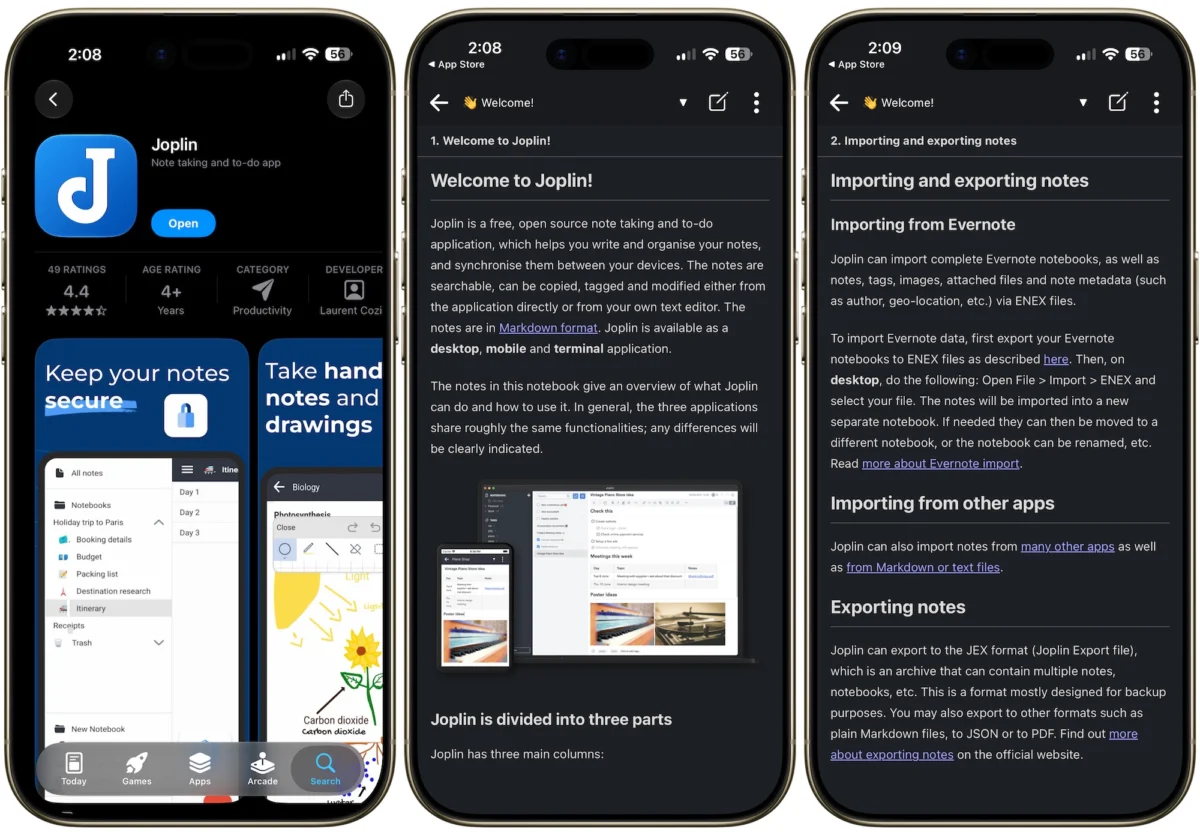
5. Joplin: The Privacy-Centric Alternative
For the user who demands security and open-source transparency, Joplin is the clear winner.

Why Privacy Matters
Joplin provides end-to-end encryption (E2EE), ensuring that even the service provider cannot access your data. It mirrors many of Evernote’s features—including web clipping, rich media support, and plugin extensibility—but maintains an open-source, vendor-neutral footprint. You can sync your data via your own choice of storage, including Dropbox, OneDrive, or the proprietary Joplin Cloud.
The Trade-off: It lacks the polished UI of Craft or the modern aesthetic of Notion. However, for the security-conscious, this is a small price to pay for total data sovereignty.
6. Notion: The Command Center
Notion is less of a note-taking app and more of a modular operating system for your work. Its strength lies in its database-driven architecture.

Strategic Use Cases
- Collaboration: Notion is built for teams. The ability to mention users, assign tasks, and build complex, relational databases means that notes often become the project itself.
- Flexibility: With over 50 content types, you can build anything from a simple checklist to a full-blown customer relationship management (CRM) system.
The Learning Curve: Notion is a "blank canvas." If you don’t have a plan for your workflow, it can quickly become overwhelming. However, its template gallery offers a shortcut for those who need a structured starting point.
7. Apple Notes: The Underrated Giant
It is a common mistake to dismiss Apple Notes as a "default" app. In the last three years, Apple has systematically added features that make it a genuine contender for most users.
Key Capabilities
- Deep Integration: It works seamlessly with iOS, iPadOS, and macOS.
- Advanced Media Support: You can drag and drop PDFs, scan documents, and record audio directly into notes, with all media being searchable.
- Organizational Maturity: With smart folders, tagging, and cross-linking, you can build a highly sophisticated system without ever leaving the Apple ecosystem.
Chronology of Development: How We Got Here
The evolution of these tools follows a clear trajectory:

- 2018–2020: The rise of the "Personal Knowledge Management" (PKM) movement. Apps like Obsidian and Notion popularized the idea of bi-directional linking.
- 2021–2023: A focus on design and UX. Craft and Bear set new standards for how beautiful a note-taking app could be.
- 2024–2026: The AI Revolution. Evernote and Notion began integrating LLMs (Large Language Models) to assist in summarizing, rewriting, and generating content, effectively turning notes into active, generative partners.
Final Verdict: Which One Should You Choose?
The "best" app is the one you actually use. To make your final decision, consider your primary objective:
- For the Researcher: Obsidian. The ability to link ideas and own your data is unmatched.
- For the Team Player: Notion or Craft. These are built for social, collaborative workspaces.
- For the Privacy Advocate: Joplin. Open-source, encrypted, and in your control.
- For the Apple Power User: Apple Notes. If you live in the Apple ecosystem, the recent updates make it hard to justify the cost of third-party alternatives.
- For the All-in-One User: Evernote. If you want one app to handle your calendar, files, and thoughts with the help of AI, this is your home.
A Note on Long-Term Commitment
My final piece of advice is to stop chasing the new. The real power of a "second brain" is cumulative. When your notes live in one place for years, you begin to see connections that would otherwise remain hidden. Pick one of these tools, commit to it for at least six months, and only migrate if you hit a functional "ceiling" that prevents you from doing your best work. In the digital age, consistency is the greatest feature of all.


 Azzam Bilal Chamdy

 Laily UPN




