 Laily UPN
In an era where "experiential tourism" has become the gold standard for global travelers, the upcoming total solar eclipse in August 2026 has provided a definitive case study in how rare natural phenomena can shift the economic and logistical landscape of the travel industry. As the moon prepares to obscure the sun across a path spanning Iceland and mainland Spain, data from Amadeus Travel Intelligence indicates that the travel sector is experiencing a massive, event-driven surge that is rewriting seasonal booking norms.
With a 25% year-on-year increase in flight bookings to eclipse-path destinations and a dramatic rise in hotel occupancy and room rates, the event is being heralded as a landmark moment for astronomy-focused tourism. For Spain, in particular, this is a historic milestone: the first total solar eclipse visible from its mainland in over 120 years.
The Core Data: A Surge in Celestial Interest
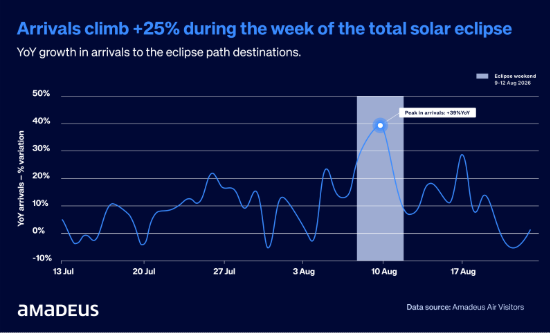
The gravitational pull of the eclipse is evident in the numbers. According to Amadeus Air Visitors data, arrivals to airports located along the eclipse’s path of totality—including hubs in Spain and Iceland—have surged by 25% compared to the same window in 2025. This influx of travelers is not merely a seasonal uptick but a calculated migration of people seeking a front-row seat to one of nature’s most awe-inspiring displays.
The financial implications for the hospitality sector are equally pronounced. Amadeus Demand360® data for the week of August 9–16, 2026, reveals a significant tightening of room supply. Occupancy rates across the affected regions in Spain and Iceland have climbed by 16% compared to the previous year. More notably, hoteliers are capitalizing on this high-intensity demand; the Average Daily Rate (ADR) has seen a staggering 36% increase, reflecting the premium that travelers are willing to pay for proximity to the eclipse path.
Chronology of a Phenomenon: From Lunar Precursors to the Total Eclipse
The fervor surrounding the 2026 eclipse did not emerge in a vacuum. Industry analysts have observed a clear correlation between booking spikes and major astronomical events over the past 24 months.
The Lunar "Warm-up"
The appetite for "astrotourism" was primed in September 2025, when a total lunar eclipse—frequently referred to as a "Blood Moon"—captured global attention. Travel providers noted a distinct spike in booking activity during this time, suggesting that astronomical events act as a "gateway" for travelers to plan future long-haul, experience-based trips.
This trend continued into March 2026, when another total lunar eclipse occurred, visible across North America, the Pacific, Australia, and parts of East Asia. The sustained interest in these events created a momentum that directly fueled the surge in reservations for the upcoming August 2026 solar spectacle.

The August 2026 Window
The current focus of the industry is firmly fixed on the period between August 7 and August 12, 2026. This window represents the primary arrival phase for visitors. The eclipse itself will traverse a path including major Spanish cities like Bilbao, Barcelona, Santander, San Sebastián, Asturias, La Coruña, Madrid, Palma de Mallorca, Valencia, and Ibiza, as well as the Icelandic capital, Reykjavík.
Destination Focus: Bilbao and the "Trio of Eclipses"
While interest is high across all path-adjacent destinations, certain cities have emerged as clear winners in the race for tourist attention. Bilbao leads the charge with an astonishing 366% increase in bookings compared to 2025. Following close behind are Asturias (+292%) and Valencia (+137%).
These figures suggest that travelers are not just choosing locations based on climate or existing popularity, but are specifically vetting destinations for the best astronomical viewing conditions. The international reach of this demand is significant, with the United States, Japan, Argentina, and Canada serving as the top long-haul origin markets for travelers heading to the eclipse path.
For Spain, this event is part of a larger strategy. Miguel Sanz, General Director at Turespaña, describes the current period as the beginning of a "Trio of Eclipses" (2026, 2027, and 2028). "This positions our country as the world’s leading astronomical destination in the coming years," says Sanz. He notes that the phenomenon is a catalyst for promoting "inland destinations and rural areas," helping to redistribute tourist flows away from the historically overcrowded coastal resorts and toward unique, nature-integrated settings.
Shifting Traveler Profiles: Short Stays and Solo Journeys
The data also reveals a fascinating shift in how people are choosing to travel. The "eclipse effect" is actively shrinking the traditional vacation timeline. Stays lasting between one and five days have increased by 57%, indicating that a large segment of the market is flying in specifically for the event rather than incorporating it into a broader two-week holiday.
Furthermore, the social composition of these travelers is changing:
- The Couple’s Experience: 40% of travelers are arriving in pairs, an 18% increase over 2025, suggesting that the event is a high-priority "bucket list" item for couples and travel companions.
- The Rise of the Solo Traveler: Perhaps most striking is the 48% increase in solo travelers compared to the previous year. This confirms a broader industry trend where independent travelers are prioritizing high-impact, experience-led journeys over traditional package vacations.
Strategic Implications: How the Industry is Responding
For the hospitality and travel industry, the 2026 eclipse is more than a spectacle; it is a complex logistical puzzle. Sol Freixa, Vice President of Commercial Destinations at Amadeus, emphasizes the need for data-driven agility.
"Travelers increasingly seek experiences that feel unique and memorable, and major natural phenomena can create powerful motivations to travel," says Freixa. "Short, high-intensity demand spikes present a clear opportunity for destinations and hotels. Data-driven insights support providers to anticipate booking patterns and adjust pricing strategies dynamically so they are best positioned to maximize revenue."
The Revenue Management Challenge
The 36% jump in ADR highlights the challenge of dynamic pricing during non-traditional peak periods. Hotels must balance the need to maximize revenue with the risk of pricing themselves out of the market. Furthermore, the short, concentrated nature of the stay (the 1–5 day trend) requires hotels to rethink their minimum-stay requirements and operational staffing levels, which are often calibrated for longer, more predictable summer stays.
The Sustainability of Astrotourism
Beyond the immediate revenue, there is the long-term potential for destination branding. As noted by Turespaña, the eclipse is being used to highlight "tourism products linked to astronomy." By positioning rural regions as ideal settings for science and nature tourism, local authorities hope to establish a legacy that outlasts the final shadow of the eclipse. This could lead to a permanent increase in interest for these regions, providing a more balanced distribution of tourism across Spain’s diverse geography.
Conclusion: A New Frontier in Travel Intelligence
The 2026 solar eclipse serves as a definitive indicator that modern travel is increasingly driven by "event-based motivation." As travelers grow more comfortable with solo travel and become increasingly willing to undertake long-haul flights for brief, high-impact experiences, the travel industry must adapt accordingly.
By leveraging tools like Amadeus Travel Intelligence, providers are moving from a reactive model to a proactive one. They are no longer simply waiting for summer holiday bookings to arrive; they are actively tracking celestial paths and aligning their strategies to capture the high-value, highly motivated demographic of the modern astronomical tourist.
As August 2026 approaches, the eyes of the world—and the focus of the travel industry—will remain firmly fixed on the sky. The success of this period will likely serve as a blueprint for how global tourism boards and hospitality giants manage similar high-profile, time-sensitive events in the future, proving that in the digital age, data is the most reliable guide for navigating the stars.


 Rifan Muazin
 Evan Lee Salim