Jia Lissa
The rapid proliferation of generative AI has fundamentally altered the software development lifecycle. In the past, product management was defined by deterministic roadmaps—clear inputs leading to predictable, repeatable outputs. Today, that paradigm has shifted. As companies move beyond the "proof of concept" phase, they are discovering that the primary obstacle to AI adoption is no longer a research bottleneck, but a product design failure.
The gap between a brilliant AI prototype and a reliable, user-ready product is where the modern AI Product Manager (PM) resides. Unlike their predecessors, these professionals must navigate the chaotic terrain of probabilistic systems, where outputs can hallucinate, drift, and vary wildly across different user segments. This role is no longer just about feature prioritization; it is about managing the intersection of machine learning trade-offs, compute economics, regulatory compliance, and cross-functional leadership.
The New Frontier: Why AI Product Management is Different
In traditional software, if a feature fails, it is usually due to a logic error or a bug. In AI, the system might be "working as intended" while still providing an incorrect or harmful answer. This transition from deterministic to probabilistic thinking is the foundational requirement of the role.
AI PMs operate at the nexus of three competing forces: Latency, Cost, and Accuracy. Every decision—from choosing a Large Language Model (LLM) to determining the depth of a Retrieval-Augmented Generation (RAG) pipeline—is a trade-off. An AI PM must be fluent enough in these technical constraints to challenge engineering assumptions while effectively translating those technical risks to stakeholders in legal, finance, and the C-suite.
A Four-Phase Roadmap for the Modern AI PM
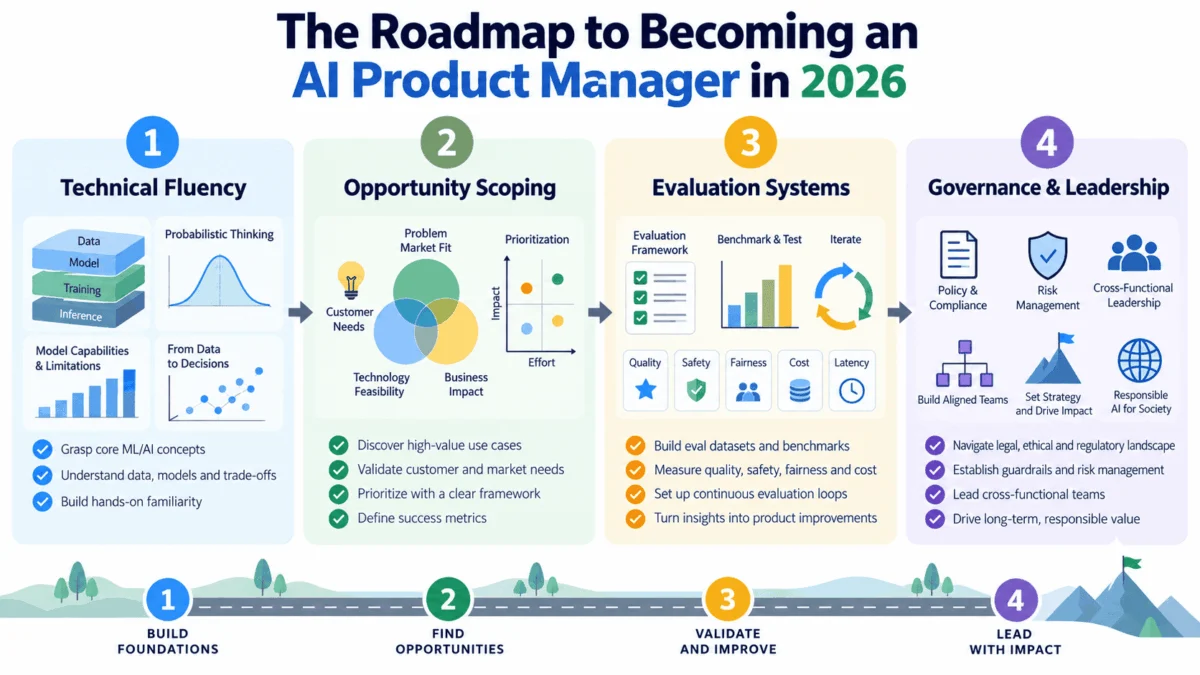
Mastering this role requires a structured approach. The following four phases move from technical literacy to organizational stewardship, allowing skills to compound as the PM matures.
Phase 1: Technical Fluency and the Probabilistic Mindset
The aspiring AI PM must first internalize that AI systems are not broken when they provide an "approximate" answer—they are functioning as designed.
- Architectural Intuition: You do not need to build models from scratch, but you must understand the "why" behind architectures like RAG, fine-tuning, and agentic workflows.
- The Trinity of Constraints: You will spend your career balancing latency (time to first token), cost (token consumption), and accuracy (eval performance). Understanding how context-window sizing impacts these three variables is critical.
- Actionable Steps: Focus on building a "comparison matrix" for architectural choices. For example, when scoping customer support automation, evaluate whether a pre-trained model with RAG is more cost-effective than a fine-tuned smaller model.
Phase 2: Opportunity Discovery and Feasibility Scoping
Many AI products fail because they solve problems that don’t need AI. The AI Product Canvas is an essential framework here, forcing PMs to map tasks by two axes: Value (if the system succeeds) and Risk (if it hallucinates or fails).
- Build vs. Buy vs. Assemble: This is a financial and operational calculus. You must model the unit economics of compute. As your product scales, how do your gross margins hold up against API token costs or GPU hosting fees?
- The Economic Model: A successful AI PM treats compute as a variable cost. If you cannot explain to a CFO how your token usage scales with your user base, your product will eventually collapse under its own weight.
Phase 3: UX, Evaluation Systems, and Iteration
This is the most significant departure from traditional product management. In a world of probabilistic outputs, binary "pass/fail" testing is obsolete.
- Eval-Driven Development: You need to build a system that evaluates the system. This involves automated metrics, such as RAGAS for retrieval performance, and rigorous human-in-the-loop (HITL) testing.
- Designing for Trust: How do you design an interface that signals uncertainty? If a model is unsure, should it hallucinate, or should it offer a "I don’t know" response? Designing graceful degradation is a core UX challenge.
- Red-Teaming: Security is not a post-launch phase. Adversarial testing—prompt injection, boundary probing, and worst-case scenario simulation—must be integrated into the CI/CD pipeline from day one.
Phase 4: Governance, Compliance, and Leadership
As you scale, the PM becomes the ultimate "translator." You must align research engineers (who care about benchmark performance), legal teams (who care about liability), and executives (who care about ROI).
- Regulatory Literacy: With the advent of the EU AI Act and evolving U.S. executive orders, PMs must understand data residency, privacy, and sector-specific requirements (like HIPAA or SOC 2).
- Data Lineage: You are responsible for knowing where your training data comes from and where your user data goes. In the age of enterprise AI, the "black box" approach to data is a liability that will shut down projects.
Supporting Data: The Cost of Scalability
Industry data suggests that the "demo-to-production" gap is primarily financial. While early prototypes rely on massive, expensive models like GPT-4 or Claude 3.5 Sonnet, sustainable products are increasingly moving toward a "cascading" architecture.
| Task Complexity | Model Choice | Cost Profile | Latency |
|---|---|---|---|
| High (Reasoning) | Frontier Model (e.g., GPT-4) | High | Slower |
| Medium (RAG) | Mid-tier Model | Medium | Moderate |
| Low (Classification) | Small Language Model (SLM) | Negligible | Near-instant |
Effective AI PMs use this data to build "cost-efficient intelligence," routing simple queries to low-cost models while reserving expensive compute for high-value reasoning tasks.
Official Perspectives: The Role of the AI PM
Experts and educators, such as Vinod Chugani, emphasize that the AI PM role is still being defined. "The habit that distinguishes strong AI PMs is intellectual honesty about uncertainty," Chugani notes. "They don’t oversell model capabilities; they build solid fallback systems and treat evaluation as infrastructure rather than an afterthought."
Legal departments are also increasingly involved in the product lifecycle. In a recent white paper on the EU AI Act, regulators highlighted that "accountability by design" is the new mandate. For the AI PM, this means that every model deployment must come with a paper trail of risk assessment, bias testing, and human oversight mechanisms.
Implications for the Future of Work
The emergence of the AI Product Manager signals a shift in what it means to be a "technical" professional. The role is less about writing code and more about managing the behavior of systems that are increasingly autonomous.
- Shift in Skill Sets: Traditional PMs who rely solely on user stories will find themselves struggling. The future requires a blend of data literacy, financial modeling, and a deep understanding of AI safety.
- Increased Cross-Functional Collaboration: The PM is no longer just the bridge between design and engineering; they are now the bridge between technical R&D and legal/compliance.
- The End of the "Set and Forget" Product: Because AI models evolve (via updates or data drift), the AI PM role is inherently cyclical. You never truly "ship" an AI product; you monitor it, evaluate it, and iterate on it perpetually.
Conclusion
The path to becoming an AI Product Manager in 2026 is paved with the need for continuous learning. The technical landscape—the models, the frameworks, and the regulations—will shift rapidly. However, the foundational discipline remains constant: scope with rigor, measure what matters, and cultivate a culture of trust.
For those willing to embrace the discomfort of managing non-deterministic systems, the opportunity is immense. As AI becomes the engine of the global economy, the individuals who can successfully translate that engine into a reliable, human-centric product will be the most valuable assets in the modern enterprise.

 Asro
 Siti Muinah