Nana Muazin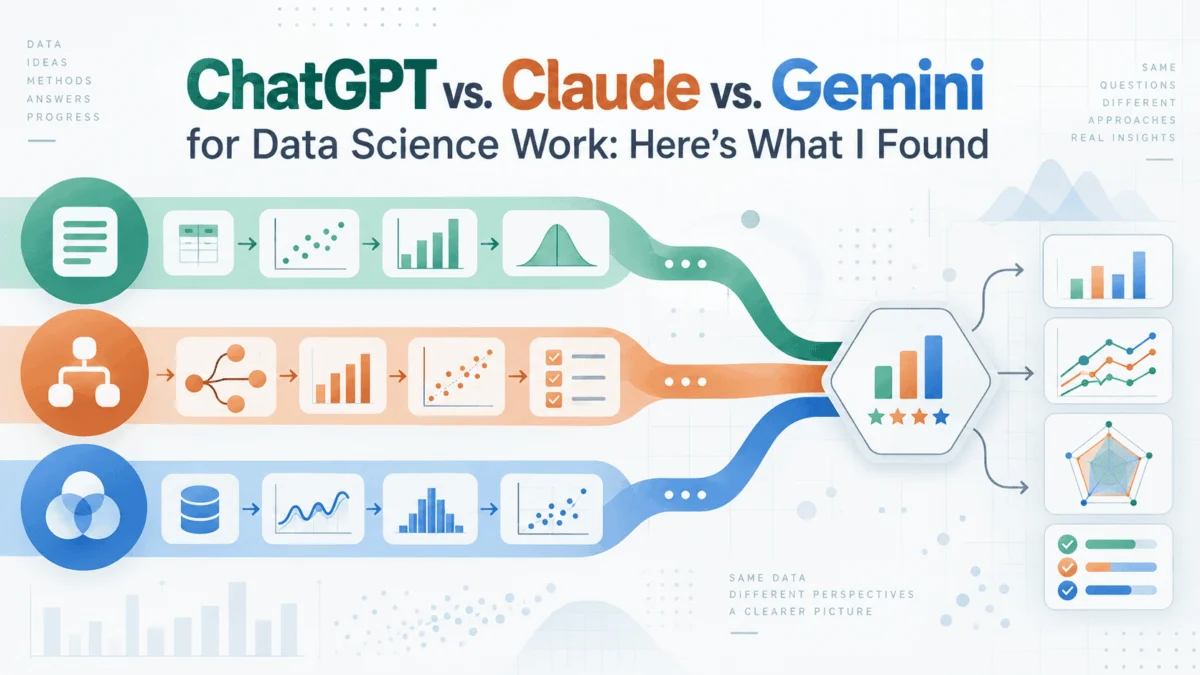
In the rapidly evolving landscape of data science, the integration of Large Language Models (LLMs) has transitioned from a novel experiment to a foundational component of the professional toolkit. Data scientists are no longer just writing code; they are orchestrating AI assistants to perform exploratory data analysis (EDA), debug complex pipelines, and interpret intricate statistical outputs.
As the industry matures, the "Big Three" of the generative AI world—OpenAI’s ChatGPT, Anthropic’s Claude, and Google’s Gemini—have emerged as the primary contenders for professional data tasks. Each brings a unique architecture and philosophy to the table, creating a nuanced ecosystem where the "best" tool is often contingent on the specific phase of the data lifecycle.
Main Facts: The Evolving Landscape of AI-Assisted Analytics
The current paradigm of AI-assisted data science is defined by three distinct service models. While all three models are capable of generating Python, R, and SQL, their operational strengths differ significantly.
- ChatGPT (OpenAI): Positioned as the pragmatic generalist, its strength lies in its "Advanced Data Analysis" environment. It allows users to upload raw files, execute Python code in a sandboxed container, and generate visualizations iteratively.
- Claude (Anthropic): Known for its focus on reasoning and instruction-following, Claude has become the preferred choice for tasks requiring high-fidelity code structure and logical rigor. Its recently added code execution capabilities allow it to handle data analysis with a high degree of precision.
- Gemini (Google): Built as a native component of the Google ecosystem, Gemini excels in high-context tasks and seamless integration with BigQuery, Google Sheets, and Drive. It is the tool of choice for researchers who require cross-platform synthesis and broad information retrieval.
Chronology: The Shift Toward Agentic Data Science
The trajectory of these tools reflects the rapid pace of AI development.
- The Early Phase (2022-2023): Initial interest was focused on basic code completion. AI assistants functioned primarily as "smart autocomplete" for syntax.
- The Integration Phase (2023-2024): Platforms introduced file uploads and built-in code interpreters. This allowed data scientists to move from text-based code generation to end-to-end analytical workflows.
- The Reasoning & Ecosystem Phase (2025-Present): Current developments emphasize long-context windows and agentic capabilities. We are currently seeing models that can manage entire repositories of code, analyze massive datasets in a single prompt, and interact directly with cloud infrastructure.
A 2025 peer-reviewed study underscores this evolution, testing six AI assistants across 20 statistical selection scenarios. The study confirmed that while all models achieved 100% accuracy in identifying the correct statistical tests, the clarity and pedagogical value of the explanations varied, with Claude often leading in structural logic and Gemini in instructional depth.
Supporting Data: Comparative Performance Metrics
When evaluating these tools for professional application, data scientists often look at three key performance indicators (KPIs): Code Quality, Statistical Reasoning, and Contextual Handling.
1. Statistical Reasoning
While all models can define a Welch’s t-test or explain the assumptions of linear regression, the depth of their reasoning differs:
- Claude: Provides the most disciplined, step-by-step logical framework, which is vital for academic or rigorous research environments.
- ChatGPT: Excels at "business translation," bridging the gap between abstract statistical theory and the practical constraints of a specific project.
- Gemini: Excels at cross-referencing concepts, helping users understand the interconnectedness of statistical methodologies.
2. Code Generation and Execution
In testing, ChatGPT’s data analysis environment remains the most "mature" for quick EDA. It allows for a fluid conversation where a user can say, "Remove the outliers in column X and re-run the chart," and the model executes this immediately.
Conversely, for complex architectural tasks—such as building a modular data preprocessing pipeline or writing a production-grade Python class—Claude consistently produces cleaner, more maintainable, and better-documented code. Gemini, meanwhile, is the clear winner when the workflow is tied to Google’s Cloud Platform, often providing library-specific syntax that is better aligned with BigQuery’s unique requirements.
3. Contextual Capacity
Context window size—the amount of data a model can "see" at once—is a differentiator for large-scale analysis. Gemini offers the industry’s largest context windows, enabling users to feed it entire technical reports or documentation manuals. Claude maintains high performance across long, complex documents, making it ideal for deep-diving into legacy codebases. ChatGPT’s memory remains its strongest asset, as it maintains persistent preferences (e.g., coding styles, library preferences) across long-term sessions.
Official Responses and Industry Caveats
Despite the power of these tools, industry leaders and technical educators, such as Vinod Chugani, caution against "AI dependency." The consensus among practitioners is that these tools serve as co-pilots, not replacements.
The Hallucination Factor: All three models are prone to "statistical hallucinations." They may suggest a procedure that is mathematically sound in a vacuum but inappropriate for a specific dataset due to violations of assumptions like independence or heteroscedasticity.
The Security Imperative: Data privacy remains the most significant barrier to adoption in enterprise settings. Organizations must differentiate between consumer-facing interfaces and enterprise-grade API tiers. Uploading proprietary data to a standard chat interface can inadvertently expose trade secrets or sensitive information to model training sets.
The "Black Box" Problem: Official documentation from the model providers emphasizes that these tools are probabilistic, not deterministic. When an AI generates a model, it does not "know" the business logic; it is predicting the next token in a sequence based on probability. Consequently, the burden of verification—checking for correct library syntax, verifying statistical significance, and validating assumptions—remains firmly with the human data scientist.
Implications: The Future of the Data Science Workflow
The rise of these AI assistants suggests a fundamental shift in the role of the data scientist. As the "grunt work" of writing boilerplate code and generating basic visualizations is automated, the value of the human practitioner shifts toward synthesis, validation, and strategy.
Strategic Task Allocation
For the modern data scientist, the "best" assistant is often a mix of all three, chosen based on the task:
- For EDA on a single, messy CSV: Use ChatGPT. Its sandboxed environment is designed specifically for this task, allowing for rapid iteration.
- For Complex Statistical Justification: Use Claude. Its ability to follow strict instructions and provide a logical, step-by-step breakdown makes it the most reliable for high-stakes statistical decision-making.
- For Research and Integration: Use Gemini. When the project requires searching through current web data or interacting with files in Google Drive, Gemini’s native ecosystem integration is unparalleled.
- For Production-Grade Code: Use Claude. The quality of its logic and its propensity for writing clean, modular code make it the best for building scalable pipelines.
The Human-in-the-Loop Requirement
The professional implication of this technology is clear: the data scientist of the future is an editor and auditor. As AI tools become more capable, the ability to discern why a model chose a particular path—and to catch the subtle errors that occur when the model drifts from best practices—will be the defining skill of the next generation of data professionals.
Ultimately, these tools are not merely software; they are partners in an analytical dialogue. By treating them as such, and by maintaining a rigorous standard for validation, data scientists can leverage these AI assistants to move faster, think more broadly, and tackle problems that were previously too time-consuming to explore. As the field continues to evolve, the most successful practitioners will be those who master the art of the "AI-human hybrid workflow," blending the sheer computational power of LLMs with the nuanced, context-aware judgment that only a human expert can provide.

 Sagoh
Sagoh
 Evan Lee Salim