
 Muslim
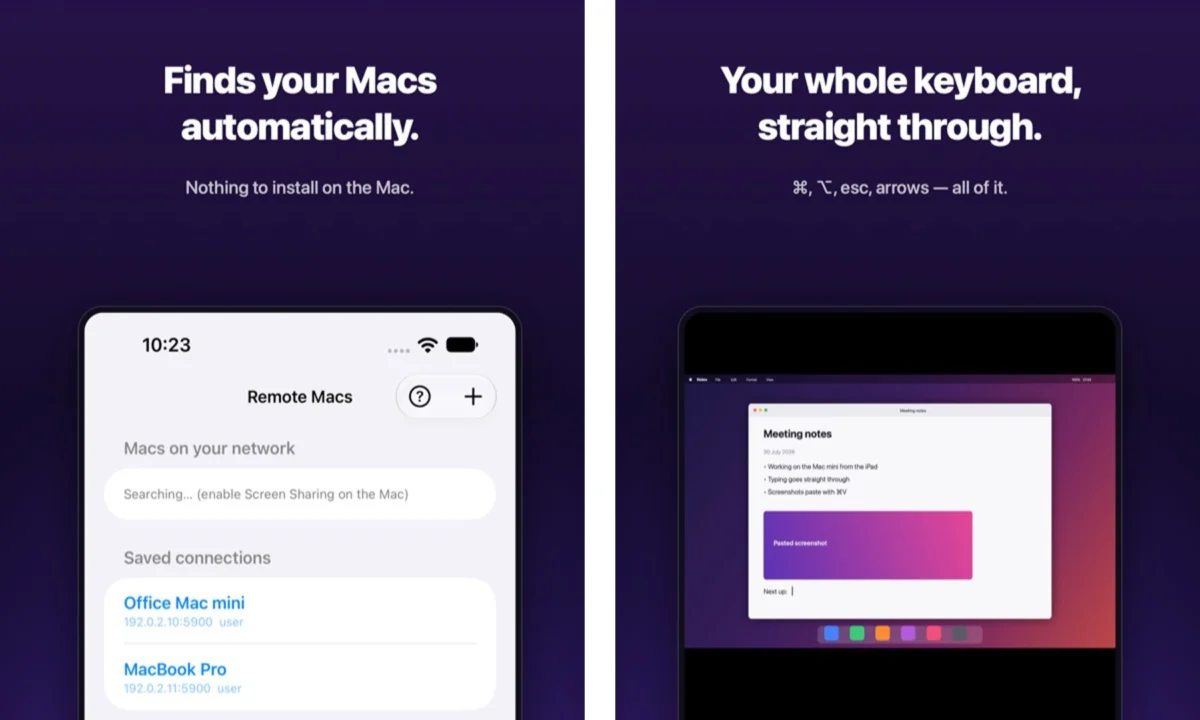
The launch of the iPhone Duo has sent shockwaves through the mobile hardware market, redefining the boundaries between smartphone utility and laptop productivity. While enthusiasts are still stress-testing the device’s hinge, a clever piece of software has emerged that threatens to render the need for a portable workstation obsolete. Meet Headroom, a remote desktop application by MusicFlow that effectively turns Apple’s latest foldable flagship into a miniature, fully functional Mac.
By leveraging the native Screen Sharing capabilities already baked into macOS, Headroom allows users to bridge the gap between their desktop and their pocket without the friction of installing third-party server software or managing complex cloud configurations.
Main Facts: A Seamless Bridge Between OS Environments
At its core, Headroom is designed for high-performance, low-latency remote interaction. Unlike traditional remote desktop clients that require the installation of heavy background agents on the host machine, Headroom communicates directly with macOS’s built-in Screen Sharing protocol.

The application’s primary draw is its unique UI adaptation, which recognizes the physical state of the iPhone Duo. When the device is held in a "clamshell" or "laptop" orientation, Headroom intelligently splits the screen: the top half displays the live macOS interface, while the bottom half converts into a functional touch-based keyboard and trackpad. When unfolded into a full tablet-like state, the Mac desktop expands to fill the entire canvas. This context-aware design ensures that users can manage professional workflows—ranging from checking on AI agent progress to executing complex terminal commands—without the interface feeling cramped or disjointed.
Chronology: The Rapid Evolution of Remote Access
The journey to this integration was not planned as a mainstream consumer release. The concept began as a "dogfooding" project by the developers at MusicFlow.
- Q1 2026: Initial prototyping begins. The lead developer, needing a way to monitor autonomous AI agents running on a Mac Mini while away from their desk, builds a rudimentary internal tool to access their workstation from an iPad.
- August 2026: With rumors of the iPhone Duo’s imminent release, the development team shifts focus to optimizing the interface for a foldable aspect ratio. The primary challenge was the "hinge zone"—the strip of pixels where the fold occurs.
- October 15, 2026: The iPhone Duo launches globally. Within 24 hours, the Headroom team pushes the final build to the App Store, having stress-tested the UI against the device’s unique folding states.
- October 20, 2026: Early adopters begin sharing clips of the app in action on social media, sparking a viral discourse on whether the "miniaturization" of the Mac is finally here.
Supporting Data: Performance and Technical Architecture
The technical heavy lifting in Headroom is achieved through a combination of Apple’s Metal graphics framework and ZRLE (Zero-Run-Length Encoding) compression. This combination allows for a remarkably smooth frame rate, even over standard Wi-Fi connections.

Technical Specifications
- Protocol: Native macOS Screen Sharing (VNC-based with Apple enhancements).
- Rendering: Metal API-accelerated frame decoding.
- Connectivity: Local network zero-config; VPN-tunneled for remote access.
- Device Compatibility: Optimized for iPhone Duo (folding states); backward compatible with iPad and standard iPhone models.
- Localization: Fully supported in 17 languages.
The app’s performance is further bolstered by its ability to handle mouse-like gestures—scrolling, zooming, and right-clicking—via intuitive touch inputs. For users who require precision, the app supports external Bluetooth keyboards and trackpads, effectively turning the iPhone Duo into a "thin client" for a powerful Mac workstation located elsewhere.
Official Responses and Developer Insights
In a statement provided to the press, the team at MusicFlow emphasized that Headroom was never intended to replace the MacBook, but rather to extend its reach.
"The goal was to eliminate the ‘gap’ in productivity," says the lead developer. "We noticed that people were often leaving their Macs running at home to handle long-running processes—rendering, AI training, or data compilation—but they had no elegant way to check on them without lugging a laptop along. The iPhone Duo provides the perfect form factor to treat your Mac as a persistent, always-available cloud entity."

While Apple has not officially commented on the third-party utilization of their Screen Sharing protocol, the community reception has been largely positive. Tech analysts point out that by using Apple’s own tools, Headroom avoids the security vulnerabilities often associated with rogue remote-access software.
Implications for the Future of Personal Computing
The success of Headroom on the iPhone Duo carries profound implications for the future of mobile computing. It suggests a paradigm shift where the "computer" is no longer the device in your hand, but the device that has the power to do the work.
The Rise of the "Headless" Lifestyle
As more users adopt powerful, always-on desktop Mac studios or Mac Minis, the demand for high-fidelity remote control will increase. Headroom provides a blueprint for how mobile devices can serve as high-utility windows into more powerful, stationary hardware. This could lead to a decline in the need for high-end "Pro" laptops for users who simply need the power, not the portability.

The "Foldable" Advantage
The iPhone Duo’s success in hosting this app proves that foldable hardware is more than a novelty. By providing a physical space for a dedicated control surface (the keyboard/trackpad) while simultaneously showing the content, the device solves the primary issue of remote computing on a phone: the "fat finger" problem. When the UI is separated from the input, the iPhone Duo becomes a legitimate, albeit small, laptop replacement.
Security and Connectivity
Of course, the convenience of constant access comes with risks. Security experts caution that leaving a Mac open to screen sharing—even behind a VPN—requires a robust, password-protected environment. The developers of Headroom have actively recommended the use of professional-grade VPNs like Tailscale to ensure that the remote stream is encrypted from end-to-end.
Conclusion: A Window to the Desktop
Headroom is currently available as a free trial on the Apple App Store, with a one-time Pro purchase available to unlock unlimited session lengths. It represents a significant milestone in 2026 computing: the year the phone finally stopped being a consumption-only device and started being a legitimate portal to professional-grade workflows.

Whether you are a developer monitoring an AI agent, a video editor checking a render status, or a power user who simply wants to access their full file system on the go, Headroom offers a sophisticated, elegant, and—most importantly—native way to bridge the divide. As the iPhone Duo continues to find its place in the pockets of consumers, tools like Headroom will undoubtedly define how we interact with our digital lives. The Mac may stay on the desk, but thanks to the foldable revolution, the control is now firmly in your hand.


 Pevita Pearce
 Dwi Wanna





