
 Iffa Jayyana
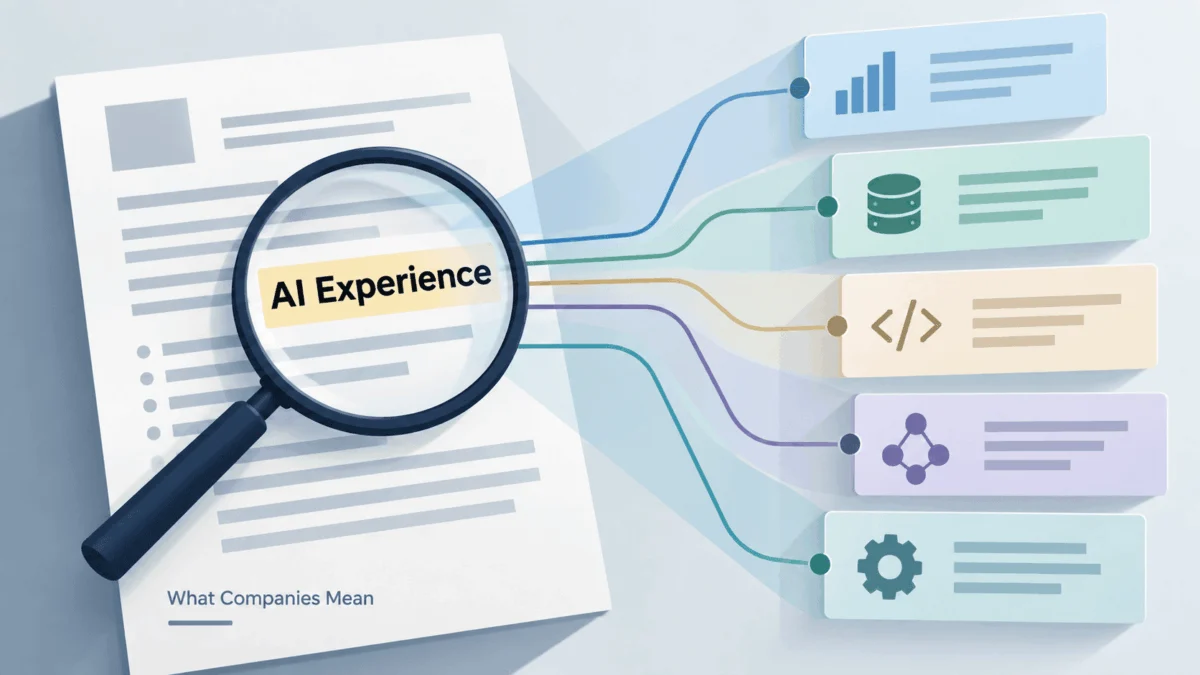
In the modern job market, the phrase "AI experience" has become a ubiquitous, yet profoundly ambiguous, fixture in job descriptions. From entry-level data analyst roles to senior research positions, companies are clamoring for candidates who possess this elusive skill set. However, a closer examination reveals that this requirement is rarely a standardized technical metric. Instead, it acts as a nebulous catch-all term that means vastly different things depending on the hiring manager, the industry vertical, and the specific operational challenges a company faces.
For data analysts, statisticians, and researchers, this creates a significant barrier to entry—or, more accurately, a barrier to interpretation. How does one effectively translate years of rigorous statistical training into a language that satisfies an automated resume screener or a non-technical recruiter? The answer lies in deconstructing the phrase, understanding the four core categories of AI expectations, and strategically mapping existing expertise to these demands.
The Genesis of Ambiguity: Why "AI Experience" Lacks a Standard
To understand the current hiring landscape, one must first recognize that "AI experience" is a marketing term, not a technical one. Unlike "five years of experience in Python" or "proficiency in R," which denote specific, verifiable competencies, "AI experience" serves as a signaling device.
Companies often include this requirement to project an image of modernity and innovation. Hiring teams are frequently disconnected from the granular technical realities of their own data needs; they use the term to filter for candidates who are "plugged in" to recent developments in large language models (LLMs), predictive analytics, or automation. Because the term lacks a formal industry definition, the responsibility of interpretation falls entirely on the job seeker. The goal is not just to match keywords, but to decode the organizational intent behind the listing.
The Four Pillars of "AI Experience"
While the definitions vary, the vast majority of job postings fall into four distinct categories. Identifying the category is the first step in tailoring your application:
- Tool Proficiency: The employer wants someone who can leverage off-the-shelf AI tools (such as ChatGPT, Copilot, or automated data visualization platforms) to increase individual productivity.
- Conceptual Fluency: The employer needs a team member who understands the lifecycle of machine learning—how models are trained, tested, and deployed—even if they aren’t the ones writing the raw code.
- Applied Machine Learning: This is the "hard" category. The firm requires someone who can build, tune, and maintain custom models using libraries like Scikit-learn, TensorFlow, or PyTorch to solve specific business problems.
- Domain-Specific Integration: The rarest and most specialized category. Here, the employer needs someone who understands how to apply AI specifically within a niche field, such as applying computer vision to medical imaging or deploying predictive models in high-frequency trading.
Translating Statistical Rigor into AI Competency
Many seasoned statisticians feel the need to overhaul their resumes with trendy buzzwords. This is often a strategic error. The gap between a statistician and an "AI practitioner" is frequently one of vocabulary and tooling rather than underlying mathematical reasoning.
If your resume highlights "predictive regression models for quarterly demand," you are already describing supervised learning. A hiring manager reading for "AI experience" is looking for evidence of model evaluation, feature engineering, and output interpretation. The strategy should be to bridge the gap:
- From "Regression" to "Supervised Learning": Emphasize how you validated your models against unseen data.
- From "Data Cleaning" to "Feature Engineering": Focus on the iterative process of selecting and transforming inputs to improve model accuracy.
- From "Reporting" to "Inference": Detail how you communicated the limitations and confidence intervals of your outputs to stakeholders.
By framing experience around outcomes and reasoning processes, you convert your traditional statistical background into the modern language of AI.
Chronology of a Hiring Decision
Understanding the lifecycle of a job posting helps in timing your application and tailoring your follow-up.
- Phase 1: The Aspirational Posting: When a role is first listed, the requirements are often a "wish list" of everything the department head could possibly want. Do not be discouraged by the inclusion of "AI experience" in a list of twelve other requirements.
- Phase 2: The Screening: Recruiters often use basic keyword matches. If you don’t use the specific vocabulary of the job description, your resume may never reach a human eye.
- Phase 3: The Technical Interview: This is where the "AI experience" is tested. The interviewers will move past the buzzwords to ask how you handle bias, how you validate models, and how you choose between different algorithms.
- Phase 4: The Strategic Alignment: The final round often focuses on whether you understand the trade-offs of using AI, particularly in terms of cost, latency, and accuracy.
Decoding the Signal: A Practical Framework
Treat every job posting as a raw dataset. Apply a lens of skepticism and look for the "hidden" evidence.
What the Seniority Level Tells You
The level of the role is the most reliable predictor of what "AI experience" actually means in practice:
| Seniority Level | The Real Expectation | Practical Application |
|---|---|---|
| Junior | Adaptability | Learning internal systems and executing defined AI-assisted tasks. |
| Mid-Level | Informed Collaboration | Bridging the gap between engineering and business; participating in model validation. |
| Senior | Strategic Judgment | Determining when AI is the wrong solution and managing deployment risks. |
The "Modifier" Clue
Pay close attention to the language surrounding the requirement. "AI experience preferred" suggests a soft-skill focus. "Hands-on machine learning experience required" combined with a specific stack (like AWS SageMaker or PyTorch) indicates a role that requires actual model building.
Common Misconceptions: Debunking the Myths
There is a pervasive anxiety among data professionals that they are falling behind if they haven’t "built an LLM from scratch." This is largely unfounded.
Myth 1: "I need to list every AI tool I’ve touched."
Listing every tool can actually be a red flag, signaling a lack of depth. Hiring managers prefer candidates who demonstrate sound judgment. Focus on the problem you solved, and use the tool only as a secondary piece of evidence.
Myth 2: "I’m disqualified if I haven’t built a model from scratch."
In most business environments, the ability to interpret data, identify bias, and evaluate the performance of a model is far more valuable than the ability to write code from zero. These are core statistical skills that many companies are desperate for, even if they don’t know how to ask for them correctly.
Myth 3: "I need a certification."
While certifications can provide a foundational vocabulary, they are rarely the deciding factor in an interview. A candidate who can explain the potential pitfalls of an AI deployment in a specific business context will almost always outperform a candidate who simply lists a series of online certificates.
Implications for the Future of Data Careers
As AI continues to integrate into the enterprise, the line between "Data Scientist" and "AI Practitioner" will continue to blur. The implications for professionals are clear: the most successful candidates will be those who remain grounded in statistical fundamentals while developing the agility to translate those skills into new, AI-driven contexts.
The rise of "AI experience" as a job requirement is not a signal that statistics are obsolete. On the contrary, it is a signal that statistics are more important than ever. In an era where AI can generate answers, the ability to judge the quality, ethics, and accuracy of those answers is the new premium skill.
By deconstructing the vague requirements of modern job postings, you can stop feeling like an outsider and start positioning yourself as the critical thinker that every organization currently needs. "AI experience" is not a wall; it is a starting point for a conversation about how your foundational analytical skills can drive the future of the company.


 Asro
 Siti Muinah





