
 Sagoh

The PHP ecosystem, the backbone of approximately 70% of the modern web, is currently grappling with a high-stakes security landscape. Following a tumultuous week marked by the emergency patching of two critical remote code execution (RCE) vulnerabilities—collectively dubbed "PHP2Shell"—the PHP security team has issued an advisory regarding a newly identified, unpatched vulnerability. While this latest flaw requires a specific, non-standard configuration to exploit, it underscores the persistent and evolving threat profile facing the world’s most widely used server-side scripting language.
The New Threat: Understanding CVE-2026-115560
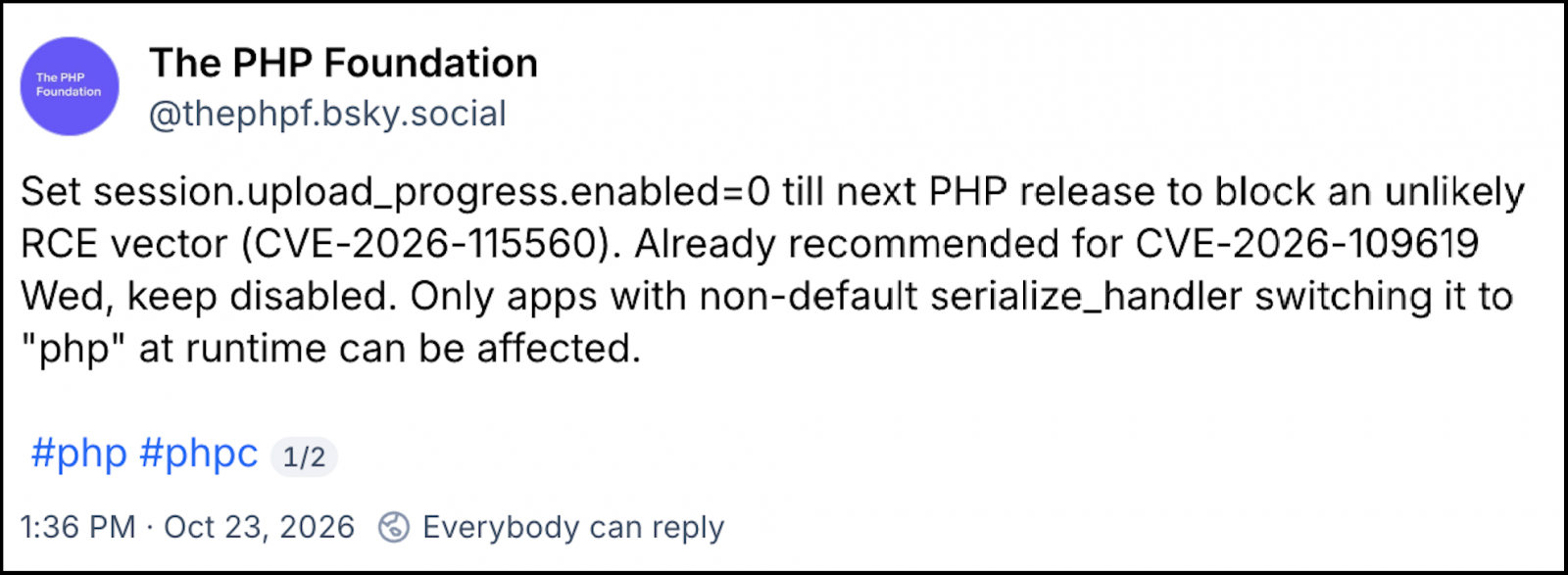
On Friday, the PHP maintainers disclosed a new RCE vulnerability, tracked as CVE-2026-115560. Unlike broader vulnerabilities, this flaw is highly contextual, requiring a precise, unusual combination of application settings and code execution logic to be actionable.
Technical Requirements for Exploitation
According to the official advisory, an attacker can only achieve remote code execution if the target application meets three specific conditions:
- Configuration: The application must explicitly set
session.serialize_handlertophp_binaryorphp_serializein its configuration. - Runtime Manipulation: The application must then use
ini_set()to switch that handler tophpat runtime. - Trigger: The application must call
session_start()while session upload progress is enabled.
Because this sequence of operations is rare in standard development practices, the PHP team has opted to address this in the regular release cycle rather than issuing an immediate, out-of-band emergency patch. However, for organizations that inadvertently utilize this configuration, the risk remains significant.
Recommended Mitigation
The PHP security team has provided a straightforward, interim workaround for administrators concerned about their exposure:
- Immediate Action: Set
session.upload_progress.enabled=0in your PHP configuration. - Persistence: If this mitigation was already applied during the recent response to the PHP2Shell vulnerabilities, the team confirms that no further action is required at this time.
The "PHP2Shell" Crisis: A Chronology of Disclosure and Exploitation
The discovery of CVE-2026-115560 comes on the heels of a massive security operation involving two other critical RCE vulnerabilities, collectively referred to as "PHP2Shell" (CVE-2026-109618 and CVE-2026-109619). The lifecycle of this vulnerability—from discovery to widespread exploitation—serves as a case study in the challenges of modern vulnerability disclosure.

The Leaked Disclosure
The situation surrounding PHP2Shell was complicated by an premature information leak. Details regarding the vulnerability, including CVE identifiers and specific mitigation advice intended for critical infrastructure providers, were exposed online before the official patches were ready for public distribution. This leak effectively removed the "safety buffer" usually afforded to administrators, allowing threat actors to begin reconnaissance and testing against the vulnerabilities before a defense was available.
Timeline of Events
- Pre-Patch Period: Cybersecurity researchers at Amazon Threat Intelligence identified active exploitation attempts targeting the PHP2Shell flaws at least four days before the official patches were released.
- Mid-Week Alert: The PHP security team issued a warning, urging administrators to prepare for urgent updates.
- Patch Release: On Wednesday, the official emergency patches were deployed to address CVE-2026-109618 and CVE-2026-109619.
- Post-Disclosure: Multiple firms, including Cloudflare, watchTowr, Previdian, Hadrian, and Patchstack, confirmed that while initial proof-of-concept (PoC) code was non-functional, the threat landscape shifted quickly as attackers refined their methods.
Supporting Data: The Scale of Exposure
PHP’s ubiquity is its greatest strength and its most significant liability. According to data from W3Techs, nearly 70% of the internet relies on PHP. The exposure metrics are staggering: VirusTotal estimates suggest that there are more than 5.1 million PHP-powered hosts accessible via the public internet. Of these, roughly 3.8 million have at least one port open to external traffic, creating a massive attack surface for threat actors looking to exploit unpatched or misconfigured servers.
The Reality of "In-the-Wild" Attacks
AWS Chief Information Security Officer (CISO) CJ Moses confirmed that PHP2Shell is currently seeing "broad exploitation attempts in the wild." The activity is characterized by a diverse range of payloads and varying anonymization infrastructures, suggesting that multiple threat actors are involved in the campaign.
Data from the Dataminr Threat Research and Cyber Engineering (TRACE) team indicates that while most observed activity remains limited to scanning and fingerprinting, the transition to successful exploitation is inevitable. "It remains only a matter of time for working PoCs or successful exploitation activity to emerge," the report warned.
Official Responses and Industry Implications
The speed at which the PHP maintainers responded to the PHP2Shell crisis reflects a growing maturity in how open-source projects manage high-severity disclosures. However, the incident has reignited debates regarding the "embargo" process and how to prevent information leaks in the future.
Lessons from the PHP Foundation
The PHP Foundation has acknowledged the disruption caused by the premature leak and is currently reviewing its disclosure protocols to strengthen the security of future releases. Their goal is to ensure that critical information remains protected long enough for the majority of the ecosystem to prepare, without compromising the transparency required by the open-source community.
The View from the Front Lines
Security experts emphasize that patch management alone is no longer a sufficient security strategy. As the Dataminr report suggests, the "dwell time" between a vulnerability being disclosed and the first successful compromise is shrinking. Organizations must adopt a layered defense strategy, including Web Application Firewalls (WAFs), egress filtering, and continuous monitoring, to detect the "scanning and fingerprinting" phase before an attacker can deploy a working payload.
Implications for Future-Proofing Infrastructure
The dual-threat scenario—dealing with active exploitation of PHP2Shell while simultaneously mitigating a new, unpatched flaw—highlights the importance of "Defense-in-Depth."
Beyond the Patch
The recent findings from the 2026 Blue Report provide a sobering perspective on modern infrastructure security: once an attacker gains valid credentials or finds a foothold, nearly 63% of their subsequent actions often go unblocked. This statistic is vital for PHP administrators. Relying solely on patching a known vulnerability ignores the "post-exploitation" phase. If an attacker successfully leverages a PHP RCE to gain a shell, they will attempt to move laterally through the network.
Best Practices for PHP Administrators
- Hardening Configurations: Never rely on default PHP settings. Disable unused features, such as
session.upload_progress, if your application logic does not strictly require them. - Runtime Monitoring: Utilize tools that can monitor for
ini_set()calls or other anomalous runtime behavior, especially in legacy codebases. - Egress Filtering: Limit the ability of your web servers to communicate with unknown external IPs. Even if an RCE is successful, preventing the server from downloading a malicious payload or "calling home" can mitigate the impact.
- Visibility: Implement robust logging. In the case of PHP2Shell, early detection of the "scanning" phase was the only way to proactively block attackers before they could find a weakness.
Conclusion
The recent vulnerabilities affecting PHP demonstrate that even the most mature and widely used technologies are not immune to critical security lapses. As we move into the final months of 2026, the reliance on PHP means that any flaw in its core code has immediate, global consequences.
While the PHP team continues to work on a permanent fix for CVE-2026-115560, the onus remains on system administrators to audit their configurations, apply the suggested workarounds, and remain vigilant against ongoing scanning activity. The digital landscape is becoming increasingly hostile; in this environment, proactive configuration management is not merely a "best practice"—it is the first line of defense against an ever-persistent threat.
Administrators are urged to monitor the official PHP website for the upcoming release, which will include the formal patch for CVE-2026-115560, and to prioritize the hardening of all internet-facing PHP hosts to minimize their exposure to future exploits.

 Ali Ikhwan

 Neng Nana






