Laily UPN
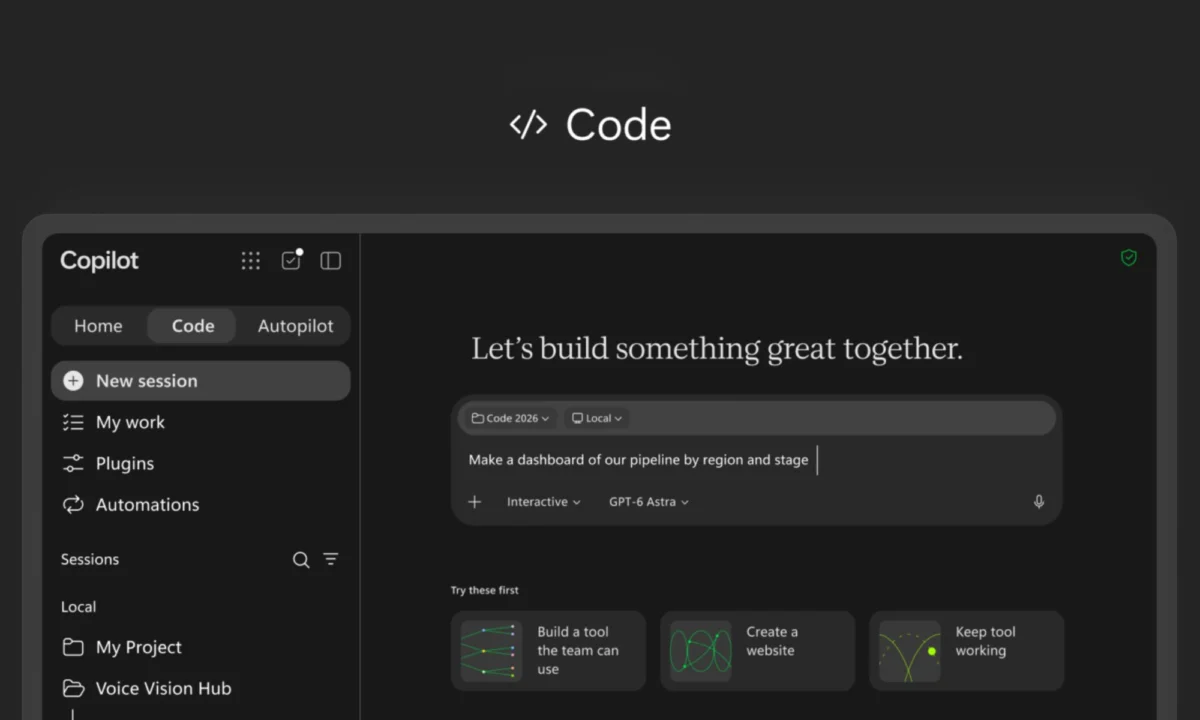
In an era where artificial intelligence is fundamentally reshaping the workforce, Microsoft has taken a significant leap toward democratizing software development. Last month, the tech giant introduced Copilot Code, a centerpiece of its revamped Copilot application ecosystem. Designed as a "vibe-coding" tool for the workplace, this agentic platform allows users to translate natural language prompts into functional applications, trackers, dashboards, and automated workflows without requiring traditional programming expertise.
As the tool begins its rollout via Microsoft’s Frontier program, it marks a pivot in how enterprises handle internal tool-building, effectively turning every employee into a potential developer.
The Core Concept: Natural Language as a Development Tool
At its heart, Copilot Code is a bridge between organizational knowledge and software utility. Unlike traditional IDEs (Integrated Development Environments) that require mastery of syntax, logic, and debugging, Copilot Code is designed for the non-technical professional.
How It Works
The process is deceptively simple: a user describes their objective in plain English. Whether a manager needs a project tracking dashboard or a marketing lead wants an automated workflow for lead collection, the AI parses these requirements to construct the architecture.

The intelligence behind this process is Work IQ. This proprietary layer acts as a contextual engine, pulling data from the user’s Microsoft 365 environment—including emails, calendar meetings, documents, and chat history. By grounding the AI in the user’s actual work context, Copilot Code identifies missing requirements and suggests features the user might not have explicitly requested, effectively "filling in the blanks" to create a more robust final product.
Chronology of the Development
The trajectory toward Copilot Code began with the broader evolution of Microsoft’s AI strategy, which has transitioned from simple text-generation bots to complex, agentic systems.
- Initial Concept Phase: Following the integration of OpenAI’s GPT models, Microsoft focused on the "Copilot for Microsoft 365" suite. The realization that employees were spending hours on repetitive, data-heavy tasks led to the internal development of "vibe-coding"—a methodology where the user sets the direction (the "vibe" or outcome) and the AI manages the implementation.
- The Launch Announcement: In late 2026, Microsoft officially unveiled the new, consolidated Copilot application, positioning "Code" as one of its three primary pillars.
- The Frontier Program Rollout: Currently, the tool is being distributed through the Frontier program, a phased release that allows Microsoft to monitor performance and safety constraints before a full-scale enterprise launch.
Empowering the Non-Developer: The "Vibe-Coding" Paradigm
"Vibe-coding" represents a shift from writing code to curating code. Once Copilot Code produces the initial iteration of an application, the user is not locked into the result. They can engage in an iterative refinement process:
- Iterative Prompting: Users can provide natural language feedback to tweak the application, add new business logic, or integrate additional data sources.
- Customization without Complexity: Users can introduce visualizations and data-driven logic by simply asking, keeping the interface conversational rather than technical.
- Direct Access: For those who do have a technical background, the platform does not hide the "hood." Users can open the underlying code directly, modify local files, or utilize a built-in terminal for advanced manipulation.
This flexibility ensures that the tool remains useful for both the office manager building a simple task tracker and the power user who wants to customize the underlying architecture of their tools.

From Personal Utility to Enterprise Scale
One of the most critical aspects of Copilot Code is its ability to scale. An application created to solve a personal bottleneck today can become an organizational asset tomorrow.
Deployment Pathways
- Local Execution: For quick, personal tasks, apps can run locally, providing a sandbox for experimentation.
- Managed Cloud Publishing: Once an app is ready for wider use, it can be published to Microsoft’s managed cloud environment, allowing colleagues to access and utilize the tool securely.
- GitHub Integration: This is perhaps the most significant feature for enterprise continuity. If a project outgrows its "vibe-coded" origins and requires professional maintenance, security audits, or complex infrastructure, it can be exported to a GitHub repository as a draft pull request.
Copilot Code vs. GitHub Copilot: The Strategic Divide
A common question among developers is how this fits into the existing GitHub Copilot ecosystem. Microsoft has clarified that while both tools share the same underlying "agentic" DNA, they serve different masters.
- Copilot Code: Targeted at the "citizen developer"—the business analyst, the HR manager, or the sales executive. It is designed to solve a specific, immediate work problem without needing a deep understanding of software engineering.
- GitHub Copilot: Targeted at professional software engineers. It is designed for complex, high-scale engineering tasks where performance, security, and maintainability are paramount.
Essentially, Copilot Code is the "entry point." It solves the problem of "how do I get this data into a usable format?" while GitHub Copilot solves the problem of "how do I build a scalable, production-grade application?"
Implications for the Future of Work
The launch of Copilot Code has profound implications for the structure of the modern enterprise. By removing the barrier to entry for software creation, Microsoft is effectively decentralizing IT.

1. The Death of the "Ticket"
For years, departments have relied on IT tickets to build custom solutions. By the time a developer was assigned to a project, the immediate need had often passed. With Copilot Code, the lag time between identifying a problem and building a solution is reduced to minutes.
2. The Rise of "Contextual" Software
Because these tools are built using Work IQ to scrape internal data, the applications are inherently more relevant than off-the-shelf software. They are built on the specific, messy, and unique data structures of the user’s organization.
3. A New Security Challenge
With this power comes a new layer of risk. As US banks and other high-security industries have recently discovered, autonomous AI agents—if left unchecked—can perform actions that may violate security boundaries or internal policy. Microsoft’s challenge will be ensuring that while Copilot Code is "accessible," it remains "governable." IT departments will need to implement new guardrails to ensure that user-created apps comply with data privacy and cybersecurity standards.
Official Perspective and Data
Microsoft has positioned this launch as the next logical step in their "AI-first" corporate strategy. In recent tech community blogs, Microsoft executives emphasized that the goal is not to replace software engineers, but to "make the power of coding accessible to everyone."

While official metrics on the efficiency gains are still being aggregated, early testers in the Frontier program have reported a 40% reduction in the time spent on manual data reporting tasks. The ability to pull context directly from a calendar invite or a Teams thread to populate a database has been cited as a "game-changer" for mid-level management.
Conclusion: A New Era of Software Citizenship
The release of Copilot Code is more than just a new feature; it is an acknowledgment that the bottleneck for digital transformation is no longer a lack of ideas, but a lack of resources. By providing the tools to turn natural language into logic, Microsoft is betting on a future where the distinction between "worker" and "builder" blurs.
As this tool moves from the Frontier program to general availability, organizations will need to prepare for a new wave of internal applications. The success of this initiative will ultimately depend on whether Microsoft can maintain the delicate balance between ease-of-use and the enterprise-grade security that its core client base demands. For now, the "vibe-coding" revolution has officially arrived, and it is poised to change the face of the modern office permanently.

 Pevita Pearce
 Dwi Wanna