
 Pevita Pearce
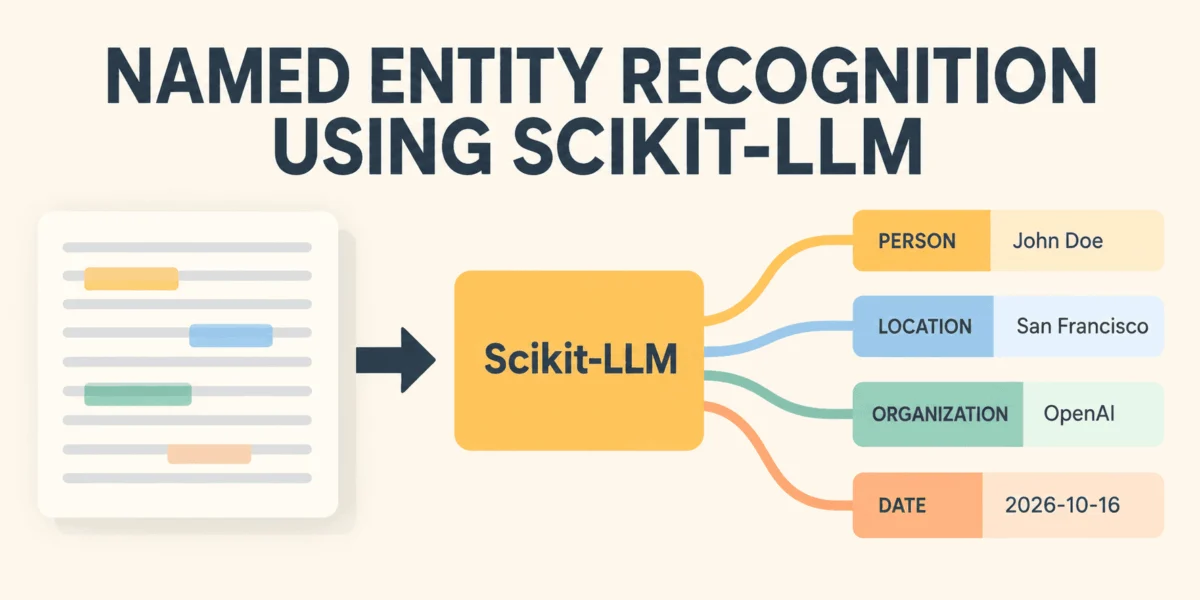
In the rapidly evolving landscape of artificial intelligence, the ability to transform unstructured, chaotic text into actionable, structured data is the "holy grail" for data scientists and enterprise analysts. Historically, this process—known as Named Entity Recognition (NER)—relied on rigid, labor-intensive Natural Language Processing (NLP) frameworks. Today, the integration of Scikit-LLM with high-performance inference engines like Groq is fundamentally rewriting the rulebook, enabling developers to achieve sophisticated entity extraction with minimal overhead and zero traditional model training.
Main Facts: The Paradigm Shift in NER
Named Entity Recognition is a cornerstone of modern data analysis. It involves identifying and categorizing key information—such as company names, executive titles, products, or geographical locations—within raw, unstructured prose. Conventional approaches, such as those utilizing spaCy or BERT-based architectures, often demand massive, annotated training datasets and weeks of fine-tuning to perform well on domain-specific tasks.
Scikit-LLM acts as a bridge, bringing the immense reasoning capabilities of Large Language Models (LLMs) directly into the Scikit-learn ecosystem. By leveraging the intuitive fit_transform API, developers can now instruct models to identify custom entities using natural language definitions rather than thousands of labeled examples. When paired with the Groq API, this approach benefits from ultra-low latency, making it not just a research tool, but a viable solution for real-time production environments.
Chronology: From Legacy Pipelines to Modern LLM Integration
The evolution of text processing has moved through three distinct eras:
- The Rule-Based Era: In the early days, NER relied on complex regular expressions and hand-crafted grammatical rules. These systems were brittle and failed whenever the linguistic context shifted slightly.
- The Statistical/Deep Learning Era: With the rise of models like Word2Vec and later Transformers, NER became more robust. However, these models were "black boxes" that required extensive fine-tuning to recognize custom entities (e.g., specific internal project codenames).
- The LLM-as-a-Service Era (The Current Landscape): The emergence of libraries like Scikit-LLM has democratized access to state-of-the-art reasoning. By abstracting the complex prompt engineering required to guide LLMs, tools like Scikit-LLM allow developers to treat complex NER tasks as simple function calls. The integration with providers like Groq ensures that these tasks are completed in milliseconds rather than seconds, marking the current pinnacle of accessible, scalable AI.
Supporting Data: Implementing the Solution
To understand the mechanics of this transformation, one must look at the technical implementation. The process begins with configuring the environment. By installing scikit-llm and configuring it to communicate with the Groq API, developers can access high-performance models (such as gpt-oss-20b) without the cost associated with proprietary, closed-source providers.
The Entity Dictionary: The New "Training Data"
Unlike traditional models that "learn" from a large corpus of text, Scikit-LLM learns from an entity dictionary. This dictionary acts as a semantic guide for the LLM.
entities =
    "EXECUTIVE": "The full name of a company leader or individual.",
    "CORPORATION": "The name of a technology company or business.",
    "PRODUCT": "A specific hardware device, software, or technology feature.",
    "CITY": "A geographical location or municipality."
By providing these definitions, the developer provides the model with the necessary "context window" to perform accurate extraction. The model no longer needs to guess what an "Executive" is; it is given a clear, functional instruction that it applies to every incoming piece of text.
The Processing Loop
Once the estimator is initialized, the GPTExplainableNER class takes over. The fit_transform method does more than just tag entities; it provides a "reasoning" step. As seen in the output, the model explicitly justifies why it classified a certain string as an entity. This transparency is a massive leap forward from legacy models, which typically provided labels without context.
Official Perspectives and Technical Implications
Industry experts have long pointed to the "Cold Start" problem in machine learning as a major bottleneck for enterprise adoption. Iván Palomares Carrascosa, an advisor in the LLM space, notes that the ability to perform NER without building custom training sets allows companies to iterate on their data strategies in hours rather than months.
The implications of this shift are profound:
- Reduced Development Lifecycle: Organizations can prototype NER pipelines over a weekend.
- Domain Agnosticism: Because the definitions are provided in plain English, the same pipeline can switch from medical entity extraction to legal contract analysis by simply updating the dictionary.
- Explainability: The built-in reasoning output allows auditors and developers to verify why the model made a specific decision, a requirement in highly regulated industries like finance and healthcare.
Implications for the Future of Enterprise Data
As we look toward the future, the integration of Scikit-LLM and Groq signals a move toward "Lean AI." Instead of training massive, monolithic models, businesses are shifting toward smaller, more nimble pipelines that leverage the reasoning power of pre-trained LLMs.
Breaking the Bottleneck of Unstructured Data
Most corporate knowledge is trapped in PDF reports, emails, and internal memos. Traditionally, unlocking this data required an army of data labelers to create ground-truth datasets. By moving to an LLM-driven approach, companies can now process this dark data at scale. The ability to extract structured JSON-like outputs from raw prose means that legacy data can finally be fed into BI tools like Tableau or PowerBI for visualization and predictive modeling.
The Role of Latency
One of the most critical factors for the success of this architecture is latency. Traditional LLM API calls can be sluggish, making them unsuitable for real-time document processing. The use of Groq’s high-speed hardware—specifically designed for fast token generation—effectively removes the latency barrier. This means that a customer service bot could, in theory, perform NER on incoming messages in real-time, instantly identifying the products, locations, and personnel involved in a support ticket before the customer has even finished typing.
Conclusion: The New Standard for NER
The transition from traditional NER models to the Scikit-LLM framework is not merely a technical upgrade; it is a fundamental shift in how we approach data engineering. By prioritizing natural language instructions over complex training cycles, we are making artificial intelligence more accessible, more transparent, and significantly more efficient.
For the modern data professional, the tools are now available to turn any unstructured data source into a clean, structured asset. Whether you are extracting executive movements from news articles or tracking product mentions in social media, the combination of Scikit-LLM and optimized inference engines provides a robust, professional-grade solution that is ready for the demands of the modern enterprise. As we continue to refine these workflows, the barrier between raw human language and machine-readable data will continue to dissolve, ushering in a new era of automated insight.


 Asro
 Siti Muinah





