Ali Ikhwan
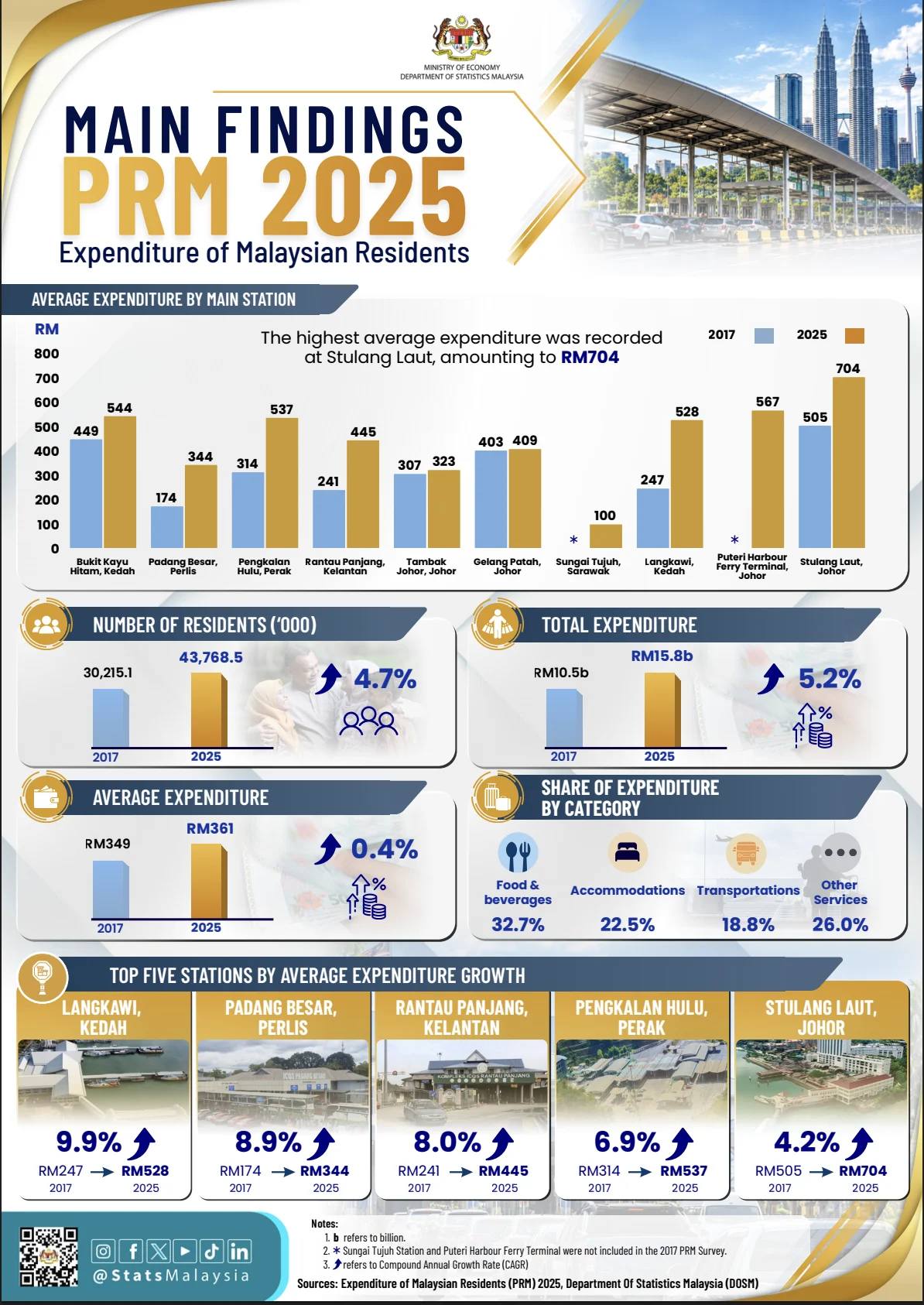
The economic heartbeat of Malaysia’s borders is pulsing faster than ever. According to the Expenditure of Malaysian Residents Survey Report (PRM) 2025, released by the Department of Statistics Malaysia (DOSM), Malaysian residents funneled a staggering RM15.8 billion into neighboring border towns throughout 2025. This figure, representing a significant increase from the RM10.5 billion recorded in 2017, underscores a growing trend of cross-border mobility driven by work, tourism, and lifestyle choices.
As the nation navigates a shifting economic landscape, the data provides a granular look at how, where, and why Malaysians are spending their money when they step beyond national boundaries.
The Evolution of Cross-Border Spending: A Chronological Overview
To understand the current surge in expenditure, one must look at the trajectory of the past decade. The PRM survey, conducted every five years, serves as a vital barometer for Malaysia’s "travel services" data within its Balance of Payments.
Between 2017 and 2025, the total expenditure by Malaysian residents in border towns grew at a compound annual growth rate (CAGR) of approximately 5.2%. While the total outlay jumped from RM10.5 billion to RM15.8 billion, the average expenditure per resident experienced a more modest rise, shifting from RM349 to RM361—a growth of 0.4% per year.
This data highlights that while the number of crossings and the intensity of travel have increased significantly, the individual spending habits of the average traveler have remained relatively stable. The 2025 survey was notably more comprehensive than its predecessor, incorporating new entry points like the Sungai Tujuh station in Sarawak to capture a more accurate representation of the regional economic footprint.
Regional Dominance: The Johor-Singapore Corridor
The survey results paint a vivid picture of regional economic dependency, with Singapore emerging as the primary destination for Malaysian expenditure, accounting for 86.7% of the total RM15.8 billion.
The dominance of the Johor-Singapore corridor is indisputable. Tambak Johor and Gelang Patah, the two primary crossings into Singapore, were the engines of this activity. Tambak Johor alone accounted for RM8.5 billion (53.8%) of the total expenditure, while Gelang Patah contributed RM5.2 billion (32.8%).
Why Johor Matters
The nature of the spending in these areas is largely dictated by the daily commute. At Tambak Johor, a massive 77% of travelers identified "work" as their primary purpose for crossing. Consequently, their spending reflects the necessities of a working professional: 31.3% on food and beverages, 23.7% on transport, and 23.4% on accommodation. A similar pattern is observed in Gelang Patah, where 65.1% of travelers are daily commuters.
In contrast, stations linked to Thailand, such as Bukit Kayu Hitam, tell a different story. While food and beverages remain a top priority (34%), there is a stronger leaning toward retail therapy, with shopping accounting for 26.7% of expenditure, suggesting a higher concentration of leisure-oriented travelers compared to the workforce-heavy flow into Singapore.
Expenditure Breakdown: Where the Money Goes
While the destination varies, the primary drain on the Malaysian wallet is consistent. Across seven of the 10 surveyed immigration entry points, food and beverages claimed the largest share of the budget, totaling 32.7% of all spending.
The Hierarchy of Expenses:
- Food & Beverages (32.7%): The undisputed leader, reflecting both the necessity of daily meals for commuters and the experiential nature of dining for tourists.
- Accommodation (22.5%): A reflection of the 85.8% of travelers who opt for overnight stays, with costs rising exponentially with the duration of the trip.
- Transport (18.8%): Fuel, public transit fares, and vehicle maintenance costs associated with crossing the border.
- Shopping (17.3%): A significant component, particularly in northern border towns.
- Entertainment (7.5%): Leisure activities.
- Others (1.3%): Including medical and organized tour services.
The survey also highlighted that the duration of stay has a direct correlation with expenditure. A one-night stay averages RM191, but this climbs to RM721 for two nights, RM933 for three nights, and a substantial RM2,703 for those staying more than a week.

Logistics: Land vs. Sea and the Payment Revolution
The logistical preferences of Malaysian travelers remain heavily skewed toward land transport, which accounts for 98.8% of total expenditure (RM15.6 billion).
Within this, buses are the most utilized, accounting for 48.9% of the total spend, followed by cars (39.3%) and motorcycles (9.8%). Interestingly, while buses command the highest total expenditure, cars boast the highest average expenditure per person at RM460. This suggests that car travelers are more likely to engage in high-value activities like shopping or extended stays, whereas bus travelers—often daily commuters—have more predictable, lower-cost routines.
The Shift Toward Cashless
A noteworthy finding of the 2025 report is the evolution of payment methods. While cash still dominates at 59.6% (RM9.4 billion), the rise of cashless payments at 40.4% (RM6.4 billion) signals a maturing digital economy. Tambak Johor and Gelang Patah serve as the primary hubs for these digital transactions, reflecting the high level of banking integration between Malaysia and Singapore.
Implications for Policy and Economy
The data provided by the DOSM is not merely a record of past activity; it is a critical input for policymakers, urban planners, and the private sector.
1. Infrastructure Planning
With 98.8% of expenditure occurring via land routes, the pressure on immigration checkpoints like Tambak Johor and Gelang Patah is immense. The data validates the government’s ongoing efforts to streamline border crossings and invest in public transport connectivity. The high percentage of commuters indicates that these border points are not just tourist entryways, but essential nodes in the daily functioning of the Malaysian labor market.
2. Economic Resilience
The fact that food and beverages make up nearly a third of all spending highlights the importance of the F&B sector in cross-border trade. For border towns, this represents a significant opportunity to develop localized supply chains and hospitality services that cater to both the transient worker and the leisure tourist.
3. Monitoring the Balance of Payments
As the government tracks the outflow of capital, the PRM 2025 report helps refine the "travel services" component of the national Balance of Payments. By understanding that a large portion of this expenditure is linked to daily employment in neighboring countries, the government can better distinguish between "leisure-driven" capital outflow and "work-driven" economic activity.
A Note on Methodology and Transparency
The DOSM survey, which covers 10 entry points across six states—Johor, Kedah, Kelantan, Perak, Perlis, and Sarawak—utilizes rigorous sampling to ensure a representative view of Malaysian border activity. The inclusion of new stations like Sungai Tujuh reflects a commitment to capturing the nuances of East Malaysia’s unique border landscape, where transit-related spending plays a larger role than in the densely populated southern corridors.
The report serves as a reminder that for many Malaysians, the border is not a barrier but a bridge. Whether it is the daily grind of a cross-border worker in Johor or the weekend excursion of a shopper in Padang Besar, the economic footprints left by these residents are shaping the regional landscape.
As we look toward the next five-year cycle, the trends established in 2025—the shift to digital payments, the dominance of land travel, and the inelastic demand for food and beverage services—will likely continue to define the bilateral economic relationship between Malaysia and its neighbors. For businesses, investors, and policymakers, these figures provide the roadmap for the next phase of regional growth.
For further analysis on the socioeconomic trends affecting Malaysia, including the 2025 decline in the fertility rate, readers are encouraged to consult the full official reports published by the Department of Statistics Malaysia.


 Azzam Bilal Chamdy
 Layla Zulfa