Muslim
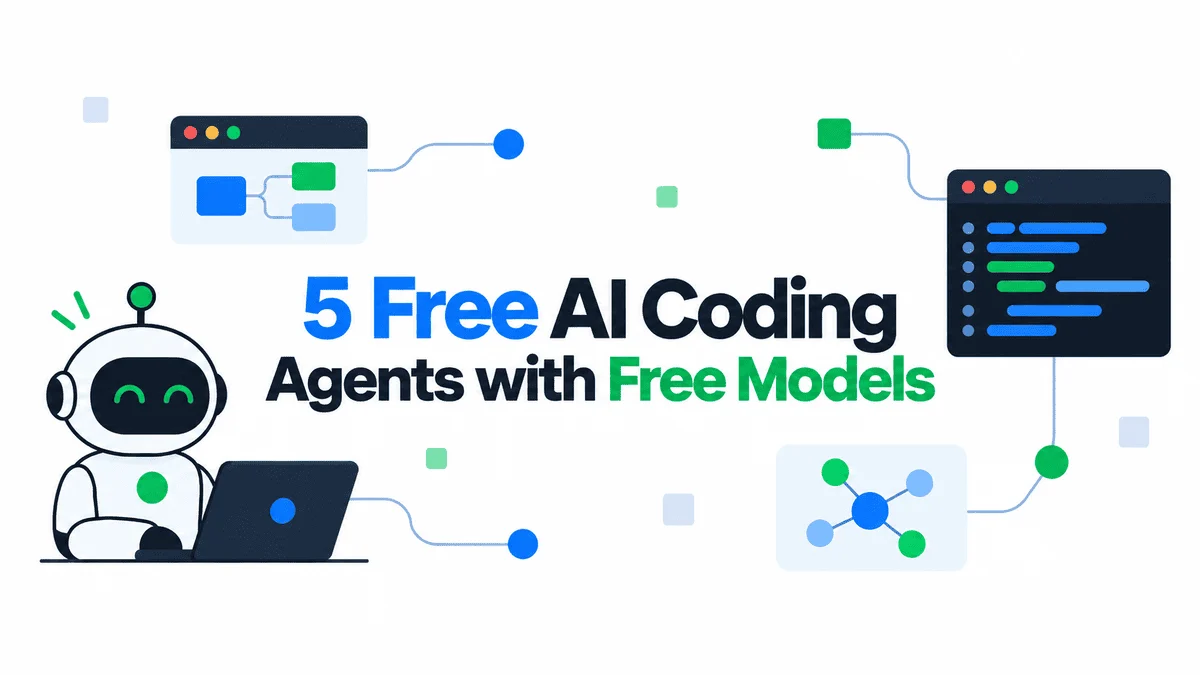
The landscape of software development is undergoing a seismic shift. For years, the promise of "AI-assisted coding" was gated behind high-cost subscriptions and complex API billing structures. Developers were forced to choose between premium enterprise tools or struggling with local models that often lacked the reasoning capabilities required for complex architectural tasks.
As we move into 2026, that barrier has effectively dissolved. A new generation of AI coding agents has emerged—tools that can navigate file systems, debug production-level errors, execute terminal commands, and perform multi-step refactoring—all without requiring a credit card or upfront API investment. This article explores five of the most capable free-to-use coding agents, examining their mechanics, their trade-offs, and why they represent a fundamental democratization of the software engineering craft.
The New Frontier: Why "Free" Agents Matter
For professional developers and hobbyists alike, the "agentic" workflow is the new gold standard. Unlike standard LLM chat interfaces, a coding agent acts as an autonomous participant in your development environment. It can "see" your project’s directory structure, run tests, and iterate based on the output of your compiler.
The primary hurdle for many has been the cost of inference. However, the rise of "Free Tier" provider ecosystems—where companies offer subsidized access to state-of-the-art models to capture market share—has created a fertile ground for experimentation. Whether you are a student, a startup founder on a bootstrap budget, or a senior engineer prototyping a new idea, these five tools provide enterprise-grade capabilities at zero cost.
1. OpenCode: The Gold Standard for Flexibility
OpenCode has rapidly become the preferred tool for developers who demand both power and variety. Operating primarily as a terminal-based agent, it excels at deep-dive repository exploration.
Why it Leads the Pack
The secret to OpenCode’s success is OpenCode Zen. This integrated service allows users to plug into a rotating library of high-performance models. Because OpenCode is model-agnostic, it acts as a gateway to the latest releases from labs like NVIDIA, Muse, and others.
- Capabilities: Full repository inspection, multi-step file editing, and command-line execution.
- The User Experience: It feels less like a chatbot and more like an extension of your own thought process. It handles complex dependency management and suggests refactors that consider the entire codebase context.
- Implications: By decoupling the agent from the model provider, OpenCode ensures that as AI labs release more efficient models, the user benefits immediately without needing to reconfigure their entire stack.
2. Gemini CLI: Google’s Generative Powerhouse
Google has long been a heavyweight in the LLM space, and the Gemini CLI is their direct answer to the growing demand for terminal-integrated AI. By leveraging Google’s own infrastructure, this tool offers a seamless experience for those already embedded in the Google Cloud ecosystem.
Chronology of Accessibility
The release of the Gemini CLI marked a turning point where Google transitioned from merely offering a web interface (Gemini Advanced) to providing a robust developer tool that integrates directly into the shell.
- The Advantage: Because Google manages both the model and the infrastructure, the latency is significantly lower than third-party wrappers.
- Limitations and Constraints: While the tool is incredibly powerful, it operates on a rate-limited quota system. It is designed for iterative development rather than sustained, 24/7 autonomous engineering.
- Best Use Case: Rapid prototyping and debugging tasks that require high reasoning capabilities without the overhead of manual model switching.
3. Kilo Code: The Ecosystem Approach
Kilo Code stands out for its versatility. What began as a VS Code extension has evolved into a comprehensive platform spanning JetBrains, CLI, and cloud-based development environments.
Supporting Data: The "Auto Free" Advantage
One of the most innovative features in the AI agent market is Kilo’s kilo-auto/free routing system. Rather than forcing the user to manually test different models to see which one is currently under a "free promotion," Kilo’s backend dynamically routes the request to the most capable model currently offering free inference.
- Interoperability: Whether you are a die-hard IntelliJ user or a terminal purist, Kilo provides a consistent agentic interface.
- Scalability: It is designed to scale with your project, allowing you to transition from free models to paid tiers only when your project’s scale requires it.
4. Cline: The IDE-Native Specialist
For developers who feel most at home within an Integrated Development Environment (IDE), Cline is the premier choice. Cline brings the agentic loop directly into your workspace, providing a visual audit trail of every change the AI proposes.
Why Transparency Wins
One of the primary fears regarding AI coding agents is the "black box" effect—the fear that an agent might delete a file or run a destructive command. Cline mitigates this by requiring explicit confirmation for critical actions.
- The "FREE" Mark: Cline’s internal provider selector explicitly highlights models that are currently available under free-tier arrangements. This transparency allows users to manage their development costs effectively.
- Ideal For: Developers who want the power of an autonomous agent but demand the ability to review code changes before they are committed to the repository.
5. Crush: A Terminal Experience Redefined
Built by the engineering team at Charm, Crush is designed for the terminal aesthetic. It is highly polished, performant, and deeply integrated with terminal-first workflows.
Official Philosophy
The developers at Charm have a unique philosophy: the terminal is not a legacy interface; it is the most efficient workspace for a developer. Crush embodies this by supporting LSP (Language Server Protocol) and MCP (Model Context Protocol) natively.
- The Hyper Tier: Through "Charm Hyper," users are granted a monthly allowance of credits. This is not a "trial" but a sustained free tier that allows for consistent use.
- Performance: Because Crush is optimized for the terminal, it consumes fewer system resources than browser-based or Electron-heavy IDE extensions, making it an excellent choice for machines with limited RAM.
Implications: The Shifting Economics of Software Development
The existence of these tools signals a major shift in the software industry. We are moving away from an era where "coding productivity" was a luxury bought by corporations and toward an era where it is a commodity available to anyone with a laptop and an internet connection.
The "Free" Paradox
It is vital for developers to understand the trade-offs of these free tiers. While these agents are fully capable, they operate under the grace of the providers.
- Quota Volatility: As demand for AI increases, providers may adjust quotas.
- Model Availability: A model that is free today might be moved behind a paywall tomorrow as it gains popularity.
- Data Privacy: When using free hosted models, developers should be mindful of their codebase privacy. While most agents allow for local-only processing, using hosted free models means sending code to a third-party server.
Conclusion: Where to Start?
If you are looking to integrate an AI agent into your workflow today, the path is clear:
- Start with OpenCode if you want the best balance of model flexibility.
- Use Gemini CLI if you want the reliability of Google’s infrastructure.
- Adopt Kilo Code if you need multi-IDE support.
- Choose Cline if you prioritize IDE-based visual feedback.
- Try Crush if your heart belongs to the terminal.
The "AI Revolution" in coding is no longer about the theoretical future—it is about the tools on your screen right now. By leveraging these agents, you aren’t just writing code faster; you are learning how to orchestrate machine intelligence to handle the grunt work of software engineering, leaving you free to focus on the high-level architecture and creativity that truly defines a developer.
As these tools continue to evolve in 2026, the question is no longer "Can I afford to use an AI agent?" but rather, "Can I afford not to?"

 Asro
 Siti Muinah