
 Nana
The colorful marigolds, the scent of copal incense, and the striking imagery of catrinas have transcended their traditional Mexican roots to become a global cultural phenomenon. New data from Amadeus Travel Intelligence reveals that the Day of the Dead—Día de los Muertos—is no longer merely a local religious observance; it has evolved into a powerhouse of international tourism.
As travelers increasingly seek "experiential" vacations that connect them with authentic cultural rituals, Mexico’s primary hubs for these celebrations, Mexico City and Oaxaca, are seeing an unprecedented surge in interest. According to the latest figures, international arrivals to these iconic destinations have climbed by 22% year-over-year, marking a sustained shift in global travel demand.
Understanding the Tradition: More Than a Holiday
While often conflated with Halloween due to their proximity on the calendar, Día de los Muertos is fundamentally distinct. Traditionally celebrated on November 1 and 2, the festival is a profound, life-affirming meditation on mortality. It is a time when the veil between the living and the dead is believed to thin, allowing spirits to return for a brief reunion with their families.
The centerpiece of the tradition is the ofrenda—an altar adorned with photographs of the departed, sugar skulls, favorite foods, candles, and vibrant cempasúchil (marigold) flowers. In recent years, the visibility of these celebrations has been amplified by global pop culture, most notably the iconic opening sequence of the James Bond film Spectre, which featured a massive, fictionalized parade in Mexico City. This cinematic exposure acted as a catalyst, sparking a curiosity that has translated into a consistent and growing influx of international visitors eager to witness the spectacle firsthand.
A Chronological Surge: Mapping the Traveler Influx
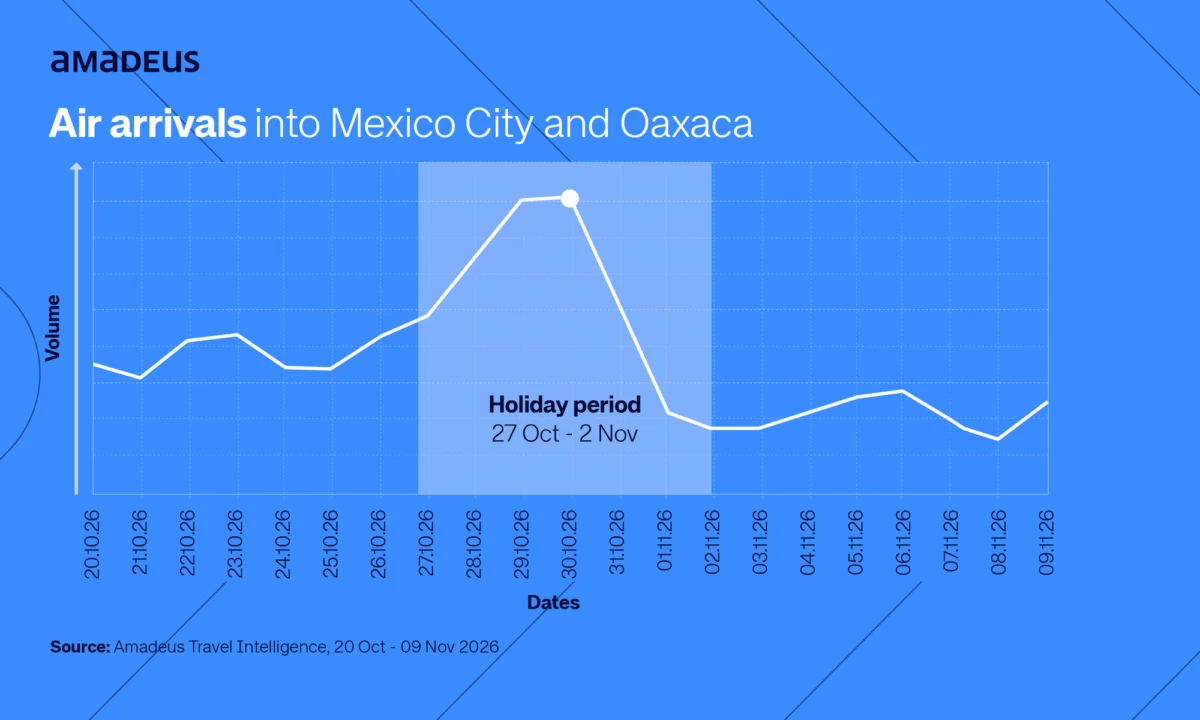
The "Day of the Dead effect" is characterized by a specific, highly condensed window of travel. Amadeus data highlights that the excitement is not limited to the two days of the holiday; rather, the entire week leading up to the celebration serves as the primary engine for tourism volume.
The Buildup (October 20–26)
In the week preceding the festivities, travel begins to pick up pace as early arrivals secure their footing. This period is marked by the final preparations for the ofrendas and the beginning of street-level community gatherings.
The Peak Period (October 27 – November 2)
This is the epicenter of the travel spike. Total arrivals to Mexico City and Oaxaca during this window are up 32% compared to the preceding week. The data shows a distinct peak in arrivals on October 29 and 30. This suggests that international and domestic travelers are prioritizing an arrival strategy that puts them in the city center just before the main festivities commence, allowing them to acclimate before the height of the processions.
The Post-Holiday Taper (November 3–9)
Following the culmination of the holiday on November 2, travel interest experiences a sharp decline. Arrivals during this week are nearly double (99% higher) in the pre-holiday period compared to the immediate post-holiday window, underscoring the event-driven nature of the travel demand. Once the spirits have departed and the altars are dismantled, the surge in tourism evaporates almost as quickly as it appeared.
Supporting Data: The Demographics of the Modern Pilgrim
The profile of the traveler visiting Mexico for Día de los Muertos offers significant insights into the changing nature of the tourism industry.
Traveler Composition
The traveler base is dominated by smaller groups. Duos represent 41% of all international arrivals, while solo travelers account for 37%. Together, these two segments comprise more than three-quarters of the total visitor count, suggesting that the experience is being consumed primarily as a personal, intimate, or couples-oriented journey rather than a large-group vacation.
Duration of Stay
Travelers are increasingly choosing to linger. Medium-length stays—defined as 6 to 13 days—are currently leading the growth trajectory with a 31% increase. This trend indicates that visitors are moving beyond the "day trip" mentality to immerse themselves in the local culture, likely opting to visit multiple sites or participate in community-led workshops and tours throughout the region. Short-term stays (1–5 days) have also seen a healthy growth rate of 18%.
The Domestic Powerhouse
While international interest is rising, domestic travel remains the backbone of the festival’s economic impact. Domestic air arrivals across Mexico for the holiday window have grown by 24% compared to last year. Mexico City remains the primary domestic hub, capturing 29.4% of total arrivals, while Oaxaca has seen an impressive 49% surge in domestic interest. Notably, the segment of solo domestic travelers has skyrocketed by 48%, reflecting a growing trend of independent local exploration.
Official Perspectives: Navigating the Data-Driven Future
The sheer velocity of this growth presents a unique challenge for the hospitality sector. Jill Boegel, SVP of Commercial, Americas, Hospitality at Amadeus, frames this not as a fleeting trend but as a fundamental shift in the global travel landscape.
"What we are seeing with the Day of the Dead festival isn’t a temporary travel trend, but a shift in global travel demand that grows larger every year," says Boegel. She emphasizes that for stakeholders, the challenge lies in the preparation. "Through our data, we are seeing that the build-up to major cultural events and festivals such as the Day of the Dead are just as important as the days themselves."
Boegel warns against the dangers of relying on traditional, intuition-based planning. "Navigating these spikes and influxes of demand requires a deep, data-driven understanding of traveler behavior. Relying on intuition or outdated metrics can lead to missed opportunities for hoteliers and Destination Marketing Organizations (DMOs) as well as overwhelmed staff and operations."
The Broader Implications for Tourism and Hospitality
The rise of Día de los Muertos as a major tourist destination has several long-term implications for the Mexican tourism industry and the global hospitality sector at large.
1. The Challenge of Seasonality Management
The extreme peak-and-trough nature of the holiday travel window presents a logistical challenge. Hotels and local service providers must grapple with an environment where demand is virtually non-existent one week and at absolute capacity the next. This requires sophisticated yield management strategies, dynamic pricing models, and agile staffing solutions to prevent service degradation during the peak influx.
2. Infrastructure and Sustainability
With a 32% jump in arrivals over a single week, the burden on local infrastructure—from airport capacity to public transportation and local waste management—is significant. As the event gains more global recognition, DMOs must balance the economic benefits of increased tourism with the preservation of the sacred, communal nature of the holiday. Over-tourism can dilute the very authenticity that attracts visitors in the first place.
3. The "Experience Economy" Shift
The preference for 6–13 day stays points toward a broader trend in the global travel sector: the rise of the "experience economy." Travelers are no longer satisfied with being passive observers; they are seeking deeper, more meaningful engagement with traditions. For hoteliers, this means that the hotel is no longer just a place to sleep—it must act as a gateway to the culture, offering curated experiences, access to local artisans, and insights into the rituals of Día de los Muertos.
4. Data-Driven Decision Making
The success of this year’s holiday cycle validates the necessity of real-time travel intelligence. By understanding that the "buildup" is just as critical as the main event, businesses can better optimize their marketing spend, promotional offers, and operational resources. The ability to predict these granular fluctuations allows stakeholders to move from a reactive stance to a proactive one, ensuring they are prepared for the exact moment the crowds arrive.
Conclusion: A Balancing Act
The growth of Día de los Muertos as an international travel destination is a testament to the universal appeal of cultural connection. As travelers move away from generic "sun and sand" vacations in favor of immersive, culturally rich experiences, Mexico stands as a premier destination.
However, as the numbers continue to climb, the future of the festival will depend on the delicate balance between commercial success and cultural preservation. With the support of data-driven insights and a strategic approach to hospitality, Mexico is well-positioned to manage this evolution, ensuring that the ancient spirits of the Día de los Muertos continue to be honored with the respect and gravity they deserve, even as the world comes to watch.
Methodology Note: The insights presented are based on Amadeus Travel Intelligence data, comparing air arrivals to Mexico between October 20 and November 9, 2026, against the same period in the previous year, as of October 1, 2026.


 Rifan Muazin

 Evan Lee Salim





