Evan Lee Salim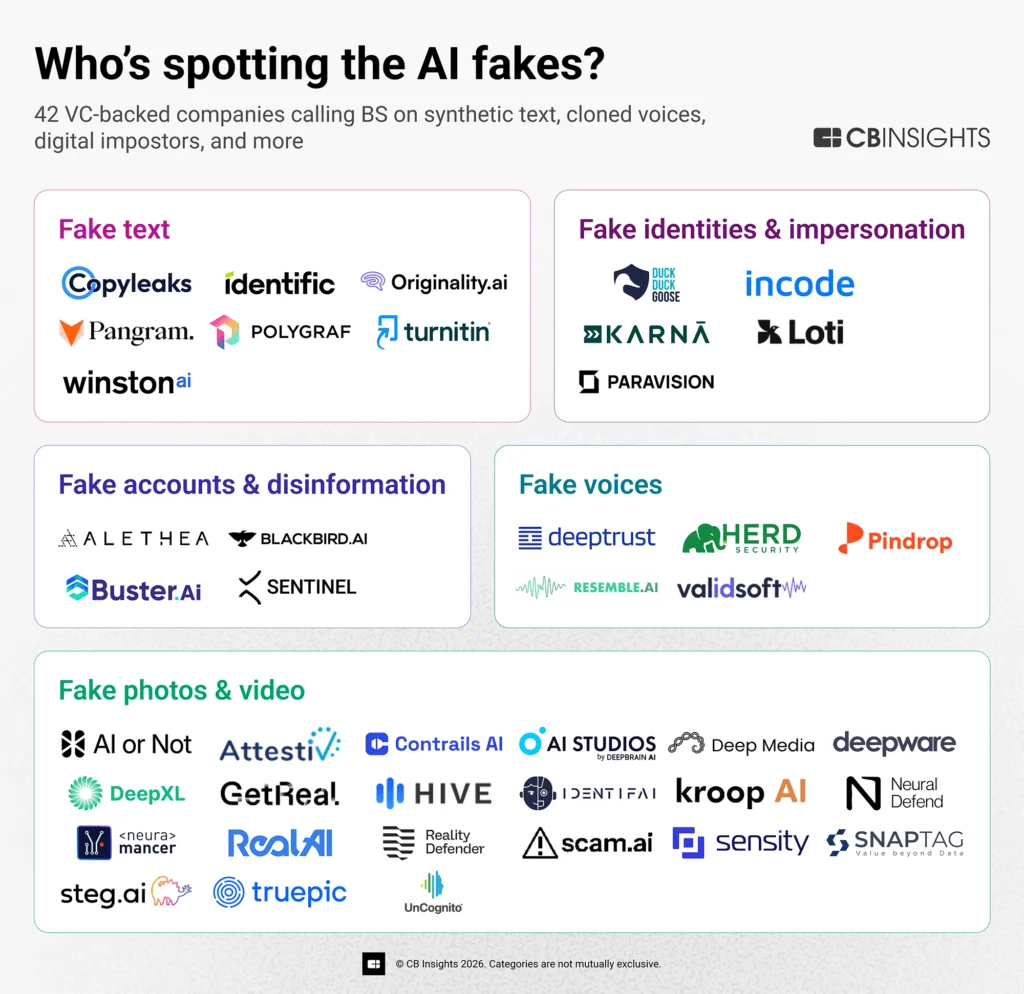
The digital landscape has entered an era of profound epistemic uncertainty. When OpenAI recently unmasked a network of seven fictitious journalists—including one "Ervin Hoskins," who successfully placed op-eds in regional Florida newspapers regarding the war in Iran—it wasn’t just a case of plagiarism or bot-spamming. It was a demonstration of a new, industrialized form of information warfare. Hoskins, like his cohorts, never existed; his professional history was a fabrication, his bylines were generated by Large Language Models (LLMs), and his influence was real enough to breach the editorial gates of local American media.
As AI-driven synthesis tools become more sophisticated, the line between reality and hallucination is blurring. From voice-cloned CEO impersonations to synthetic job candidates padding resumes with AI-generated faces, the "fake-catching" industry has emerged as the latest high-stakes frontier for venture capital. A new market map identifying 42 VC-backed startups dedicated to AI forensic detection reveals a burgeoning ecosystem designed to restore trust in a digital world where seeing—and hearing—is no longer believing.
The Chronology of a Crisis: From Novelty to Threat
The current state of AI-driven deception did not emerge overnight; it is the culmination of rapid technological democratization.
- 2022-2023: The Generative Explosion. The public release of high-fidelity image generators and text-based LLMs introduced the world to the capabilities of synthetic media. Initially perceived as a novelty, these tools were quickly weaponized for disinformation.
- 2024: The Year of Impersonation. Fraudsters began utilizing real-time voice cloning to bypass biometric security at banks and carry out "pig-butchering" scams and corporate social engineering.
- 2025: The Institutional Pivot. Faced with massive losses from deepfake-enabled financial fraud, major financial institutions began integrating forensic AI detectors into their onboarding and transaction verification workflows.
- 2026: The "Verification" Gold Rush. As demonstrated by the recent surge in capital, the market has shifted from experimental detection to mandatory security infrastructure. Since January 2025, the sector has seen 26 major deals totaling $125 million, signaling that "truth-tech" is now a core enterprise requirement.
Supporting Data: Following the Money
The market map of these 42 startups highlights a distinct trend: the money is following the pain points. Of the $125 million raised since the start of 2025, a staggering $74 million has flowed specifically into companies focused on catching fake voices and synthetic identities.
This capital concentration is not merely speculative; it is a direct response to the high-friction environment of global finance. Companies like Incode, which led the pack with a $37 million round, are setting the pace by providing robust identity verification that can withstand the scrutiny of AI-generated inputs.
The participation of "smart money" from the financial sector is particularly telling. Capital One’s backing of GetReal Labs and BNY’s strategic investment in Reality Defender indicate that the world’s most conservative institutions are betting on these startups to serve as the new gatekeepers of the financial system.
The New Guard: Who is Building the Truth?
Interestingly, the leaders of this "fake-catching" revolution are not traditional fraud investigators. Instead, they are a hybrid class of technologists and former cyber-security operators.
Of the 11 startups on the list founded since 2023, seven focus exclusively on high-stakes environments: banking, insurance, and enterprise-level video conferencing. The pedigree of these founders is telling. For example, the founder of IdentifAI cut their teeth leading a major Italian cybersecurity firm for nearly a decade, while the CEO of DeepXL brings a deep legal and regulatory background from their time at major Nordic financial institutions.
This demographic shift suggests that the battle against AI-generated fraud requires a multidisciplinary approach. It is no longer enough to understand code; these founders must navigate the intersection of engineering (often ported from self-driving car sensor fusion and security software) and regulatory compliance.
Official Responses and Strategic Alliances
The "fake-catching" industry is increasingly operating via a "platform-native" strategy. Rather than forcing users to upload files to a third-party website, these detection startups are partnering with existing software giants to build verification into the tools people use every day.
- Integrated Defense: Software companies are licensing detection APIs, allowing video conferencing platforms and CRM systems to flag synthetic content in real-time.
- The M&A Outlook: Industry analysts expect a wave of consolidation. Companies like Equifax have already signaled their intent; by housing detection technology like Incode inside their existing Kount fraud platform, they are effectively turning identity verification into a defensive moat. During their July 2026 earnings call, Equifax explicitly identified "identity and fraud" as one of their four primary acquisition lanes for the coming fiscal year.
Implications: The Dystopian Reality of "Ervin Hoskins"
The case of Ervin Hoskins serves as a grim case study for the implications of this technology. If a fake persona can bypass the editorial scrutiny of a newspaper, the potential for market manipulation, political destabilization, and corporate sabotage is immense.
1. The Cost of Verification
The immediate consequence of this arms race is that verification is becoming an expensive, recurring cost for businesses. Companies must now pay to verify that their employees, clients, and partners are human, creating a "tax on truth" that will inevitably trickle down to the consumer.
2. The Vulnerability of Small Players
While large corporations can afford to build or buy sophisticated detection suites, small businesses and independent media outlets remain dangerously exposed. The "Ervin Hoskins" scenario highlights that local media—often lacking the resources for high-end AI forensics—is the primary target for bad actors looking for low-cost, high-impact influence operations.
3. The Funding Window
For investors, the clock is ticking. Four of the companies currently on the map are entering critical funding windows. As these startups mature, the market will likely see a split between those that successfully scale their partnerships with enterprise platforms and those that remain niche players.
Conclusion: A Permanent State of Vigilance
The "fake-catching" industry is no longer a peripheral concern of cybersecurity enthusiasts; it is a fundamental pillar of the future digital economy. As AI continues to iterate, the goal for these 42 startups is not to reach a "solved" state, but to ensure that the cost of deception remains higher than the value of the outcome.
Ervin Hoskins may be a ghost, but the problem he represents is very much alive. Whether through the lens of a bank’s anti-money laundering software or the editorial gatekeepers of our local news, the next few years will be defined by a singular, persistent effort: the struggle to distinguish the authentic from the synthetic. For the companies currently raising capital in this space, the mission is simple—they are building the infrastructure for a reality that is increasingly difficult to verify.
As we look toward 2027 and beyond, the market for "truth" will likely become as essential as the market for electricity or cloud storage. In a world where AI can write the news and clone the face of a CEO, the most valuable commodity in the global economy is, ironically, the ability to prove that you are who you say you are.


 Lina Irawan
 Nila Kartika Wati