Lina Hope
For decades, hotel sustainability was relegated to the "PR and Marketing" folder—a collection of "save the towel" cards and website badges designed to offer a veneer of environmental consciousness. However, the hospitality landscape has undergone a seismic shift. Today, sustainability has transitioned from a superficial marketing exercise into a core financial strategy.
For modern hoteliers, the transition is no longer optional. As energy costs soar and regulatory pressures mount, sustainability is becoming the most reliable lever for protecting Gross Operating Profit (GOP). By treating resources—energy, water, and waste—with the same rigor as revenue management, properties are discovering that the path to profitability is often paved with efficiency.
The Financial Imperative: Moving Beyond Messaging
Sustainability becomes a genuine profit strategy only when it moves from corporate messaging to rigid operational discipline. The "old guard" of hospitality viewed green initiatives as a cost center—a checkbox to satisfy guests or appease local regulators. The modern, high-performing hotel, however, views resource management as a direct contributor to the P&L statement.
The core strategy is simple: reduce "leakage." Just as a revenue manager tracks RevPAR, a sustainability-focused operator tracks resource consumption per occupied room. By minimizing avoidable energy spikes, water waste, and excessive single-use purchasing, hotels protect their bottom line before they even attempt to win a single dollar of "green premium" from guests.
The Energy Equation
Energy is the most accessible entry point for this financial transformation. According to data from the U.S. Environmental Protection Agency (EPA) via ENERGY STAR, approximately 47,000 U.S. hotels spend roughly 6 percent of their total operating costs on energy. In an industry defined by razor-thin margins, a small percentage reduction in energy spend can have a disproportionate impact on the net margin.
Consider a 110-room independent property. By upgrading to smart LED lighting, optimizing HVAC control systems, and training housekeeping staff to manage equipment usage in vacant rooms, the hotel creates a more resilient balance sheet. These actions don’t just "feel" good; they represent tangible capital preserved that would otherwise have been incinerated in the form of wasted electricity.

Chronology of the Shift: From PR to Performance
The evolution of hotel sustainability can be viewed through three distinct phases:
- The "Greenwashing" Era (Pre-2015): Sustainability was purely visual. Hotels focused on guest-facing programs like linen reuse, which were often implemented to save on laundry costs but marketed as altruistic environmentalism.
- The Certification Boom (2015–2022): As corporate travel buyers began mandating ESG (Environmental, Social, and Governance) reporting, hotels sought certifications like LEED or EarthCheck to remain eligible for lucrative corporate RFPs.
- The Operational Discipline Era (2023–Present): Driven by rising energy prices and stringent new EU "green claims" regulations, sustainability is now a data-backed operational necessity. The focus has shifted from appearing green to measuring intensity.
Supporting Data: Where the Money is Saved
The most effective savings are those the guest never perceives. A truly sustainable hotel manages its heating, cooling, and lighting systems so seamlessly that the guest experience remains pristine.
The Cost-Saving Matrix
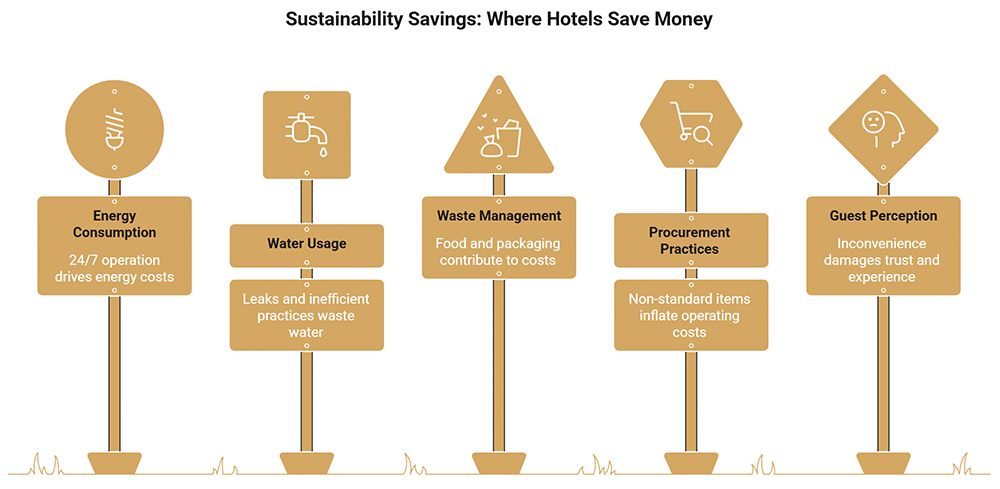
| Cost Area | Primary Action | Key Metric | Objective |
|---|---|---|---|
| Energy | Smart room controls & HVAC automation | Cost per occupied room | Decouple consumption from occupancy |
| Water | Leak detection & flow regulators | Cost per occupied room | Reduce waste in laundry/facilities |
| Waste | Food waste audits & bulk procurement | Waste cost per cover | Protect margin on F&B |
| Procurement | Shift to durable/refillable items | Cost per guest supply | Lower long-term OpEx |
Research indicates that an energy management system linked to property management systems (PMS) can reduce total energy costs by 35 to 45 percent. When a room is marked as "vacant" or "out of order," the system automatically scales back the climate control—a simple logic that prevents thousands of dollars in unnecessary waste annually.
The Rate Premium: A Conditional Reality
Does sustainability command a higher nightly rate? The answer is nuanced. Research from Florida-based certified hotels suggests that properties with sustainability credentials often outperform their competitive sets in RevPAR and ADR. However, this advantage is highly dependent on the market segment.
For luxury and upscale hotels, sustainability is a "quality signal." Guests in these segments often possess higher discretionary income and view environmental stewardship as an essential component of a premium, modern experience. Conversely, in the budget and economy segments, price and location remain the dominant drivers.
For the budget hotelier, the business case for sustainability should begin and end with cost reduction. Any resulting "rate lift" should be viewed as an added bonus, not the primary objective.
The Three-Line Sustainability Test
Before committing capital to a sustainability project, every hotel owner should apply the "Three-Line Test" to ensure the investment is sound:
- The Cost Line: Does this reduce my cost per occupied room? (This is the mandatory baseline).
- The Compliance Line: Does this protect my ability to bid on corporate contracts or meet regulatory reporting requirements?
- The Rate Line: Does my target demographic value this enough to pay a premium?
If a project cannot satisfy at least one of these lines, it is likely a "vanity project" rather than a sound investment.
The Impact of New Greenwashing Regulations
The commercial landscape is currently being redefined by legal frameworks like the EU’s Empowering Consumers for the Green Transition Directive. Starting in September 2026, the era of "vague environmental claims" will effectively end. Hotels can no longer market themselves as "eco-friendly" without verified, third-party substantiation.
This regulatory shift transforms sustainability from a marketing choice into a legal risk. Hotels that fail to provide verifiable proof for their claims face potential fines and, more damagingly, the loss of trust from increasingly savvy corporate and MICE (Meetings, Incentives, Conferences, and Exhibitions) buyers.
Official Responses and Industry Standards
The World Travel & Tourism Council (WTTC) has taken a lead role in standardizing these metrics. By elevating its "Hotel Sustainability Basics" to a formal, independent third-party certification scheme, the WTTC is providing the industry with a roadmap for compliance.
Gloria Guevara, President and CEO of the WTTC, notes that sustainability must be "practical, achievable, and scalable." The goal is to move the industry away from disconnected, independent efforts toward a universal language of performance that corporate buyers can trust.

Implications for Future Operations
What does this mean for the future of hotel management? It implies that the role of the "Sustainability Manager" will either become a dedicated position or, more likely, be integrated into the responsibilities of the General Manager and Department Heads.
For independent hotels without the resources of global conglomerates like Hilton or Marriott, the strategy must be "sequenced."
- Stage 1: Metering and benchmarking (Know your baseline).
- Stage 2: Quick wins (LEDs, low-flow fixtures, HVAC scheduling).
- Stage 3: Systems integration (Connecting PMS to facility controls).
- Stage 4: Certification (Legitimizing the performance for the market).
Conclusion: Sustainability as a Competitive Moat
The "say-do gap"—the phenomenon where guests claim to value sustainability but book the cheapest room—is a reality that hotels must navigate. However, by anchoring the sustainability business case in operational efficiency rather than consumer behavior, hoteliers remove the risk.
When you lower your cost of operation, you improve your bottom line regardless of whether the guest chooses your room for your "green" credentials or simply because of your price. By measuring sustainability against the activity of the hotel—cost per occupied room—managers can finally move past the PR exercises of the past and into a future where sustainability is synonymous with profit.
The hotel of the future is not just "green"; it is lean, data-driven, and highly disciplined. Those who master these metrics today will not only survive the upcoming regulatory shifts but will thrive as the most profitable operators in their competitive sets.


 Ammar Sabilarrohman
 Rifan Muazin