Dwi Wanna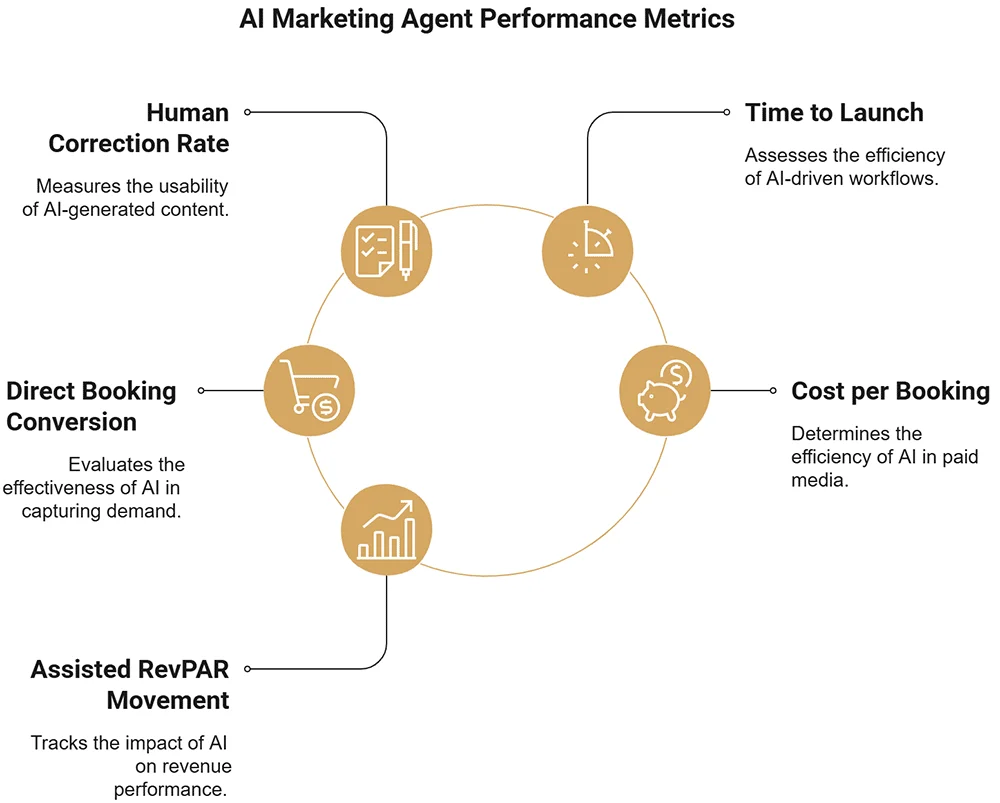
The hospitality industry is currently undergoing a structural transformation that mirrors the early days of the internet. The shift is not merely about using generative AI to write social media posts; it is about the rise of Agentic AI—autonomous systems capable of reasoning, planning, and executing complex marketing workflows. For hotel managers and marketing directors, these agents represent a fundamental change in how demand is captured and how guests discover properties.
The Paradigm Shift: From Chatbots to Agents
To understand the current landscape, one must distinguish between standard generative AI and true agentic systems. A basic chatbot is a reactive tool: it waits for a user prompt, generates a response, and then goes idle. An AI agent, by contrast, is a goal-oriented system. It receives an objective, evaluates the data, navigates through various software tools, and executes a series of tasks to achieve a desired outcome.
For example, an agent tasked with boosting weekend occupancy does not just write a Facebook post. It monitors real-time booking data, identifies a drop in conversion for leisure travelers, drafts a personalized email campaign, creates two distinct audience segments, generates landing page copy, and queues the entire project for human approval. This is the new standard of efficiency.
The Two-Front Agent Model: A Strategic Framework
The most sophisticated hotels are currently adopting the "Two-Front Agent Model." This framework treats AI adoption as a dual-pronged strategy:
Front One: Internal Deployment
These agents live within the hotel’s technology stack. They integrate with the Property Management System (PMS), CRM, and revenue management software. They are designed to automate labor-intensive operations, such as follow-ups on abandoned bookings, weekly performance reporting, or multi-channel segmentation.
Front Two: External Exposure
This is the "discoverability" layer. Travelers are increasingly moving away from traditional search engines, turning instead to AI assistants like ChatGPT, Gemini, and Perplexity to plan itineraries and compare properties. If a hotel’s digital footprint is not structured to be understood by these LLMs (Large Language Models), the property essentially ceases to exist for a growing segment of tech-savvy travelers.
Chronology of the AI Integration
The transition to AI-driven marketing has accelerated rapidly since the mainstreaming of Large Language Models in late 2022.
- 2023: The Generative Phase. Hotels experimented with AI for content creation—writing blog posts, social captions, and basic email newsletters.
- 2024: The Integration Phase. Focus shifted toward "Answer Engine Optimization" (AEO) and "Generative Engine Optimization" (GEO), as hotels realized that search traffic was fragmenting across AI platforms.
- 2025–2026: The Agentic Era. The industry has entered a phase where autonomous systems are beginning to bridge the gap between revenue management, marketing, and operations. Recent audits of search algorithms indicate that "experiential" travel queries are increasingly favoring non-OTA (Online Travel Agency) sources, provided those sources offer high-quality, structured data.
Supporting Data: Why Visibility Matters
The commercial stakes are high. A 2026 audit of Google Gemini involving 156 hotel queries in Tokyo revealed an "Intent-Source Divide." While transactional queries (e.g., "book a room at X hotel") still favor major OTAs, experiential queries (e.g., "best boutique hotel in Tokyo for art lovers") saw 55.9% of citations coming from non-OTA sources.

This finding suggests that hotels that invest in "experience-led" content and structure their data correctly have a distinct advantage in the AI-driven search economy. As Paarul Suri, former executive at Hyatt and IHG, noted: "If you’re not there on those AI recommendations, you’re out."
Official Perspectives and Industry Insights
The consensus among industry leaders is that fragmented systems are the greatest hurdle to success. Luminita Mardale, General Manager at the Ramada by Wyndham Bucharest Otopeni Airport, emphasizes the need for a holistic approach:
"In hospitality, the biggest missed opportunities often come from disconnected systems. Marketing promotes one message, revenue management adjusts pricing separately, and operations deliver the experience. An AI agent that connects these silos—marketing, revenue, CRM, and operations—into a single, intelligent decision-maker is the ultimate goal. It aligns every department around one mission: the right experience for the right guest at the right time."
Robert Cole, senior research analyst at Phocuswright, echoes this sentiment with a warning to hoteliers: "Hotels must control their sources of truth, or another party will fill the gap with a technology layer and monetize it."
Implications for Independent Hotels
For independent properties, the prospect of managing AI agents may seem daunting, but size can be an advantage. Smaller hotels can act with more agility than large chains. The recommended roadmap for independent properties includes:
- Clean Data Foundations: Before deploying any agent, ensure that property data (amenities, policies, room types) is structured and consistent across all platforms.
- Monthly Visibility Audits: Manually query AI assistants with "traveler intent" questions. If your property isn’t appearing, adjust your content to be more descriptive and fact-based.
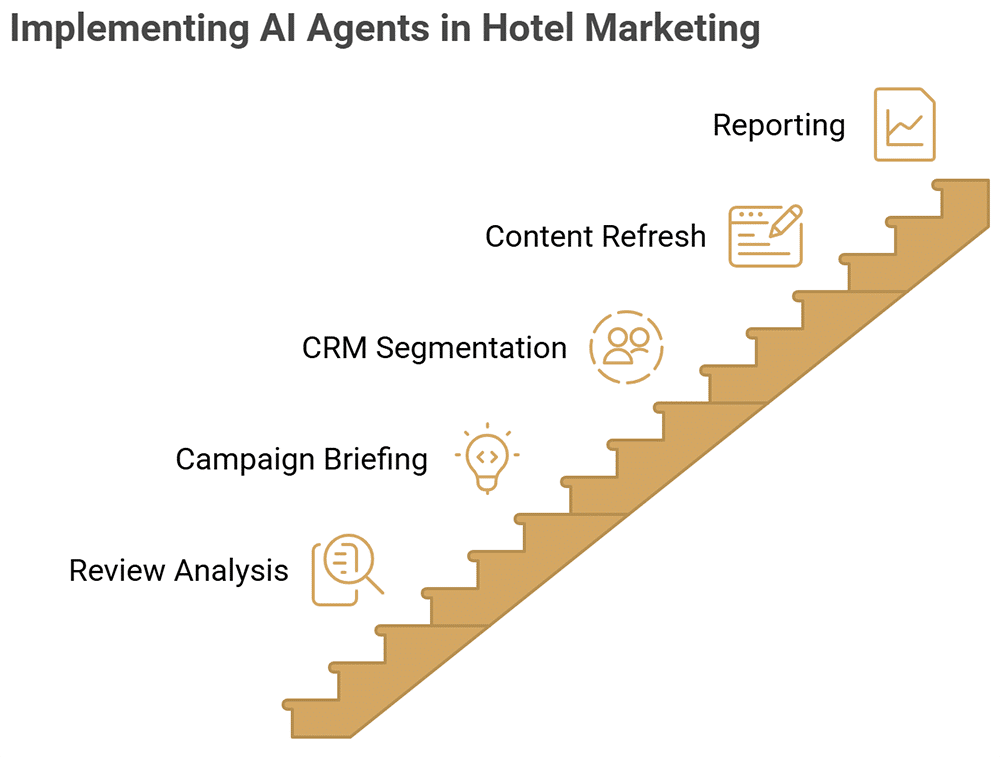
- Targeted Deployment: Do not try to automate everything at once. Start with one high-impact, low-risk task—such as analyzing guest reviews to identify sentiment trends—and expand from there.
Implementing Controls and Ethical Guardrails
As AI agents take on more autonomy, the risk of "hallucinations" or brand-damaging outputs increases. To mitigate this, hotels must establish rigorous control layers:
- Human-in-the-loop (HITL): All external-facing communications, including special offers and review responses, must remain under human approval until the agent proves a near-zero error rate.
- Source Traceability: Every recommendation made by an agent must be traceable to a specific data source (e.g., a specific guest review or a pricing rule).
- Regulatory Compliance: With the FTC’s recent crackdown on fake or deceptive AI-generated reviews, it is essential that all AI-assisted marketing remains transparent and rooted in authentic guest experiences.
Conclusion: The Human-AI Partnership
The goal of AI agents is not to replace the human marketer. Instead, it is to liberate them from the tyranny of repetitive execution. By offloading the "busy work" of segmentation, reporting, and basic content assembly to autonomous agents, marketing directors can refocus on the high-level strategy: empathy, brand positioning, and the creation of unique, memorable guest experiences.
The hotels that will thrive in this new era are not those that use the most AI, but those that use AI to better understand their guests and act with greater precision. By managing the Two-Front model—deployment for efficiency and exposure for discovery—hotels can reclaim their direct booking share and ensure they remain at the center of the traveler’s digital journey.


 Ammar Sabilarrohman
 Rifan Muazin