Rifan Muazin
For many independent bed-and-breakfast owners, the daily operational routine is a high-wire act of administrative multitasking. A typical morning might begin with checking a digital calendar for new overnight reservations, followed immediately by updating room availability on Booking.com, responding to guest inquiries via WhatsApp, processing a deposit for a weekend stay, and coordinating with the housekeeping team to ensure rooms are prepared for the next arrival.
For years, many owners managed this complexity through a combination of physical notebooks, Excel spreadsheets, and a dozen open browser tabs. However, as the hospitality landscape becomes increasingly digitized, these manual systems have become a significant liability. As bookings climb across multiple channels, the margin for human error—such as double bookings or missed payment deadlines—grows exponentially. This shift has pushed modern B&B operators to adopt specialized reservation software, moving away from fragmented workflows toward unified, cloud-based Property Management Systems (PMS).
The Core Problem: The “Disconnected Workflow” Trap
The fundamental challenge for any small-to-mid-sized property is the fragmentation of data. When an owner uses a spreadsheet to track bookings, that file is essentially an "island." It does not automatically communicate with an Online Travel Agency (OTA), nor does it instantly update the guest’s profile or trigger a housekeeping alert.
Manual systems suffer from a lack of real-time synchronization. Consider the scenario of a boutique inn that receives a phone booking at the same time a guest makes a reservation through an OTA. Without a central, automated system, the owner must manually update both the spreadsheet and the OTA extranet. If this update is delayed by even an hour, the risk of a "double booking"—selling the same room to two different guests—becomes a reality. Such incidents are not merely inconvenient; they damage the property’s reputation and can lead to costly penalties from booking platforms.
The Evolution of the B&B Booking Stack
Modern reservation software is no longer just a digital calendar. Today’s systems are sophisticated ecosystems that integrate several critical functions into a single dashboard.
1. The Centralized Reservation Calendar
The cornerstone of any good system is a dynamic, visual calendar. Unlike a static spreadsheet, this interface provides an at-a-glance view of all incoming and outgoing guests, cleaning statuses, and room availability. It allows owners to make changes in real-time, which then ripple across all connected platforms.
2. The Booking Engine: Driving Direct Revenue
A primary goal for any B&B is to reduce dependence on high-commission third-party sites. A web booking engine transforms a property’s website into a sales channel. By allowing guests to check availability and confirm reservations directly, owners can capture commission-free bookings while maintaining full control over the guest relationship from the first click.
3. The Channel Manager: Mastering Distribution
For B&Bs, OTAs like Airbnb, Booking.com, and Expedia are essential for visibility. A channel manager acts as the "traffic controller" for these platforms. It automatically pushes rate and availability updates to all channels simultaneously. When a room is booked on one site, the channel manager instantly closes that availability across all others, effectively eliminating the risk of overbooking.
Comparative Analysis: Manual vs. Automated Operations
The shift toward technology is a move toward operational scalability. The following table highlights the stark contrast in efficiency:
| Workflow | Spreadsheet/Manual Method | Connected B&B System |
|---|---|---|
| Reservations | Manual entry; high error risk | Automatic sync; real-time updates |
| OTA Inventory | Manual updates for each site | Unified, automatic distribution |
| Guest Records | Scattered files; poor history | Centralized CRM and profiles |
| Housekeeping | Verbal or written notes | Digital status alerts in real-time |
| Reporting | Time-consuming manual calculation | Instant, data-driven analytics |
When Manual Systems Cease to be Viable
There is a "tipping point" for every property. Usually, as soon as a B&B manages more than five rooms or begins to cross-list on more than two booking platforms, the human cost of manual management outweighs the subscription cost of a software platform.
The primary implication of continuing to use manual methods is the loss of "opportunity cost." If an owner spends three hours a day updating calendars and sending manual invoices, that is three hours they are not spending on guest services, marketing, or strategic improvements. In the competitive hospitality sector, these hours are the difference between a stagnant property and a growing, profitable business.
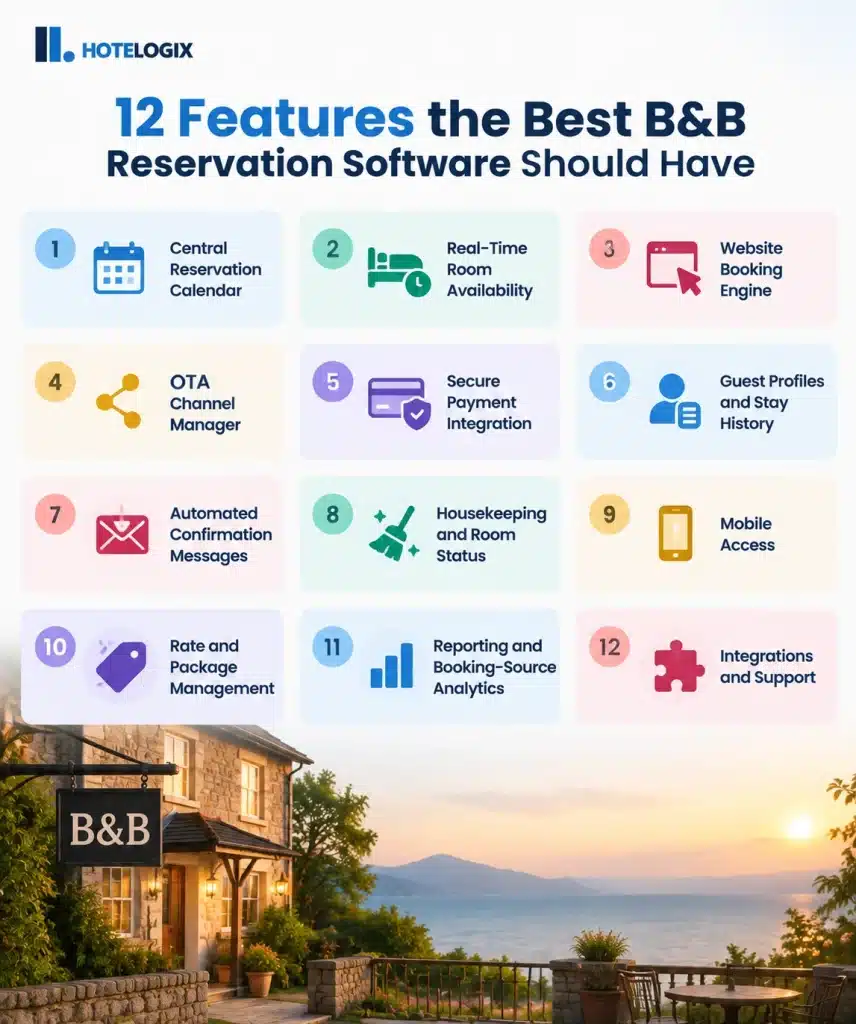
The 12-Point Essential Feature Checklist
When evaluating potential software, owners should look beyond basic functionality and focus on how the system integrates into their daily life. The most robust platforms offer:
- Centralized Calendar: A single source of truth for all bookings.
- Real-Time Inventory: Automatic updates across all channels.
- Direct Booking Engine: Commission-free reservations on the property website.
- Integrated Channel Manager: Seamless connection to major OTAs.
- Automated Payment Processing: Handling of deposits and balances.
- Guest Profile CRM: Storing preferences to personalize future stays.
- Automated Communication: Pre-stay and post-stay messaging.
- Housekeeping Management: Real-time room status updates.
- Mobile Accessibility: Full management capability from a phone or tablet.
- Rate Management: Flexible packages and seasonal pricing tools.
- Comprehensive Reporting: Insight into revenue and occupancy trends.
- Scalable Architecture: Ability to support future growth or multiple properties.
The Economic Implications: Total Cost of Ownership
When selecting software, owners often focus solely on the monthly subscription fee. However, professional operators consider the "Total Cost of Ownership" (TCO). This includes implementation, training, potential integration fees with payment gateways, and the cost of ongoing support.
The most expensive software is often the one that fails to integrate, requiring the owner to pay for multiple, disparate tools. Conversely, an integrated platform like Hotelogix provides a comprehensive suite that covers the entire guest journey—from discovery on an OTA to the final checkout. By consolidating these functions, owners often find that the software pays for itself through time saved and increased direct bookings.
Strategic Implementation: How to Switch Systems
Migrating from a manual system to a cloud-based PMS is a significant step, but it does not need to be disruptive. The industry standard for a smooth transition involves an eight-step roadmap:
- Audit: Identify all current bookings and guest data across all platforms.
- Data Preparation: Standardize room names, rates, and occupancy rules.
- Future-Proofing: Input all confirmed upcoming bookings into the new system.
- Channel Mapping: Sync OTAs, ensuring the new system is the "master" record.
- Direct Channel Setup: Test the website booking engine extensively.
- Financial Configuration: Set up payment gateways and tax rules.
- Team Training: Ensure staff are comfortable with the new interface.
- The "Dry Run": Process a full reservation from inquiry to checkout to verify data flow.
The Role of Hotelogix in the Modern B&B
As independent properties navigate an increasingly complex digital world, platforms like Hotelogix have emerged as the standard for professionalizing B&B operations. By offering a cloud-based, all-in-one solution, Hotelogix addresses the specific pain points of independent operators.
Hotelogix provides a centralized dashboard that eliminates the need to jump between windows. Whether it is managing housekeeping status, handling multi-currency payments, or analyzing which booking source provides the highest RevPAR (Revenue Per Available Room), the platform provides the data-driven insights necessary for long-term growth. Furthermore, as a property grows, the software scales with them, supporting multi-property management for those who wish to expand their portfolio.
Conclusion: Investing in the Future of Hospitality
The transition from manual calendars to an integrated, cloud-based B&B reservation system is not merely a technical upgrade; it is a fundamental shift in business strategy. In an era where guests expect instant confirmation and seamless digital experiences, relying on outdated tools is a risk that most independent owners can no longer afford.
By centralizing reservations, distribution, and operations, owners gain the most valuable asset of all: time. This time can be redirected toward what matters most—delivering the personalized hospitality that makes the B&B experience unique. As the industry continues to evolve, the most successful properties will be those that embrace technology to manage the complexity of the back-end, allowing the front-end guest experience to shine.
For those ready to move beyond the limitations of spreadsheets, the path is clear: invest in a connected ecosystem that offers visibility, control, and the foundation for sustainable growth. Whether you are a three-room boutique or a fifteen-room guesthouse, the right reservation software is the key to unlocking your property’s full potential.


 Ammar Sabilarrohman
 Pevita Pearce