
 Basiran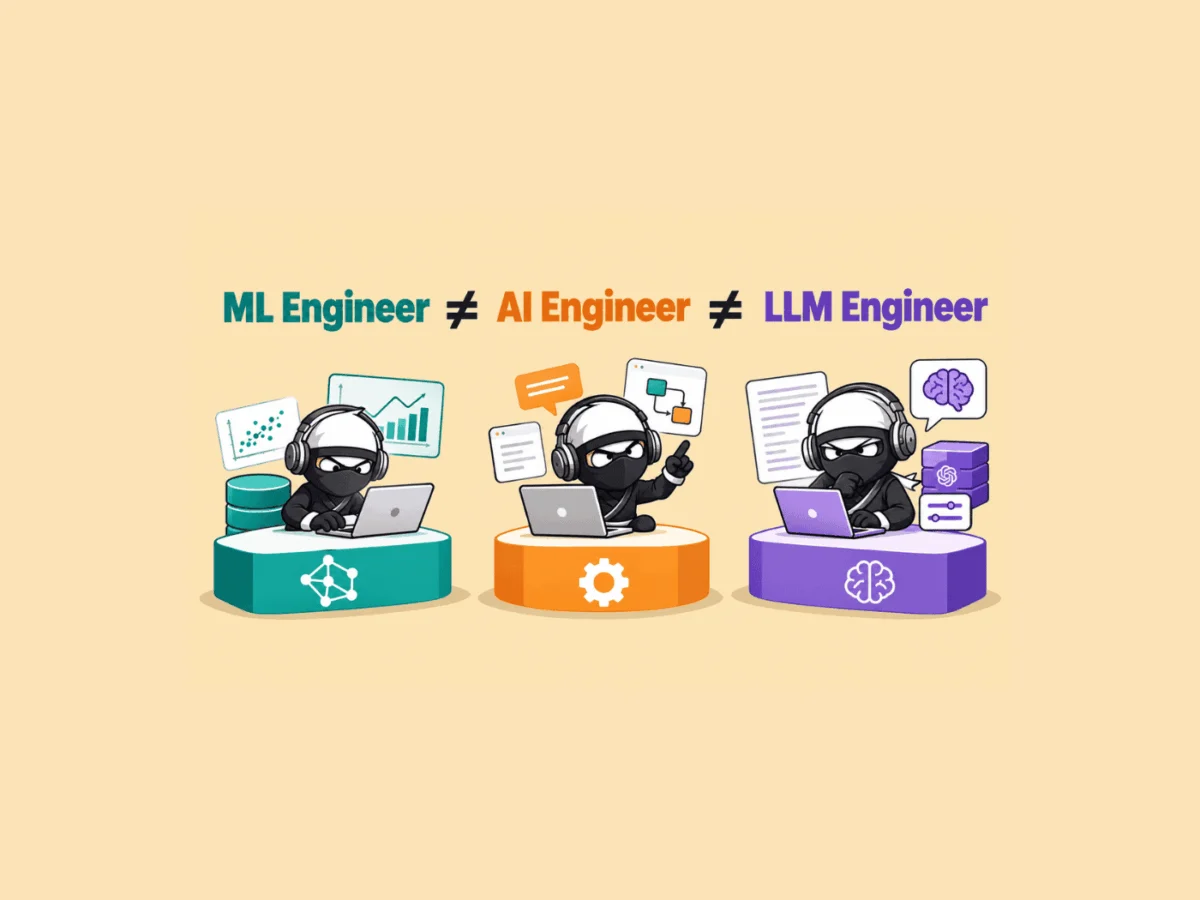
If you spend an hour browsing major job boards today, you will encounter a phenomenon that has become the hallmark of the current technological gold rush: "Title Inflation." A search for "AI" yields a dizzying array of roles—AI Engineer, Applied AI Engineer, LLM Engineer, and Machine Learning (ML) Engineer. Despite the variation in nomenclature, the bullet points often look identical: Python proficiency, familiarity with API keys, a passing mention of "retrieval," and a vague promise of "production reliability."
However, beneath the surface of these near-identical job descriptions lies a chasm of difference in daily responsibilities, technical requirements, and long-term career trajectories. For the job seeker, this ambiguity is not merely a bureaucratic annoyance; it is a professional hazard. Choosing the wrong role based on a buzzword-heavy title can lead to a career path that bears no resemblance to the one you envisioned.
The Core Problem: Why Titles No Longer Match Reality
The confusion stems from a rapidly evolving industry that has yet to standardize its internal taxonomy. Machine learning engineering emerged as a distinct discipline once the deployment of predictive models transitioned from a research curiosity to a core business requirement. However, the generative AI boom of 2022 created a secondary category—the AI Engineer—almost overnight.
Because the industry is still in a "Wild West" phase, companies are assigning titles based on recruitment trends rather than internal function. Two postings with nearly identical responsibilities can carry significantly different salary bands simply because one company opted for the trendy "LLM Engineer" label while another chose the more traditional "Software Engineer – AI."
Defining the Three Pillars of AI Engineering
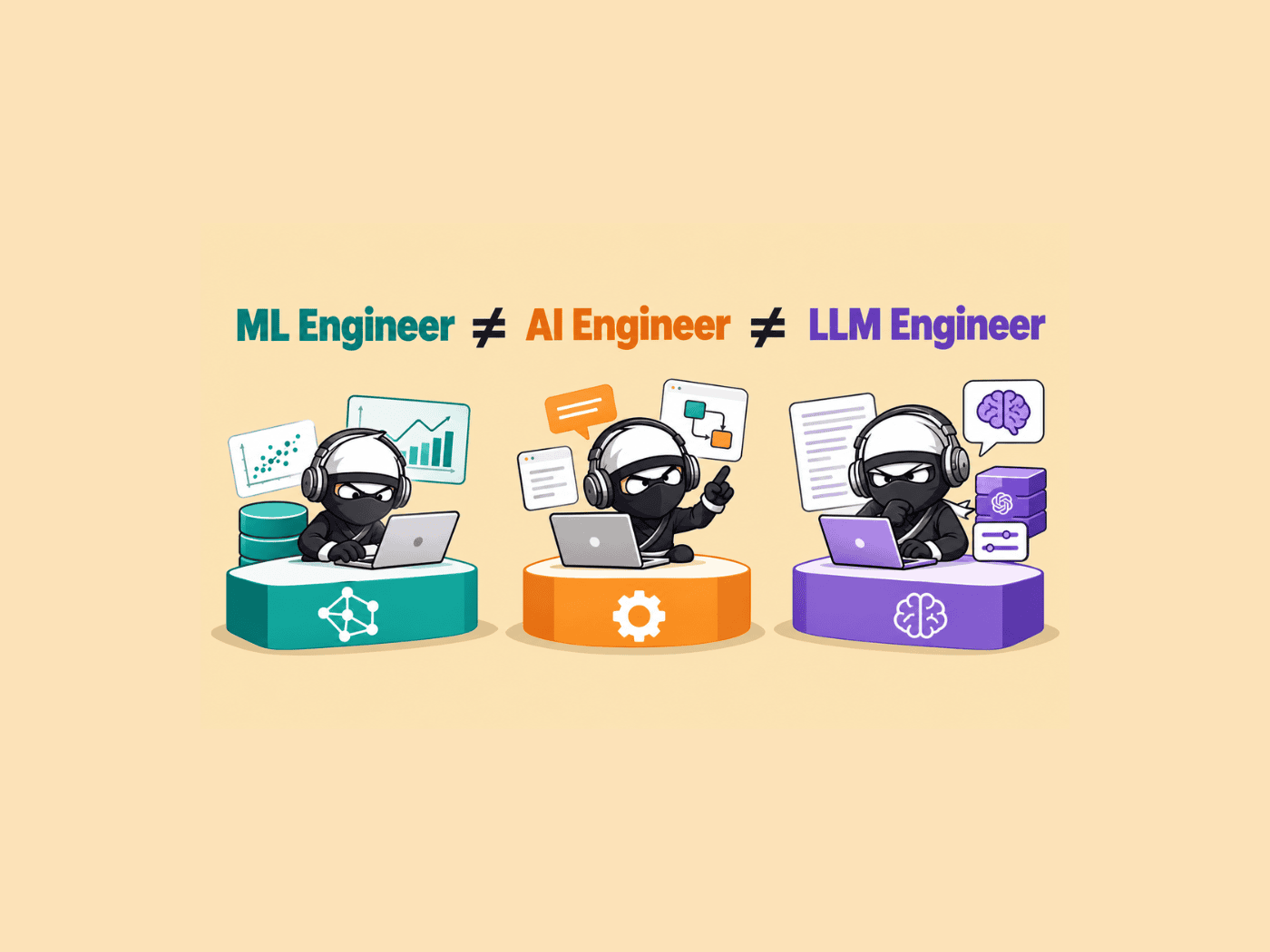
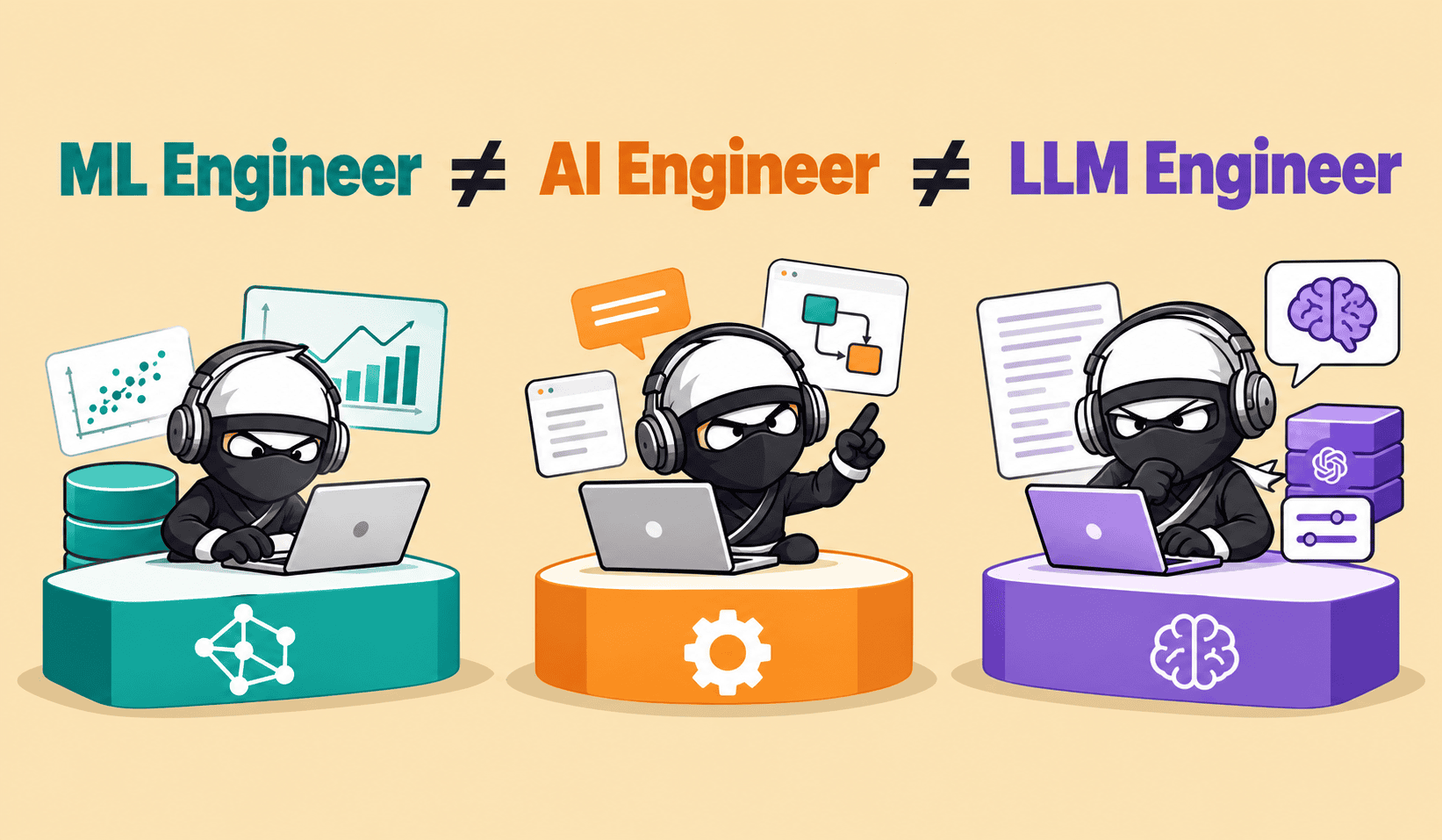
To cut through the noise, we must categorize these roles by their actual output—what they build, own, and maintain six months after the initial deployment.
1. The Machine Learning Engineer: The Architect of Scale
The Machine Learning Engineer sits at the intersection of data science and software engineering. Their primary function is to transform a prototype—often developed by a data scientist—into a robust, scalable production system.
The Core Loop:
- Data Acquisition and Cleansing: The engineer builds pipelines to collect and sanitize raw data.
- Model Training and Selection: They select algorithms, train models using frameworks like PyTorch or TensorFlow, and validate them against rigorous metrics such as RMSE or confusion matrices.
- Deployment and Monitoring: Once in production, the focus shifts to monitoring drift and retraining models as new data arrives.
The reality of this role is that 80% of the work is data-centric rather than algorithm-centric. A model fails not because the algorithm was suboptimal, but because of "bad grain," leaked labels, or poorly designed feature windows.
2. The AI Engineer: The Orchestrator of Intelligence
The AI Engineer operates one step downstream from the ML Engineer. They rarely train models from scratch. Instead, they act as the "connective tissue" between existing, pre-trained models—often accessed via APIs—and real-world product requirements.
The Daily Workflow:
- Prompt Engineering and Retrieval: They spend significant time refining prompts and optimizing RAG (Retrieval-Augmented Generation) pipelines.
- Orchestration: Using tools like LangChain, LangGraph, or LlamaIndex, they chain together various components to create complex, multi-step tasks.
- Evaluation and Guardrails: A major portion of their time is dedicated to monitoring for hallucinations, quality degradation, and ensuring the output meets strict product standards.
Many candidates enter this role expecting to train neural networks, only to discover that their days are spent debugging data pipelines and managing API latencies.
3. The LLM Engineer: The Specialist
The LLM Engineer is essentially an AI Engineer with a specialized focus on Large Language Models. While an AI Engineer might work with computer vision or recommendation systems, the LLM Engineer is tasked with the deep-dive optimization of text-based models.

The Key Differentiator: Fine-Tuning
The defining task of the LLM Engineer is fine-tuning—adjusting a pre-trained model’s weights on a domain-specific dataset. They utilize techniques such as LoRA (Low-Rank Adaptation) or QLoRA to ensure the model performs reliably on niche tasks where general-purpose models fall short.
However, a senior LLM Engineer knows that the best fine-tuning is often the one that never happens. They spend considerable time exhausting other options—improving retrieval quality, adjusting prompt structure, or swapping base models—before resorting to the high cost and maintenance burden of fine-tuning.
Chronology of an Evolving Role
The evolution of these titles tracks the rapid shift in AI accessibility:
- Pre-2015: The "Data Scientist" did it all—from raw data cleaning to building custom, rudimentary models.
- 2015–2021: The rise of "Machine Learning Engineering" as a specialized career path focused on infrastructure, MLOps, and productionizing predictive models.
- 2022–Present: The "Generative AI" explosion. The shift from training models (high compute, high data, research-heavy) to consuming models (API-driven, orchestration-heavy) birthed the AI and LLM Engineer roles.
Supporting Data: Salary and Organizational Impact
The lack of standardization has direct implications for compensation. According to industry analysis, salary bands for these roles are often disconnected from the actual technical complexity of the work. A "GenAI Engineer" at a boutique agency may command a higher salary than a "Machine Learning Engineer" at a legacy enterprise, despite the former performing tasks that are significantly less rigorous in terms of mathematical modeling and infrastructure stability.

Furthermore, organizational structure dictates the scope of the role:
- Small Startups: One person often covers all three domains—training the model, building the retrieval system, and shipping the feature.
- Large Corporations: Responsibilities are fragmented into specialized silos: AI infrastructure, model quality, forward-deployed engineering, and research.
Official Industry Perspectives
Industry experts and talent acquisition specialists emphasize that the "title trap" is a symptom of a market that is moving faster than its HR departments. When companies post roles, they are often guessing at the market rate for the skills they need.
"The best way to evaluate a role," says Nate Rosidi, founder of StrataScratch, "is to ignore the title and read the bullet points. Ask yourself: What will I be building in the first 90 days? What will I be responsible for after the launch? If the answer is ‘monitoring API calls,’ you are an AI Engineer. If the answer is ‘training a recommendation model,’ you are an ML Engineer."
Implications for Career Strategy
For the aspiring professional, this environment requires a shift in strategy. Instead of chasing titles, focus on building a robust, foundational skill set that bridges the gap between these roles.

- Prioritize Fundamentals: Regardless of the title, the interview bar remains stubbornly focused on SQL, data shaping, and the ability to define a problem. Memorizing a specific library is less valuable than understanding how to avoid data leakage or how to evaluate a model’s output for bias.
- Focus on "The Loop": During interviews, ask the team about their development lifecycle. Do they spend their time cleaning data, or do they spend their time connecting LLM APIs? The answer will reveal the true nature of the role.
- Ignore the Hype: Remember that titles are transient. Companies rename these roles faster than they update their interview criteria. A strong foundation in systems design and data architecture will keep you relevant regardless of whether the industry shifts from "AI Engineer" to a new buzzword next year.
Conclusion
The divide between ML Engineers, AI Engineers, and LLM Engineers is real, but it is often obscured by a marketing-driven approach to hiring. A Machine Learning Engineer builds and ships models; an AI Engineer builds the product around a model; and an LLM Engineer optimizes that model through fine-tuning and specific linguistic domain mastery.
The next time you see a job posting, look past the title. The "official" name of the role is merely the wrapper; the description of the day-to-day work is the product. Choose your career path based on the problems you want to solve, the systems you want to own, and the technical challenges that excite you, rather than the temporary status associated with a trending job title.


 Evan Lee Salim
 Ammar Sabilarrohman




