
 Sagoh
Sagoh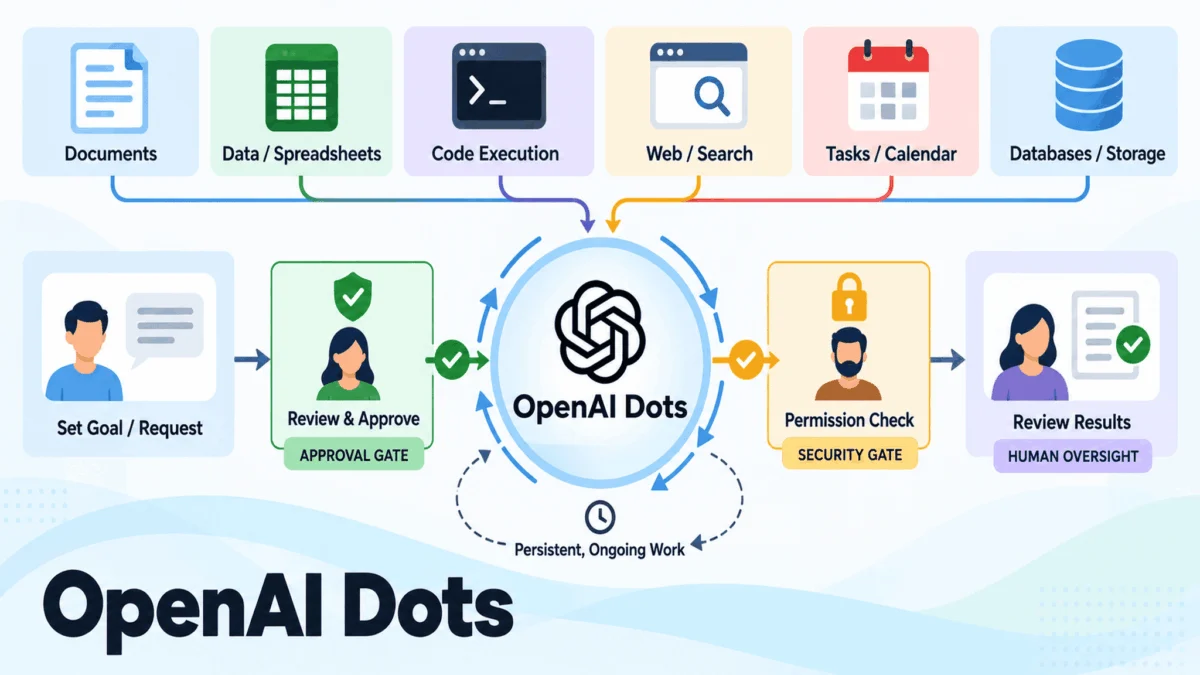
On September 29, 2026, the artificial intelligence landscape shifted from the era of the chatbot to the era of the collaborator. At its DevDay 2026 conference, OpenAI unveiled "Dots"—a suite of autonomous, persistent AI agents designed to function as digital coworkers rather than mere reactive assistants.
For the data science and machine learning community, this announcement represents more than a product update; it signals a fundamental change in how AI integrates into the professional stack. Unlike previous iterations of large language models (LLMs) that require a human to pull the lever for every action, Dots are built to live in the background, utilizing dedicated cloud compute to bridge the gap between human intent and automated execution.
Main Facts: What Are Dots?
At its core, a Dot is an autonomous agent powered by OpenAI’s new GPT-6 Astra model. Unlike standard ChatGPT, which operates on a request-response basis and terminates its state upon the closing of a browser tab, a Dot is "always-on." It operates on its own dedicated cloud environment, maintaining a continuous connection to over 4,000 third-party applications.
Key Capabilities
- Persistence: Dots retain context across sessions. They do not require a "reset" or a re-explanation of project parameters. They learn from ongoing feedback loops, effectively building a "mental model" of the user’s preferences and workflows over time.
- Proactive Execution: Dots are designed to pursue standing goals. If a user sets a goal—such as "monitor client feedback and draft pull requests for identified bugs"—the Dot will proactively monitor connected communication channels, pull relevant data, and draft deliverables for human approval.
- Multi-Platform Reachability: Users can interact with their Dots via ChatGPT, Slack, Microsoft Teams, or voice interfaces, allowing for a seamless integration into existing enterprise communication ecosystems.
Chronology: The Evolution Toward Agency
The release of Dots is the culmination of a multi-year trajectory in the AI industry. To understand the significance of this moment, one must look at the progression of OpenAI’s feature sets:
- 2022-2023 (The Chatbot Phase): The introduction of ChatGPT marked the first widespread adoption of LLMs. Interaction was entirely synchronous and transient; the AI possessed no memory of past sessions and no capacity to act outside the chat window.
- 2024 (The Tool-Use Phase): OpenAI introduced "GPTs" and initial API-based tool integrations. This allowed models to search the web or run Python code, but the model remained a reactive participant, waiting for a prompt to trigger a tool.
- 2025 (The Reliability Push): The industry struggled with "brittleness"—the tendency of models to fail during long-chain reasoning tasks. Agents would often hallucinate or lose the thread of complex multi-step workflows.
- 2026 (The Agentic Era): The launch of GPT-6 Astra and the Dots architecture finally addressed the reliability gap. By decoupling the agent’s compute from the user’s device and implementing long-term memory, OpenAI has moved the AI from a tool you "use" to a coworker you "delegate to."
Supporting Data and Technical Architecture
The technical differentiation of Dots lies in the architecture of GPT-6 Astra. While previous models struggled with drift—the tendency to deviate from a task after several steps—Astra is optimized for sustained, multi-tool orchestration.
The "Delegation Model"
OpenAI has framed the use case around the concept of "high-agency delegation." In a professional environment, a data scientist might offload the "grunt work"—such as chasing status updates on Jira, normalizing data schemas from disparate email threads, or summarizing long-form technical discussions.
Initial testers have reported that Dots can handle tasks that previously required human oversight. One case study involves an agent that autonomously monitors incoming invoices, extracts metadata from emails, and drafts ready-to-send documents. Another involves a developer-centric Dot that watches customer feedback loops, scopes potential patches, builds them in a sandbox, and prepares a pull request with an accompanying video walk-through.
Official Responses and Strategic Positioning
During the DevDay keynote, Sam Altman, CEO of OpenAI, emphasized that the goal of Dots is not to replace human decision-making, but to expand the "span of control" of a single engineer or data scientist.
"The best way to think about a Dot," Altman noted, "is as a chief of staff that never sleeps. You provide the intent; the Dot manages the infrastructure of the task."
However, OpenAI has been careful to temper expectations regarding autonomy. In their official documentation, they explicitly state that "Dots can still make mistakes." This is not merely a legal disclaimer; it is a technical reality of probabilistic systems. The company recommends that all "consequential work"—deploying code, authorizing payments, or sensitive data analysis—remains behind a "human-in-the-loop" approval gate.
Implications: The Shift in Practitioner Responsibility
For the data science community, the arrival of Dots necessitates a shift from being operators to being architects of agency.
1. From Prompt Engineering to Workflow Design
The skill set for working with AI is shifting. Writing a perfect prompt is becoming less important than defining a robust workflow. Practitioners must now focus on:
- Defining Boundaries: Setting explicit constraints on what an agent can access and change.
- Setting Checkpoints: Designing systems where the agent provides intermediate progress reports for human review.
- Error Handling: Building "fail-safe" mechanisms in the agent’s instructions for when it encounters ambiguous data.
2. The Privacy and Security Frontier
The implications for data privacy are profound. Because Dots retain memory of your interactions and data from connected apps, they create a new surface area for security risks. Currently, users have limited ability to audit or purge specific memories stored by their Dots. For practitioners handling HIPAA-compliant data, proprietary trade secrets, or client-sensitive financial information, the lack of granular "forgetting" features and specific enterprise-grade compliance documentation represents a significant barrier to entry.
3. The "Clarity Tax"
The most interesting implication of the Dots launch is the "clarity tax." To effectively delegate to an agent, a professional must be able to describe their workflow with high precision. If a data scientist cannot clearly define the steps of their data cleaning pipeline, they cannot successfully delegate it to a Dot. In this sense, the arrival of agents is forcing professionals to become better at documenting and articulating their own internal cognitive processes.
The Path Forward: Informed Skepticism
While the promise of Dots is significant, the current availability is restricted. Access is limited to ChatGPT Pro ($100/month) and Business Premium users, with notably significant exclusions for users in the EEA, Switzerland, and the UK.
For the average data professional, the immediate response should be one of informed skepticism. Before integrating a Dot into a production-critical environment, teams must conduct a thorough "audit of the brief."
- Which tasks are truly delegatable? Focus on high-volume, low-intellectual-risk tasks (e.g., status reporting, documentation, basic data gathering).
- What are the stopping conditions? If the agent encounters a data anomaly, does it proceed or pause? The default must be to pause.
- How does this impact the audit trail? In highly regulated fields, the lack of transparency in how the agent reached a conclusion could be a liability.
Conclusion: The Agent as a Mirror
The most profound realization from the launch of Dots is that the agent is only as capable as the brief it is given. We are entering a phase where the quality of our output will be determined by our ability to act as managers of synthetic intelligence.
For the data scientist who treats the Dot as a magic box, the outcome will likely be frustration and expensive errors. For the professional who treats the Dot as a junior engineer requiring clear instructions, explicit constraints, and regular, rigorous code reviews, the potential is transformative.
The always-on agent is finally here. The question is no longer what the AI can do, but whether we possess the discipline to define our work well enough to let it help us. As we integrate these tools, the most important work will happen before the code is even run—in the quiet, careful effort of defining exactly what we want our digital coworkers to accomplish.


 Evan Lee Salim
 Ammar Sabilarrohman




