 Pevita Pearce
In a landmark victory for international cybersecurity, a multi-agency coalition led by the Federal Bureau of Investigation (FBI), in strategic partnership with Google and Black Lotus Labs, has successfully neutralized a sophisticated, China-based "phishing-as-a-service" (PhaaS) operation known as "Outsider Enterprise." The operation, which had been functional since at least 2023, utilized advanced artificial intelligence and automated infrastructure to orchestrate a global campaign of fraud, resulting in the theft of an estimated $1.9 billion.
The takedown, executed under the umbrella of the FBI’s broader "Operation Riptide," marks one of the most significant interventions against the rising tide of AI-augmented cybercrime. By seizing command-and-control servers, cryptocurrency wallets, and internal communications, law enforcement has dealt a severe blow to an organization that had successfully compromised millions of credit card records.
The Mechanics of Outsider Enterprise: A New Era of Cybercrime
Outsider Enterprise operated not merely as a group of individual hackers, but as a robust, scalable business entity. By adopting the "phishing-as-a-service" model, the group lowered the barrier to entry for lower-level criminals, providing them with the necessary "phishing kits" to launch high-volume, convincing attacks against unsuspecting consumers.
AI-Driven Impersonation
The core of the operation’s success lay in its ability to leverage AI to craft highly convincing fraudulent communications. These kits were designed to mimic trusted global brands, including financial institutions and major service providers. Through the mass distribution of SMS messages—often referred to as "smishing"—the group targeted subscribers of major telecommunications carriers, including AT&T, T-Mobile, and Verizon.
The AI component allowed the threat actors to generate localized, grammatically accurate, and contextually relevant messages, bypassing traditional spam filters and increasing the "click-through" rate significantly. Google’s internal data revealed that in just a two-week window in May, the infrastructure pushed out over 2.5 million fraudulent SMS messages to Android users, demonstrating the sheer velocity of the operation.

Chronology of a Global Takedown
The dismantling of Outsider Enterprise was the culmination of months of meticulous intelligence gathering, tracking, and inter-agency cooperation.
- 2023: Inception and Expansion: Outsider Enterprise begins scaling its operations, moving from small-scale phishing to a massive, automated infrastructure. It establishes a presence on Telegram, where it coordinates with "clients" who purchase access to its phishing kits.
- Early 2026: Intelligence Convergence: Google’s security teams, alongside Black Lotus Labs, identify a pattern of 9,000 fake websites and over a million fraudulent URLs linked to the same underlying infrastructure. They begin sharing telemetry with the FBI.
- May 2026: The Surge: The operation hits a peak in activity, sending millions of malicious SMS messages. The volume of reports from Android users regarding fraudulent messages triggers an accelerated response from tech giants and federal law enforcement.
- Late Spring 2026: Operation Riptide Execution: The FBI initiates a coordinated technical and legal strike. Federal agents seize administration servers, a Shopify storefront used to facilitate illicit transactions, and a critical Telegram bot that contained the identities of the service’s customers.
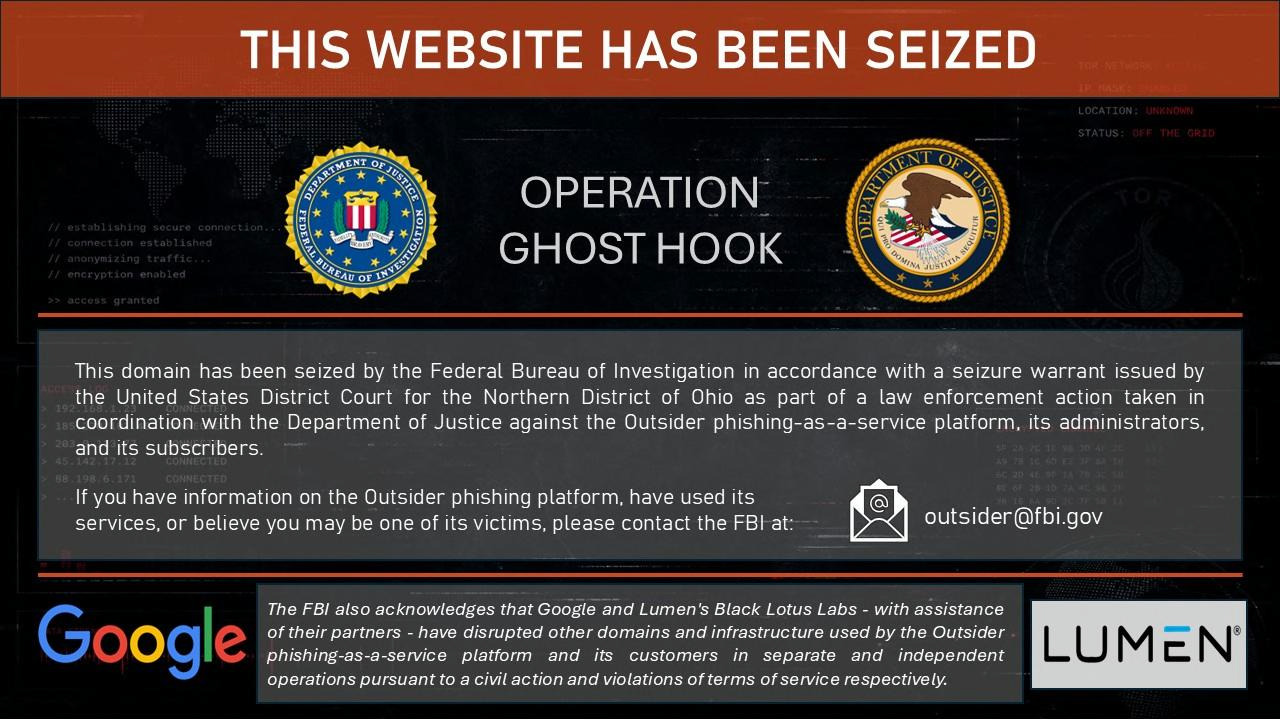
- Post-Takedown: Thousands of domains associated with Outsider Enterprise are redirected to an official FBI "seized" splash page. Legal teams from Google file civil lawsuits to permanently dismantle the remaining infrastructure.
Supporting Data: The Scale of the Damage
The economic and social impact of Outsider Enterprise is staggering. According to investigations, the group’s activities resulted in the theft of over 3.8 million credit card records. When aggregated, these breaches have caused an estimated $1.9 billion in financial losses for consumers and financial institutions globally.
The operational scale was equally impressive from a technical standpoint. By the time of the takedown, the syndicate had deployed:
- 1,000,000+: Individual fraudulent URLs.
- 9,000+: Unique fake websites designed to harvest credentials.
- 2.5 Million: SMS messages sent in a single two-week period.
- $100,000+: Cryptocurrency (USDT) seized from active payment wallets.
While the financial loss is quantified in the billions, the reputational damage to the impersonated brands and the erosion of consumer trust in digital communication channels represent a secondary, yet equally damaging, cost.
Official Responses and Strategic Collaboration
The success of the intervention is being hailed as a model for future public-private partnerships in cybersecurity.

Google’s Aggressive Stance
Google has emerged as a primary driver in the legal efforts to combat this group. By filing civil lawsuits, the company is not only seeking to hold the operators accountable but is also setting a precedent for using the court system to target the infrastructure of cybercrime syndicates.
"Our civil lawsuit targets an organized cybercrime operation known as the ‘Outsider Enterprise,’" a spokesperson for Google stated. "Based in China and coordinating through Telegram, this network distributes ‘phishing kits’ that allow criminals to blast out fake text campaigns that look like they’re from Google and other trusted brands."
FBI and Law Enforcement Strategy
The FBI has emphasized that the takedown is merely one part of Operation Riptide. The goal is to move beyond the traditional "whack-a-mole" approach of blocking individual domains and instead target the "choke points" of the cybercriminal lifecycle—specifically, their payment infrastructure and administrative control panels. By seizing the Telegram bot used for customer support, the FBI has gained invaluable intelligence on the threat actors’ clients, potentially opening the door for further arrests and legal action.
Implications for the Future of Cybersecurity
The Outsider Enterprise case serves as a wake-up call for both industry regulators and the general public. It highlights three critical shifts in the threat landscape:
1. The Proliferation of PhaaS
The "Phishing-as-a-Service" model allows even unskilled individuals to become significant threats. When sophisticated tools are packaged and sold, the barrier to entry for cybercrime effectively vanishes. Law enforcement must now focus on the distributors of these kits, rather than just the end-users.
2. The Need for Legislative Reform
Google and other industry stakeholders are actively pushing for the passage of the "Stop SCAMS Act" in the U.S. Congress. This bipartisan legislation is designed to mandate a unified national strategy, requiring the FBI to lead a coordinated effort that bridges the gap between private tech companies, federal law enforcement, and state-level agencies. The act aims to streamline the process of tracking, disrupting, and preventing these types of operations before they reach the scale of a multi-billion-dollar enterprise.
3. The Role of AI in Defense
While AI is being used to fuel scams, it is also the primary tool for defense. Google noted that its AI-powered messaging protections currently block over 10 billion malicious messages every month. The future of consumer safety relies on this "AI vs. AI" battle, where automated systems proactively scan and neutralize threats before they ever reach a user’s device.
Conclusion: A Persistent Threat
While the dismantling of Outsider Enterprise is a major win, cybersecurity experts warn that the threat is far from over. Cybercrime operations are increasingly resilient, often fragmenting into smaller cells or rebranding under different names once their infrastructure is compromised.
For the average consumer, the lesson is clear: vigilance remains the first line of defense. Even as tech companies and the FBI employ advanced technical countermeasures, the human element—the tendency to trust a seemingly legitimate SMS—remains the primary target. As Operation Riptide continues, the collaboration between the private sector and federal authorities will remain essential in staying one step ahead of the evolving, AI-enhanced threats that seek to undermine our digital economy.

 Ali Ikhwan
 Sagoh
Sagoh