
 Suro Senen
In the competitive landscape of hospitality, a hotel’s commercial success is rarely the result of chance. Instead, it is the product of a well-orchestrated corporate sales strategy—a deliberate plan designed to secure, price, and scale bookings from business travelers. While leisure demand often drives weekend occupancy, corporate demand provides the crucial midweek foundation that stabilizes a property’s revenue and dictates its financial health.
Modern corporate sales are no longer about merely responding to Requests for Proposals (RFPs) with a "hope-for-the-best" mentality. Today, the most successful hotels treat corporate accounts as a curated portfolio, balancing volume and yield to drive consistent growth.
The Strategic Shift: From Reactive Bidding to Portfolio Management
The most significant pitfall for many hotels is "reactive selling." This occurs when a sales team waits for the annual RFP season to arrive, bids on every opportunity in sight, and measures success by the sheer number of rates loaded into the system. This approach often results in "hollow occupancy"—filling rooms with low-rated business that generates minimal profit, often eclipsed by the administrative costs of rate-loading and account maintenance.
A sophisticated corporate sales strategy, by contrast, treats the corporate segment as a managed portfolio. This requires identifying companies with recurring, predictable room-night demand, negotiating rates that protect yield, and managing those relationships with the same intensity as a high-stakes investment fund.
The Four Pillars of Pre-RFP Preparation
Before the annual RFP season kicks off, revenue leaders should answer four critical questions:
- Who is our ideal corporate partner? (Which companies align with our location, service level, and price point?)
- What is our capacity for negotiated business? (How many rooms can we afford to sell at a discount before it cannibalizes high-yield transient demand?)
- Are our distribution channels optimized? (Can the corporate traveler easily find and book our negotiated rates?)
- How do we measure success? (Are we tracking ADR, materialization, and contribution to midweek occupancy?)
Why Corporate Business Remains the Bedrock of Revenue
Despite the rise of remote work and virtual meetings, business travel is not dying; it is evolving. According to the Global Business Travel Association (GBTA), global business travel spending is projected to hit a record $1.71 trillion by 2026, marking a 7.2 percent year-over-year increase.

While the total volume of trips is growing at a slower pace (1.3 percent), the spend per trip is rising. As Suzanne Neufang, CEO of GBTA, noted, "The big story this year is that companies haven’t stepped away from travel, but they are increasingly more selective and productivity-focused."
For the hotelier, this shift is an opportunity. Corporate buyers are consolidating their preferred hotel programs, choosing fewer suppliers that offer reliability, consistent rates, and verifiable value. Hotels that fail to demonstrate these traits risk being cut from the program entirely. Conversely, those that prove their value become the "preferred choice," securing stable midweek occupancy that acts as a hedge against the volatility of the leisure market.
Building the Account Portfolio: A Step-by-Step Approach
Building a successful portfolio requires identifying demand generators within a 15-minute radius of your property.
1. Identifying Prospects
Begin by mapping your local ecosystem. Are there major office parks, hospitals, universities, or industrial hubs nearby? For an independent property, the best prospects are often not global corporations, but niche players. For example, a property near a port may find more value in partnering with marine engineering firms that require long-term project stays rather than large multinationals with global, low-margin hotel programs.
2. Qualifying the Lead
Not every RFP is worth the time it takes to complete. Before bidding, score the opportunity based on:
- Volume: Does the account provide enough room nights to justify the administrative burden?
- Timing: Does the demand fall on your need periods (e.g., Tuesday/Wednesday) or your high-demand periods?
- Rate Tolerance: Is the company seeking a true partnership, or are they solely focused on driving the rate to the lowest possible denominator?
3. The Balanced Mix
Aim for a "balanced portfolio" structure:

- Anchor Accounts: 3–5 high-volume accounts (300+ room nights/year) that guarantee a base level of business.
- Growth Accounts: 10–15 mid-sized accounts (100–300 room nights/year).
- Tactical Tail: Smaller, ad-hoc accounts that use a flexible corporate rate rather than a rigid contract.
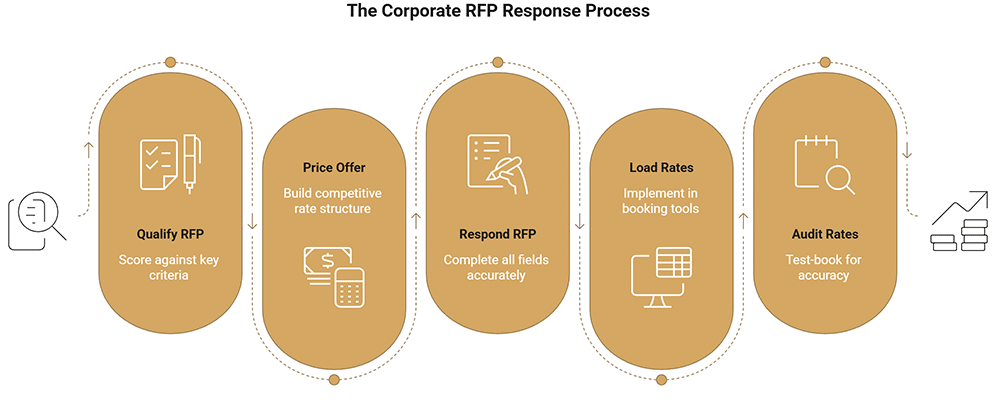
The Corporate RFP Process: A Chronological Roadmap
Success in the RFP process requires discipline and, most importantly, meeting deadlines.
| Step | Action | Timing |
|---|---|---|
| Qualify | Score RFP against room night potential and need-period fit | Within 48 hours |
| Price | Build the offer: rates, inclusions, and blackout dates | Before deadline |
| Respond | Complete all fields; incomplete bids are often auto-rejected | Platform deadline |
| Load | Load rates into GDS and client booking tools | Pre-January 1 |
| Audit | Test-book the rate to ensure accuracy | First 2 weeks of Jan |
| Review | Compare actual production vs. estimated volume | Quarterly |
Navigating Rate Structures: LRA vs. NLRA
The debate between Last Room Availability (LRA) and Non-Last Room Availability (NLRA) is at the heart of yield management.
- LRA: Guarantees the client their rate as long as a standard room is available. This is a powerful tool for winning major contracts, but it carries the risk of selling a room at a discount on a night when you could have sold it for double the price to a transient guest.
- NLRA: Allows the hotel to close out the rate during high-demand periods. This is essential for protecting yield.
Strategic Advice: Reserve LRA only for high-volume "anchor" accounts. For smaller or less predictable accounts, prioritize NLRA or dynamic pricing (a fixed discount off your Best Available Rate), which naturally fluctuates with market demand.
The Role of GDS Visibility and Technology
In the world of managed travel, if you aren’t in the Global Distribution System (GDS), you don’t exist. Half of all corporate bookings flow through Travel Management Companies (TMCs) that pull content directly from the GDS.
For independent hotels, this requires a partnership with a representation company or a GDS connectivity provider. However, connectivity is not a "set it and forget it" solution. You must conduct quarterly audits: have a partner test-book your hotel through a TMC portal to ensure the negotiated rate, room type, and inclusions (like breakfast or Wi-Fi) appear exactly as promised. High "look-to-book" ratios on the GDS are a red flag, signaling that your content is either misleading or incorrectly displayed.
Unlocking Hidden Revenue: Meetings and MICE
A common error is siloing corporate sales from MICE (Meetings, Incentives, Conferences, and Exhibitions) sales. A corporate account isn’t just a source of individual room nights; it is a potential source of monthly training sessions, project team housing, and executive retreats.
During every quarterly business review (QBR), ask the travel manager: "Who within your company handles project team logistics and training events?" Often, these meetings are booked by an entirely different department. By positioning your hotel as a full-service partner for both travel and events, you increase the total value of the account without the cost of acquiring a new client.
Conclusion: The Professional Path Forward
Corporate sales is a function of relationships and data. It requires the courage to walk away from unprofitable RFPs and the diligence to audit every rate loaded into your system. As the market continues to evolve toward more selective, productivity-focused travel, the hotels that win will be those that view their corporate accounts not as a stack of contracts, but as a strategic portfolio of partnerships.
By focusing on midweek occupancy, protecting your yield through smart rate structures, and leveraging the power of GDS visibility, you can turn your corporate sales department into a consistent, reliable engine for long-term revenue growth. Whether you are a large property or a boutique independent hotel, the goal remains the same: identify the right partners, provide undeniable value, and manage the portfolio for maximum profitability.


 Evan Lee Salim
 Iffa Jayyana