 Nana
Nana
For many hotel operators, the marketing budget is often viewed as a discretionary expense—a variable line item to be trimmed when occupancy targets are met or slashed when the market softens. However, leading industry experts argue that this perspective is fundamentally flawed. A hotel marketing budget is not a cost center; it is a vital investment in demand generation. Every percentage point underspent on direct acquisition is effectively a transfer of wealth to third-party intermediaries, often at a significantly higher commission rate.
To navigate the complexities of modern distribution, hoteliers must transition from viewing marketing as "overhead" to treating it as a calculated, data-driven revenue strategy.
The Core Definition: What Constitutes a Marketing Budget?
A professional hotel marketing budget must be rigorously defined to be effective. It encompasses the various campaigns, digital platforms, content strategies, strategic partnerships, and essential technologies required to influence booking demand. This includes paid search, metasearch, social media advertising, website maintenance, booking engine optimization, SEO, AI-driven content, email marketing, CRM programs, professional photography, and public relations.
The "USALI" Trap
The primary obstacle to effective budgeting often lies in accounting structures. Under the Uniform System of Accounts for the Lodging Industry (USALI), the "Sales and Marketing" line on a Profit & Loss (P&L) statement is frequently bloated. It often bundles fixed costs—such as payroll, franchise fees, and mandatory loyalty program contributions—with actual, performance-based marketing activity.
According to research from CBRE, franchise-related fees alone account for nearly 49 percent of the average sales and marketing department costs at U.S. hotels. This creates an illusion of a healthy marketing department, while in reality, the property may be spending almost nothing on active, discretionary demand generation. To manage a budget effectively, hoteliers must categorize expenses into three distinct buckets:

- People: Payroll, benefits, and staff training.
- Obligations: Franchise, brand, and mandatory loyalty program fees.
- True Marketing: Campaigns, channels, content, and technology.
Only the third bucket represents the budget that can be actively managed and optimized.
Benchmarking: How Much Should You Spend?
While industry averages vary, the consensus among revenue experts is that hotels should commit 4 to 8 percent of total revenue to "true marketing" (excluding payroll and franchise obligations).
- Stable Markets: Established properties in non-competitive environments may operate efficiently at the 4 percent floor.
- Competitive/Growth Markets: Properties in dense urban centers, those undergoing repositioning after renovations, or those struggling with excessive OTA dependency should look toward the 8 percent ceiling.
Context is essential. Compared to the broader retail and consumer goods sectors, where marketing spend frequently sits at 7 to 8 percent of revenue, the hospitality industry—which deals with a highly perishable product—often under-invests. Hospitality strategist Max Starkov has long championed this, noting that hotels often fear "risky" marketing spend while simultaneously paying 20-plus percent in commissions to Online Travel Agencies (OTAs) without a second thought. If your direct marketing spend is below 4 percent and your OTA share exceeds 50 percent, you are not saving money; you are simply paying a higher premium for the same demand.
Strategic Allocation: The Paid, Owned, and Earned Framework
Allocating the budget requires a balanced approach across three distinct pillars. A common mistake is over-indexing on the bottom of the funnel (last-minute paid search) at the expense of long-term brand equity.
1. Paid Media (50–60% of Budget)
This includes metasearch, paid search (SEM), social advertising, and retargeting. Its primary function is to capture existing demand and defend the hotel’s brand name from OTA bidding. This is your "defensive" layer.
2. Owned Channels (25–35% of Budget)
This involves your website, booking engine optimization, SEO, AI-search content, and CRM/email marketing. These channels convert the demand you’ve already paid for and generate repeat business at near-zero incremental cost. This is your "profitability" layer.
3. Earned Media (10–15% of Budget)
This covers PR, review management, influencer partnerships, and word-of-mouth programs. This builds demand that arrives without a direct per-booking cost, providing long-term sustainability.
When to Increase the Budget: The Four Triggers
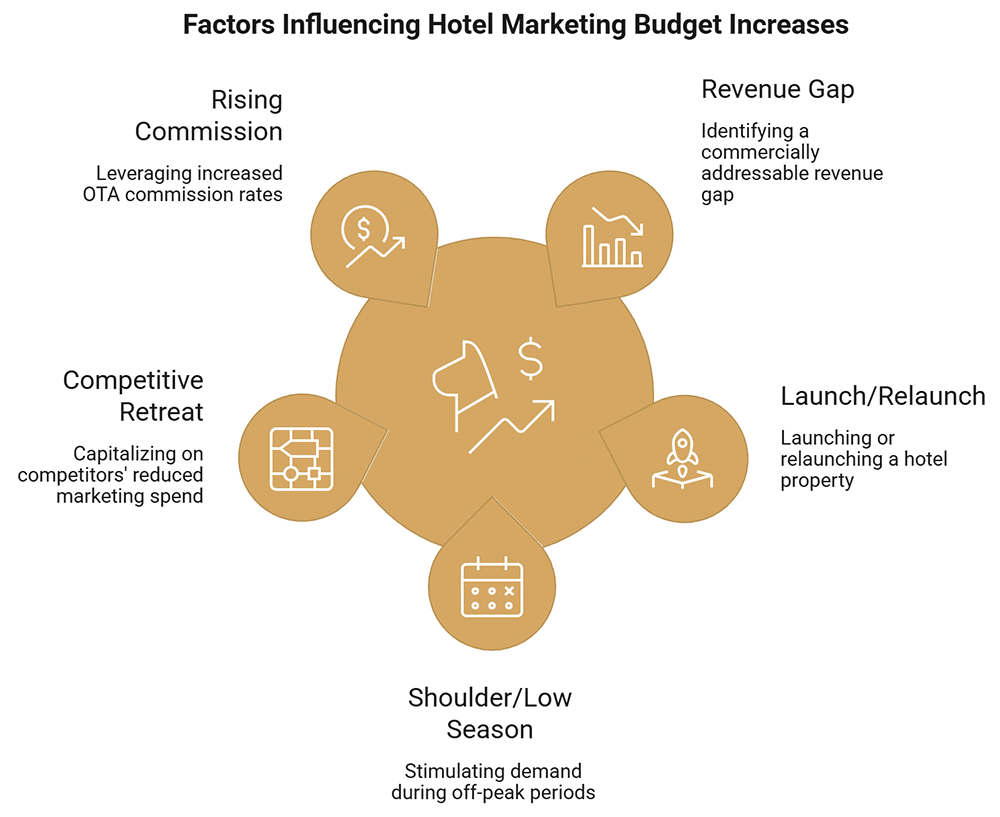
Increasing the marketing budget should never be a reaction to a bad month. It must be a strategic move to address a quantifiable revenue gap. Four specific triggers justify an increase:
- New Market Entry/Launch: Introducing a property to a market where brand awareness is zero.
- Repositioning: Communicating a shift in product or service level to a new audience.
- OTA Displacement: A deliberate, phased campaign to shift a specific percentage of bookings from high-commission channels to direct channels.
- Under-utilized Inventory: Targeting specific shoulder periods where the "contribution-per-room" justifies the acquisition cost.
The calculation is simple: If you need 300 incremental room nights, each contributing $120 after variable costs, you are chasing $36,000 in potential contribution. At a 15 percent acquisition ceiling, you have a defensible marketing allowance of $5,400. "We need more visibility" is not a business case; "We have a $5,400 acquisition budget to capture $36,000 in revenue" is.
Measuring Performance: Beyond ROAS
Return on Ad Spend (ROAS) is a popular metric, but it is often misleading because it measures attributed revenue rather than actual profit. A campaign might show a high ROAS while generating highly discounted bookings, high cancellation rates, or bookings that are expensive to service.
A robust scorecard should track:
- Spend vs. Plan: Monthly adherence to the budget.
- Net Booking Contribution: Revenue minus the cost of acquisition.
- CPA by Channel: The true cost of acquiring a direct booking.
- Booking Engine Conversion Rate: How well your owned assets convert traffic.
When reconciling data, always look at your Property Management System (PMS) rather than the ad platform’s dashboard, as platforms are notorious for claiming credit for bookings they did not influence.
The Independent Hotel Advantage
Independent properties, while lacking the scale of global chains, possess a unique advantage: the absence of heavy franchise obligations. A 60-room independent hotel does not pay the 9 percent brand fee that a chain property might. Therefore, an independent property’s 4 to 6 percent marketing spend can be deployed with far more intensity toward direct acquisition.
Without the "brand tax," independents can compete more effectively by concentrating their efforts. Rather than spreading the budget thin across eight channels, they should master three: metasearch/brand-defense search, a high-converting booking engine, and an automated CRM for guest reactivation.
Conclusion: The Path Forward
Your marketing budget is the price you pay for owning your own demand. The goal is not to minimize the spend, but to optimize the margin.

As noted by industry expert Simone Puorto, the danger lies in the delusion that you can achieve OTA-level reach with a shoestring budget. Instead, hoteliers must:
- Redefine the Budget: Separate fixed obligations from active demand generation.
- Calculate the Gap: Use your OTA commission rate as the benchmark for your Direct CPA.
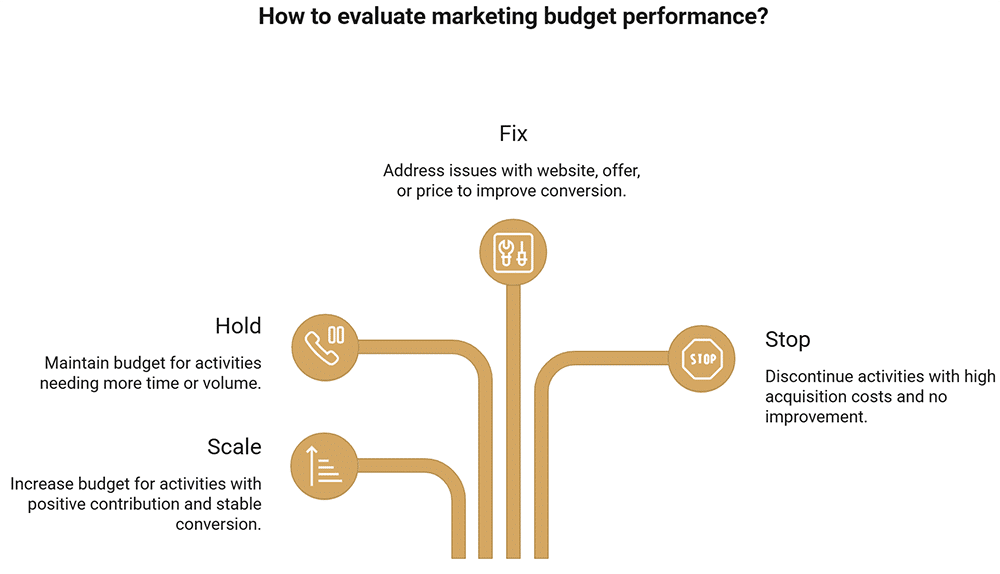
- Set the Stop Rule: Define the conditions under which you would cease funding a channel.
Hotels that master this logic move away from the exhausting debate of "how much" and begin the rewarding process of pricing their acquisition strategy as a core component of their commercial success. By anchoring the budget to arithmetic rather than habit, owners can recover margins, reduce OTA dependency, and secure the long-term viability of their assets.


 Evan Lee Salim
 Iffa Jayyana