Raul Delapena Setiawan
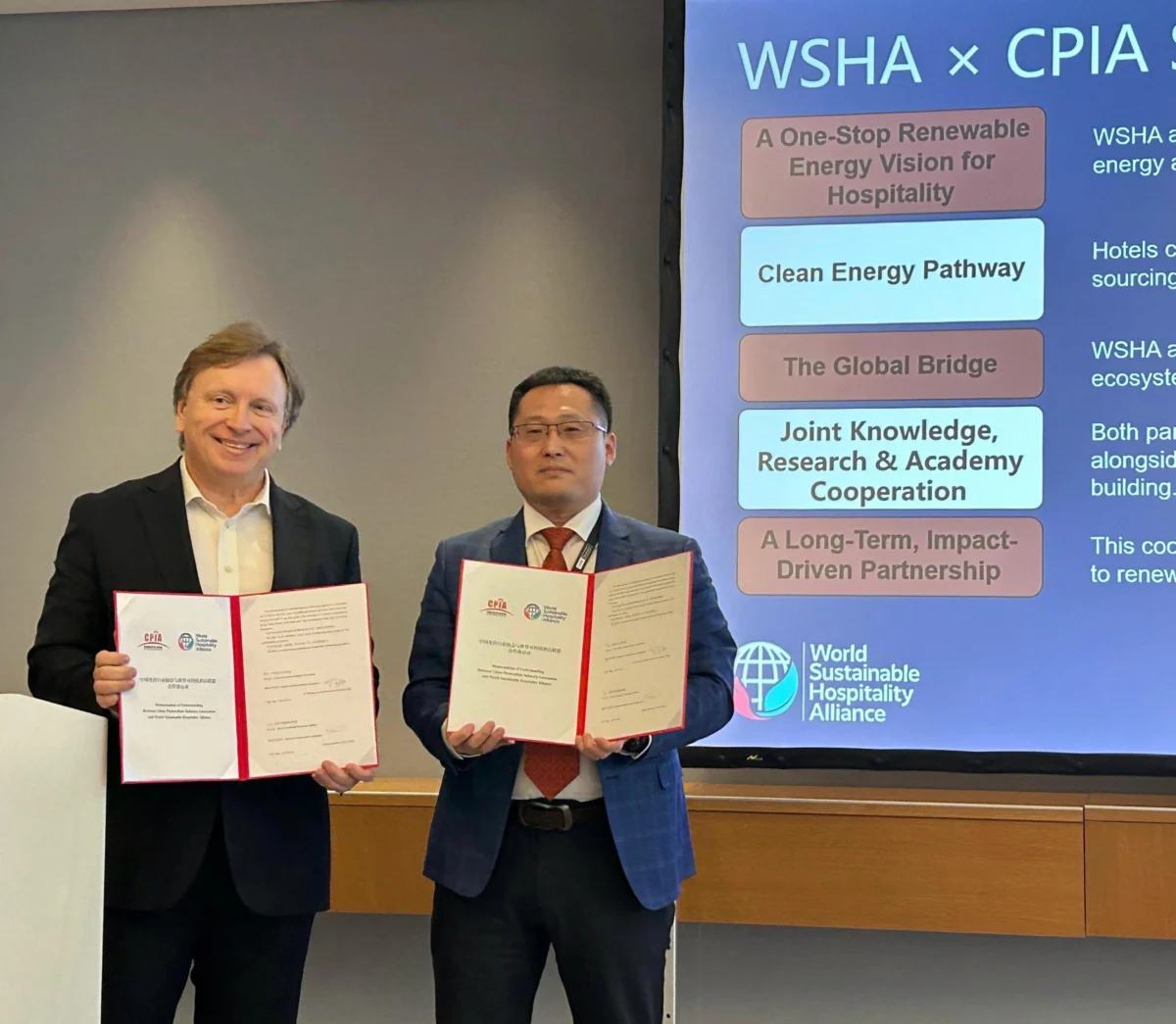
DÜSSELDORF, Germany — In a move set to redefine the carbon footprint of the international travel sector, the World Sustainable Hospitality Alliance (the Alliance) and the China Photovoltaic Industry Association (CPIA) have officially entered into a landmark strategic partnership. Announced on the global stage at the China–EU Solar & Energy Storage Industries Dialogue 2025, the collaboration marks a pivotal intersection between one of the world’s most energy-intensive industries—hospitality—and the global leader in solar technology innovation.
This alliance represents a systemic shift in how hotels approach energy procurement, transitioning from traditional grid dependency toward a model of localized, renewable, and sustainable energy production.
Main Facts: The Strategic Mandate
The partnership is designed to tackle the hospitality industry’s most pressing challenge: decarbonization. As global hotel groups face mounting pressure from investors, regulators, and eco-conscious travelers to reduce Scope 2 emissions, the need for scalable, reliable, and cost-effective renewable energy has never been higher.
The collaboration bridges two disparate worlds: the operational infrastructure of global hotel chains and the cutting-edge manufacturing capacity of China’s solar energy sector. By integrating these strengths, the Alliance and the CPIA aim to create a "one-stop" framework for renewable energy adoption.
Core elements of the agreement include:
- Infrastructure Integration: Developing frameworks to integrate onsite solar photovoltaic (PV) arrays into hotel architectural planning and retrofitting projects.
- Energy Storage Solutions: Leveraging advancements in battery technology to ensure that intermittent solar energy can provide a stable 24/7 power supply for hotel operations.
- Procurement Models: Providing guidance on long-term Renewable Power Purchase Agreements (PPAs) that allow hotel groups to lock in low-carbon energy at competitive rates.
- Capacity Building: Utilizing the World Academy for Sustainable Hospitality to train industry professionals on the technical and financial nuances of energy transition.
A Chronology of the Transition
The road to this partnership was paved by years of increasing scrutiny regarding the tourism industry’s environmental impact.
- 2020–2022: The Wake-Up Call. Post-pandemic recovery efforts highlighted that the hospitality sector could not simply return to "business as usual." Increased focus on Environmental, Social, and Governance (ESG) criteria moved sustainability from a marketing buzzword to a core business metric.
- 2023: The Search for Scalable Solutions. The Alliance identified that while many hotel groups had set Net Zero targets, they lacked the technical supply chain relationships to implement large-scale, cost-effective energy shifts.
- 2024: Bridging the Gap. Preliminary discussions began between the Alliance and CPIA. Both organizations recognized that China’s dominance in the global PV supply chain could provide the necessary hardware and expertise to meet the hospitality industry’s massive energy requirements.
- 2025 (February): Formalization. The partnership was ratified at the China–EU Solar & Energy Storage Industries Dialogue 2025 in Düsseldorf, signaling a formal commitment to cross-border, industry-wide cooperation.
Supporting Data: The Scale of the Challenge
To understand the significance of this partnership, one must look at the energy consumption profile of the hospitality industry.
According to data from the World Sustainable Hospitality Alliance, the hotel sector accounts for approximately 1% of global carbon emissions. This figure is staggering when one considers the localized nature of individual hotel operations. A single, large-scale luxury resort can consume as much electricity as a small town, with peak demands often coinciding with periods of grid stress.
The Economic and Environmental Logic:
- The Cost Factor: Energy costs typically represent the second-largest operational expense for hotels, trailing only labor. By shifting to self-generated solar power, hotels can mitigate the volatility of energy market prices, which have seen historic spikes in recent years.
- The Technological Leap: The CPIA brings access to high-efficiency solar modules that have seen a 30% increase in efficiency over the last decade, alongside rapid developments in lithium-iron-phosphate (LFP) energy storage, which are becoming the industry standard for commercial buildings.
- The Potential: With millions of square meters of roof space and unused land associated with global hotel portfolios, the industry is effectively a "sleeping giant" in terms of distributed energy generation. If fully leveraged, these properties could act as decentralized power plants for local communities.
Official Responses: A Vision for the Future
The partnership is characterized by a high degree of optimism from both leadership teams, who see this as a template for future industry-to-industry collaboration.
Glenn Mandziuk, President and CEO of the World Sustainable Hospitality Alliance, commented:
"We are proud to announce a landmark partnership between the World Sustainable Hospitality Alliance and the China Photovoltaic Industry Association. This collaboration connects one of the world’s largest energy-consuming sectors with a leading global hub of solar innovation, turning the hospitality industry’s significant annual investment into a driver of renewable energy transition. Built on five pillars—from a one-stop clean-energy pathway to global project collaboration and shared expertise—this agreement establishes a long-term, impact-driven framework for decarbonizing our sector."
RU Jialin, Director of International Affairs of the China Photovoltaic Industry Association, noted:
"The CPIA is delighted to join hands with the World Sustainable Hospitality Alliance to advance the hotel sector’s transition to renewable electricity. With the rapid progress of solar and energy storage technologies, clean power is becoming more accessible, stable, and cost-effective for hotels worldwide. Through this partnership, we will promote practical clean-energy solutions and scalable project cooperation, helping hotels reduce energy costs while accelerating low-carbon transformation."
Implications: The Road Ahead
The implications of this partnership extend far beyond the installation of solar panels on hotel rooftops. It signals a move toward "Net Positive Hospitality," a vision where hotels do not merely reduce their negative impact but actively contribute to the energy health of the regions in which they operate.
1. Technology Transfer and Global Standards
By aligning with the CPIA, the Alliance is effectively importing the best practices of the Chinese solar sector to the global hotel market. This includes high-tech monitoring software that tracks energy consumption in real-time, allowing hotel managers to adjust energy usage based on guest occupancy and weather patterns.
2. Regulatory Compliance
As governments across the EU, North America, and Asia implement stricter building efficiency codes and carbon reporting mandates, this partnership provides a "pre-packaged" solution for hotel groups to meet these standards without having to navigate the complexities of the renewable energy market alone.
3. A New Model for Procurement
Perhaps the most significant long-term impact will be in the realm of Power Purchase Agreements (PPAs). By educating hotel owners on how to enter into long-term contracts with solar developers, the Alliance is helping to stabilize the energy landscape for the entire industry. This provides the financial certainty required to justify the high initial capital expenditure (CAPEX) of green energy retrofits.
4. The Role of the World Academy
The collaboration will be anchored by the World Academy for Sustainable Hospitality, which will serve as the educational arm of the partnership. By creating modules specifically tailored for hotel engineers, procurement officers, and sustainability leads, the partnership ensures that the transition is not just technological, but cultural.
Conclusion
The partnership between the World Sustainable Hospitality Alliance and the China Photovoltaic Industry Association is a testament to the power of cross-industry collaboration. By aligning the hospitality sector’s operational scale with the solar industry’s technological prowess, the two organizations have created a roadmap that could see hotels move from being heavy energy consumers to becoming pillars of the global renewable energy infrastructure.
As the industry looks toward 2030 and beyond, this agreement provides more than just a framework—it provides a pathway to a cleaner, more resilient, and ultimately more profitable future for hospitality worldwide. The "Net Positive" goal is ambitious, but through this strategic alignment, it has moved significantly closer to reality.


 Nana

 Ammar Sabilarrohman