Asep Darmawan
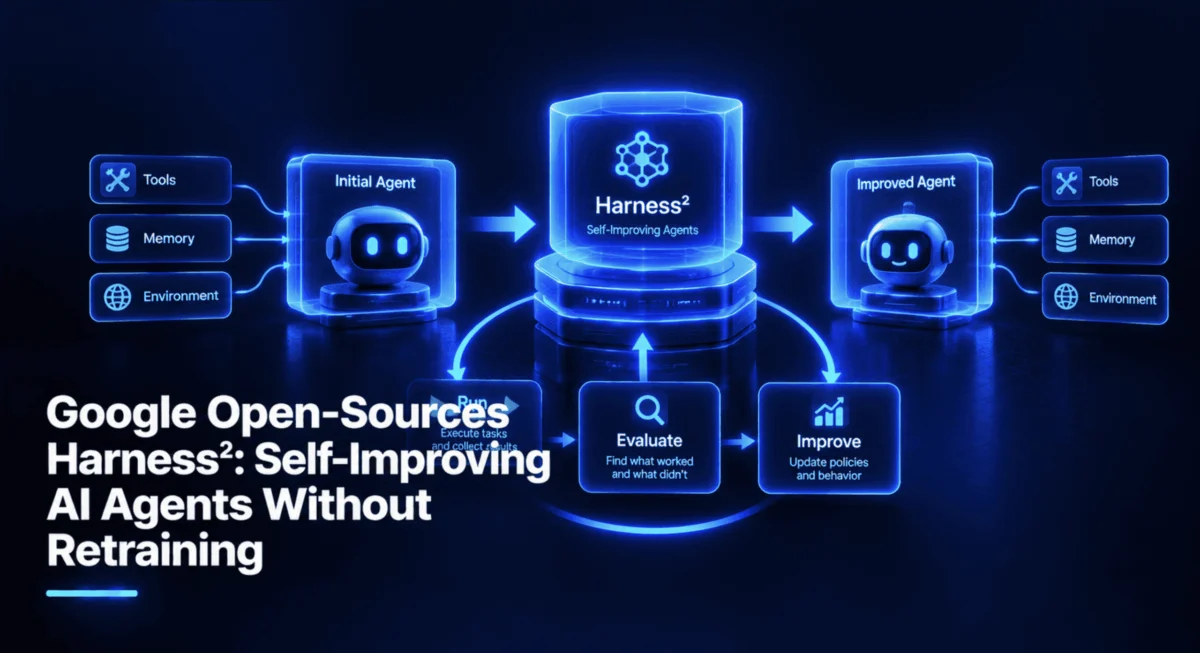
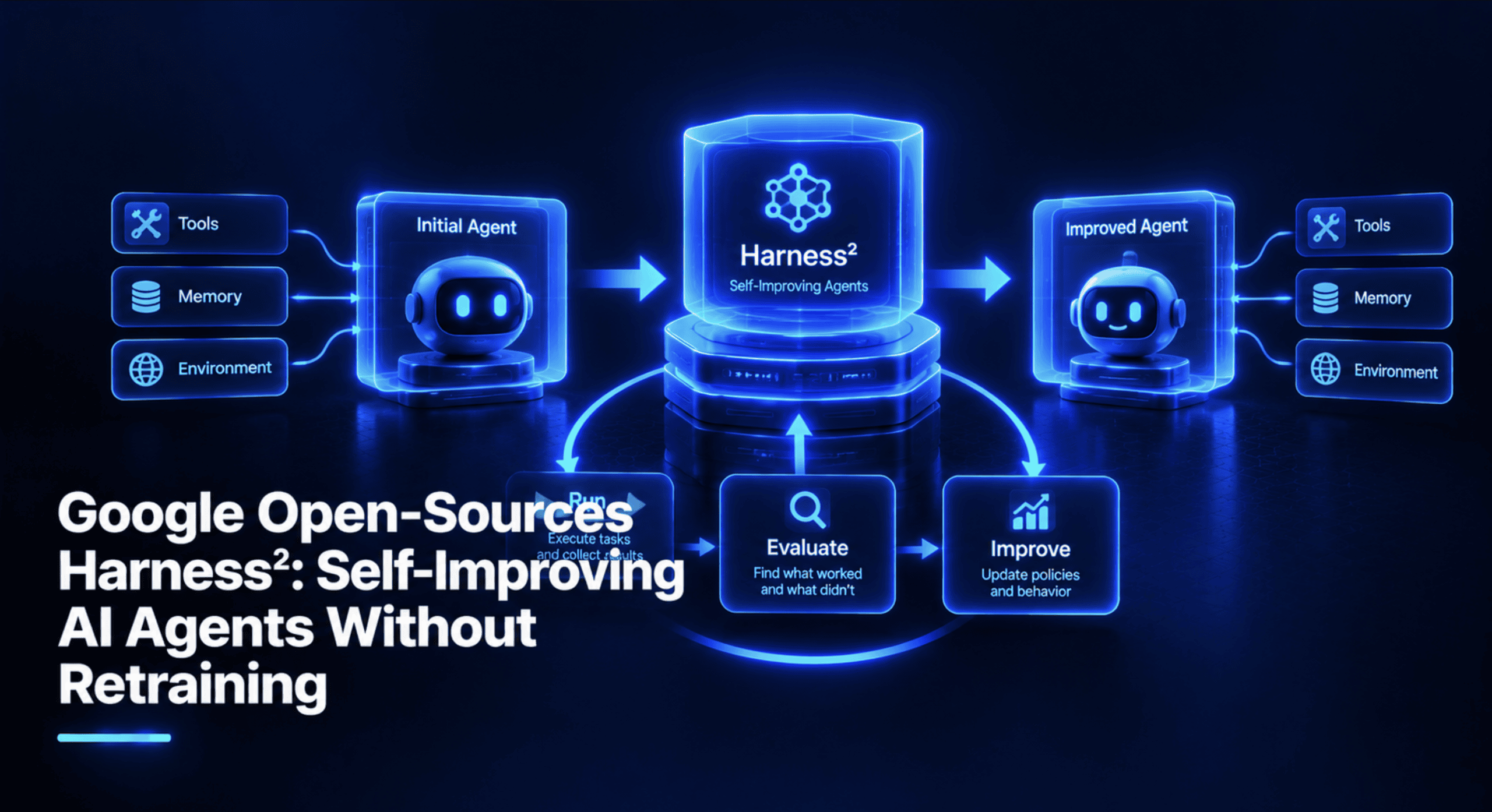
In a significant move for the artificial intelligence community, Google Research has open-sourced Harness² (Harness-squared), a groundbreaking framework designed to enable AI agents to refine their performance autonomously—without the need for costly and time-consuming model retraining. By decoupling an agent’s "intelligence" from its "harness," Google has introduced a method that treats prompts, memory, tools, and scripts as modular, editable components that can be optimized in real-time.
The release, which includes the framework’s source code under the Apache 2.0 license, a comprehensive research paper titled Harness²: Recursive Agent Harnessing for an Open World, and a dedicated project site, represents a departure from traditional fine-tuning. Instead of adjusting the deep-seated weights of a Large Language Model (LLM), Harness² empowers developers to edit the "scaffolding" around the model, allowing it to adapt to novel tasks in an "open world" environment where pre-planned instructions inevitably fail.
The Architecture of Self-Improvement: What is Harness²?
To understand Harness², one must first define a "harness." In the context of modern AI, a harness is the entire ecosystem surrounding a model that facilitates its role as an agent. This includes the system prompt, guardrails, long-term memory, specialized skills, tool-usage protocols, helper scripts, sub-agent delegation, and middleware plugins.
Historically, the process of optimizing these elements has been a manual, labor-intensive chore. Engineers observe an agent’s failure, identify the bottleneck, manually tweak the prompt or add a tool, and redeploy. While functional for predictable, closed-loop tasks, this approach is insufficient for the dynamic demands of the real world.
Harness² automates this iterative tuning process. It operates on the principle that if the model’s "surroundings" are improved, the agent’s efficacy increases, regardless of the model’s underlying architecture. By editing eight core components—System Prompt, Guardrails, Memory, Skills, Tool Guidance, Scripts, Subagents, and Plugins—Harness² allows for precise behavioral modifications without touching the frozen weights of the underlying LLM.
Chronology of Development and Mechanics
The "squared" in Harness² refers to its two-tiered recursive improvement loop, designed to optimize both individual task performance and the overall process of improvement.
Loop 1: Task-Level Recursion
When an agent faces a task, it engages in a "Propose–Probe–Compose" cycle. Crucially, this loop does not rely on a "ground-truth" answer key. Instead, the framework learns from behavioral contrasts. By running the agent multiple times and comparing the differences in outcomes, the system identifies which configuration changes (e.g., a modified script or a clearer prompt) lead to successful completion. This is a significant breakthrough for agents operating in open-ended environments where an external supervisor is not always available to provide corrections.
Loop 2: Harnessing-Level Recursion
Once a task is complete, an "experience reflector" analyzes the successful configuration. It stores the "winning" harness and extracts evidence-supported lessons into a persistent improvement harness. This library of lessons serves as a foundation for future tasks. Consequently, the agent not only becomes more capable at its current task but also grows more adept at solving future tasks by leveraging the knowledge gained from previous encounters.
Supporting Data: Benchmark Performance
Google’s testing of Harness² utilized GLM-5 and Gemini 3.5 Flash, pitting them against three rigorous benchmarks. The results demonstrate that even a single step of optimization (k=1) yields measurable performance gains.
- WorkBuddy-Bench: Focusing on office, web, and coding tasks, the framework achieved an improvement of up to 11.5 points.
- LAB (Legal Assessment Benchmark): Drawing from Harvey’s harvey-labs, the system saw an improvement of up to 11.8 percentage points in partial pass rates.
- JobBench: In professional-grade work tasks, the framework realized gains of up to 4.5 points.
These metrics suggest that the "harnessing" approach provides a viable, scalable alternative to traditional fine-tuning, especially for enterprise users who lack the infrastructure to retrain massive models but possess the domain-specific data required to guide an agent.
Implications for the AI Ecosystem
The open-sourcing of Harness² carries profound implications for the industry. By shifting the burden of improvement from model weights to modular, human-readable files, Google is effectively democratizing the agent-optimization process.
1. Cost-Efficiency and Accessibility
Retraining or fine-tuning models requires massive GPU clusters and specialized talent. Harness² requires only the computational budget to run the "improver" loops. This lowers the barrier to entry for smaller organizations and independent researchers, enabling them to customize agent behaviors using plain text files and Python scripts.
2. Interpretability and Safety
Because the improvements in Harness² are stored in editable files—such as a specific script or a rewritten system prompt—the process is highly transparent. If an agent begins behaving unexpectedly, an engineer can inspect the "Experience" logs to see exactly what "lesson" was learned and why the agent changed its behavior. This auditability is a major advantage for compliance-heavy industries like law, finance, and healthcare.
3. Cumulative Knowledge
Traditional models are often "static" after training. Harness² allows for a cumulative "knowledge base" that grows over time. As the agent encounters more tasks, its library of lessons expands, making it more resilient to the "open world" challenges that often cause standard agents to stall.
Practical Implementation: A Hands-On Guide
For those looking to integrate this framework, Google has provided a robust demo that requires no API credentials, allowing users to experience the "Propose-Probe-Compose" cycle locally.
Getting Started
- Environment Setup: Using
uvfor environment management is the recommended approach. Users can clone the repository and initialize a Python 3.12 environment in minutes. - The Demo Run: The
harness2-democommand executes a simulation where the agent discovers a bug in a financial calculation script—a bug that causes it to ignore negative values. Through the recursive loop, the agent identifies that the script is faulty, edits it to include both debits and credits, and records the lesson for future reference. - Real-World Application: For production-level tasks using Vertex AI, the framework requires the configuration of environment variables (e.g.,
HARNESS2_SOLVER_MODELandHARNESS2_IMPROVER_MODEL). Once configured, the framework can be pointed at complex benchmarks like the LAB legal test, allowing it to iterate on its own performance in real-time.
Official Perspective and Future Outlook
The release of Harness² signals a strategic pivot for Google Research, emphasizing the importance of "agentic" workflows over raw model scale. In the accompanying research documentation, the authors note that the framework is still in its infancy regarding cross-domain knowledge transfer.
"The open questions remain: how effectively can these lessons transfer across vastly different domains, and how does the cost of iterative honing compare to traditional fine-tuning over long-term deployments?" the researchers state.
With the community now having full access to the codebase, the focus shifts to third-party validation. If the performance gains observed in Google’s internal benchmarks hold true in the wild, Harness² could become the standard for building agents that are not just "smart," but continuously adaptive.
For developers, the call to action is clear: the era of "set and forget" AI deployment is ending, replaced by an era of "living" agents that learn and evolve from every interaction. By treating agent intelligence as an iterative, manageable, and modular process, Harness² provides the tools to build the next generation of autonomous systems.
Key Takeaways for Developers:
- Modular Control: Treat prompts and scripts as components of an "experience library."
- Zero-Weight Optimization: Focus on the harness, not the weights, to avoid the overhead of fine-tuning.
- Recursive Learning: Use the dual-loop architecture to ensure improvements persist and compound over time.
- Open Access: Explore the repository on GitHub to begin contributing to the evolution of autonomous agents.
As the industry grapples with the limitations of current LLM performance, Harness² offers a compelling, pragmatic, and highly extensible path forward. Whether it will become the bedrock for future enterprise AI agents is a question for the coming months, but for now, it stands as one of the most exciting developments in the field of AI autonomy.

 Siti Muinah
 Jia Lissa