Azzam Bilal Chamdy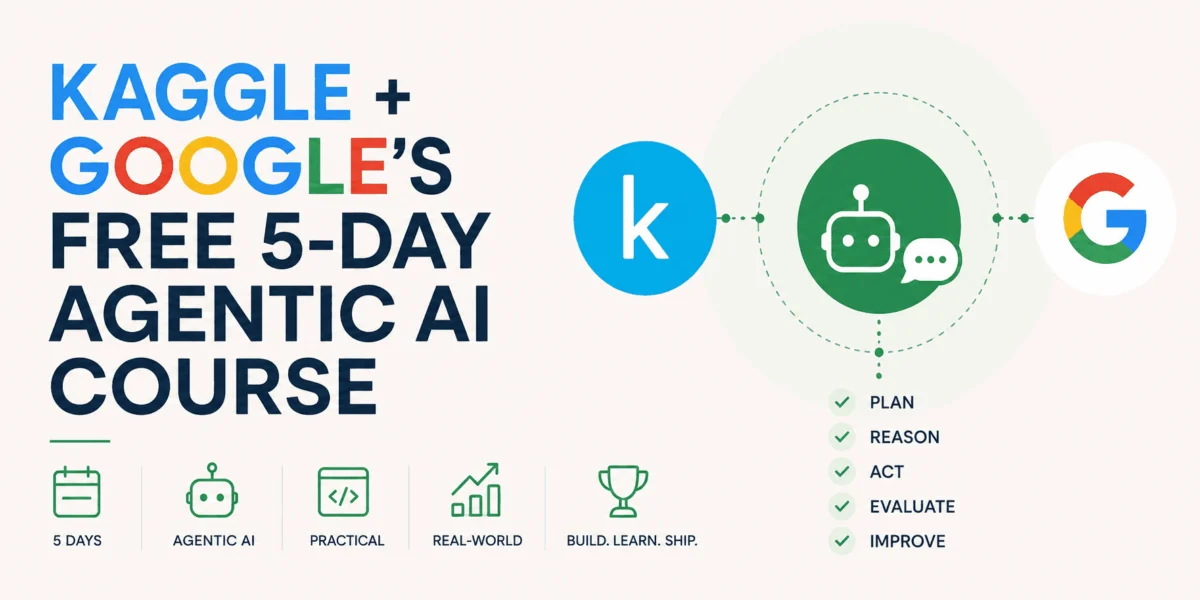
In the rapidly evolving landscape of artificial intelligence, few milestones have captured the developer zeitgeist quite like the "5-Day AI Agents Intensive." Orchestrated by Google and the data science community hub Kaggle, this initiative transformed from a fleeting experiment into a global educational phenomenon. In November 2025, an unprecedented 1.5 million registrants signed up to demystify the complex world of autonomous agents. More than just a vanity metric for engagement, this initiative yielded over 11,000 capstone submissions, marking it as one of the most successful and impactful technical training courses in the history of the software industry.
For those who missed the live-streamed event, the curriculum has been transitioned into a permanent, self-paced Kaggle Learn Guide, ensuring that the foundational knowledge of agentic architecture remains accessible to developers worldwide.
Main Facts: Decoding the Agentic Revolution
At its core, the Google-Kaggle intensive serves as a bridge between basic LLM prompting and the sophisticated world of autonomous, tool-using systems. As the industry pivots from "Chatbot AI" to "Agentic AI," confusion regarding terminology has proliferated. The course addresses this directly by defining an agent not merely as a conversational interface, but as a system capable of reasoning, tool selection, and stateful interaction.
The curriculum is built upon a rigorous framework that pairs academic theory with practical application. Each of the five modules provides a technical whitepaper—grounding the student in architectural best practices—followed by hands-on codelabs. These labs utilize Google’s Gemini ecosystem and the Agent Development Kit (ADK), providing learners with a sandbox that mirrors modern enterprise development environments.
A Chronological Evolution of the Program
The journey of the 5-Day Intensive began in the wake of the 2024 GenAI Intensive, which itself served as a massive proof-of-concept for remote technical education. The 2024 program drew over 140,000 developers and famously set a Guinness World Record for the largest virtual AI conference, proving that there was a massive, untapped demand for high-quality, structured AI training.
The 2025 Launch
In November 2025, Google and Kaggle narrowed their focus, recognizing that while developers had mastered basic generative tasks, the "agentic" shift—the ability of AI to perform multi-step, goal-oriented tasks—represented the next great hurdle. The live intensive was designed to be immersive, forcing a rapid learning cycle over five intensive days.
The Self-Paced Transition
Recognizing that the fast-paced nature of the industry requires continuous learning, the organizers pivoted the course into a self-paced guide. This allows students to digest the material at their own speed. Furthermore, in June 2026, a "vibe coding" themed refresh was introduced to cater to the growing demographic of developers interested in rapid prototyping and iterative agent design, proving that the content remains a living, breathing resource.
Supporting Data: Why 1.5 Million Developers Tuned In
The success of the intensive can be attributed to its pragmatic approach to a subject often shrouded in marketing hype. The data suggests that developers are hungry for more than just API documentation; they require architectural blueprints.
- Registration Volume: Over 1.5 million unique sign-ups.
- Completion Rate: 11,000+ completed capstone projects.
- Engagement: The shift from a single, high-intensity week to a perennial resource has seen continued traffic, indicating that the curriculum remains the "go-to" entry point for junior and mid-level engineers looking to upskill.
These figures illustrate a critical trend: the democratization of high-level AI expertise. By lowering the barrier to entry—making the course free and requiring only basic Python literacy—Google and Kaggle have effectively standardized how agentic systems are built across the industry.
Official Perspectives: The Philosophy Behind the Curriculum
The pedagogical structure of the course is designed to address the specific pain points identified by the developers who built the first generation of production agents. According to the course documentation and supplementary materials, the five-day progression is intentional:
- Day 1 (Architectures): Focuses on the "Why." It challenges students to differentiate between a standard workflow and an agentic one, preventing the common mistake of over-engineering simple tasks.
- Day 2 (Interoperability): Introduces the Model Context Protocol (MCP). This is widely considered the most critical module for modern developers, as it enables agents to move beyond text and into external systems, while emphasizing the "Human-in-the-Loop" (HITL) safety protocols necessary for enterprise-grade deployment.
- Day 3 (Memory): Addresses the "State" problem. Developers learn to implement long-term memory, enabling agents to retain context across sessions—a feature that separates amateur projects from professional-grade tools.
- Day 4 (Quality & Metrics): Often cited as the most important day of the course. It focuses on logging, tracing, and evaluation. In the industry, the ability to measure an agent’s performance is often more valuable than the code itself.
- Day 5 (Deployment): Bridges the "last mile" gap. By utilizing Vertex AI Agent Engine, students learn how to take a local notebook and deploy it into a production-ready managed runtime.
Implications: The Future of Agentic Development
The widespread adoption of this curriculum has several long-term implications for the software development ecosystem.
1. Standardization of Best Practices
Before this intensive, agent development was largely fragmented, with varying libraries and approaches. By providing a unified path through Google’s toolchain, the course has encouraged a level of standardization in how agents are architected, debugged, and evaluated.
2. The Rise of the "Agentic Engineer"
The course is effectively creating a new job category. As organizations realize that the value of AI lies in action rather than just text generation, the skills taught in this course—context engineering, tool interoperability, and rigorous evaluation—are becoming mandatory for backend engineers.
3. Bridging the "Production Gap"
The most significant hurdle in AI development remains the gap between a successful prototype and a stable production system. By focusing on Day 4 and Day 5, the intensive directly addresses the "unglamorous" aspects of AI engineering. This prepares the next generation of developers to move beyond the excitement of the "Hello World" phase and into the reality of maintaining high-uptime, reliable systems.
How to Maximize Your Learning
For those currently engaging with the materials on Kaggle, the advice from the program leads remains consistent: Do not rush the whitepapers.
The temptation for developers is often to jump straight into the code, treating the codelabs as a "fill-in-the-blank" exercise. However, the true value of the course lies in the underlying concepts of context engineering and performance evaluation. If you understand the theory, the code becomes a simple implementation detail. If you skip the theory, you will likely find your agents breaking as soon as they encounter real-world complexity.
Ultimately, the 5-Day AI Agents Intensive represents more than just a free educational resource; it is a signal of the industry’s maturation. As the barrier to entry for building complex AI systems continues to fall, the developers who possess a deep, structural understanding of agentic architectures—rather than those who simply know how to chain prompts together—will be the ones driving the next decade of innovation. With 1.5 million people having already taken the leap, the question for the modern developer is no longer whether they should learn to build agents, but how quickly they can master the craft.

 Ali Ikhwan
 Nana
Nana