Layla Zulfa
In an era where large language models (LLMs) are increasingly gated behind proprietary cloud APIs and monthly subscription fees, the open-source community continues to push the boundaries of what is possible on consumer hardware. The release of Qwythos-9B-Claude-Mythos-5-1M—a 9-billion parameter model based on the robust Qwen3.5 architecture—marks a significant milestone for developers seeking high-performance reasoning and coding capabilities that reside entirely on their local machines.
By leveraging the efficiency of llama.cpp and the agentic orchestration power of Pi, developers can now build a sophisticated, privacy-focused coding environment. This guide explores the architecture of this model, the technical implementation of the local stack, and the broader implications for the future of sovereign software development.
The Rise of Compact, High-Reasoning Models
The Qwythos-9B-Claude-Mythos-5-1M model is designed specifically to bridge the gap between heavyweight foundation models and lightweight local alternatives. At 9 billion parameters, it occupies a "sweet spot" in the current AI landscape: it is small enough to fit within the VRAM constraints of mid-range consumer GPUs (such as the NVIDIA RTX 4070 Ti Super), yet it possesses enough reasoning capacity to handle complex coding tasks, agentic workflows, and long-context documentation analysis.
The model is optimized for "Mythos" tasks—specifically reasoning-heavy programming challenges—and is distributed in GGUF format, making it natively compatible with the llama.cpp ecosystem. This architecture allows for quantization, which reduces the model’s memory footprint without sacrificing significant performance, enabling users to run powerful AI assistants on hardware that costs a fraction of an enterprise cloud server.
Chronology of the Setup: Building Your Local Agent
To transform your workstation into a powerhouse of local AI development, you must follow a structured installation path. The process is divided into three distinct phases: infrastructure preparation, model deployment, and agent integration.
Phase 1: Installing the Infrastructure
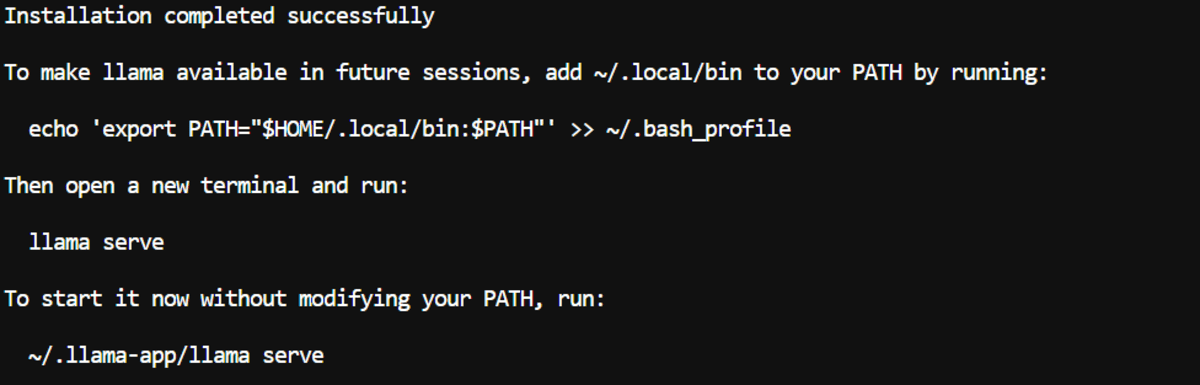
The journey begins by installing the llama.cpp CLI. This toolkit acts as the engine room for your model, providing the server capabilities necessary to communicate with your IDE or coding agent.
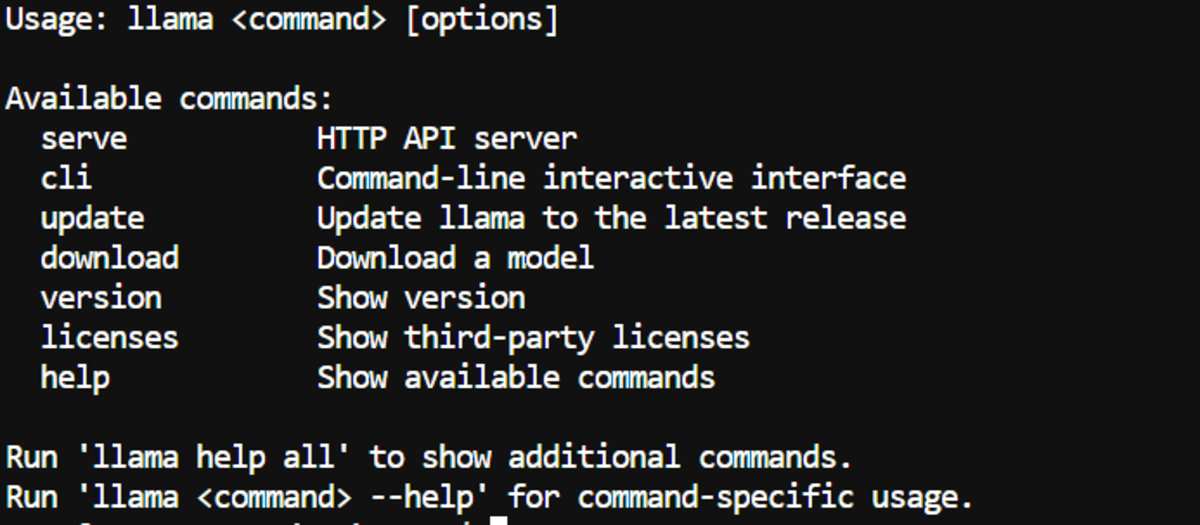
- CLI Installation: Use the standard installation script to pull the latest binaries:
curl -LsSf https://llama.app/install.sh | sh - Path Configuration: Ensure your terminal recognizes the
llamacommand by appending the local bin directory to your~/.bashrcor~/.zshrcfile. - Cache Management: For users on cloud-based development environments, disk space is at a premium. Configuring a specific
HF_HOMEvariable ensures that large model weights are stored on high-capacity volumes rather than clogging the root directory.
Phase 2: Deploying the Model
Once the infrastructure is ready, we deploy the Qwythos model using speculative decoding (MTP). The command below utilizes the llama serve functionality to launch an OpenAI-compatible API endpoint:
llama serve
  -hf "empero-ai/Qwythos-9B-Claude-Mythos-5-1M-GGUF:MTP-Q6_K"
  --alias "qwythos-9b-mtp"
  --host 0.0.0.0
  --port 8910
  --n-gpu-layers all
  --ctx-size 100000
  --flash-attn on
  --spec-type draft-mtp
  --jinja
This configuration enables several critical features: Flash Attention for optimized memory usage, a massive 100K token context window, and MTP speculative decoding, which significantly boosts inference speed by allowing the model to draft multiple tokens per step.

Phase 3: Integrating Pi as an Agentic Interface
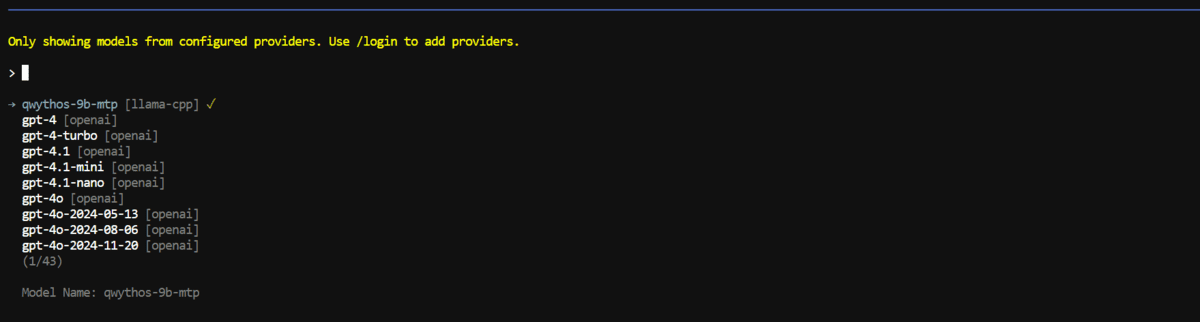
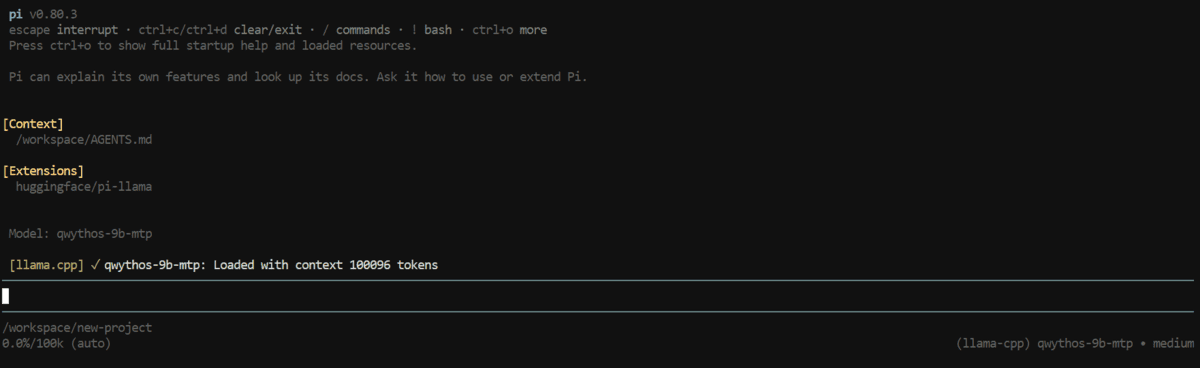
Pi serves as the orchestration layer. While llama.cpp handles the "brain," Pi provides the "hands," allowing the model to interact with the file system, run terminal commands, and manage project structures. Installing the pi-llama plugin bridges the gap between the server and the agent:
pi install git:github.com/huggingface/pi-llama
export LLAMA_BASE_URL="http://127.0.0.1:8910/v1"
Performance Metrics and Supporting Data
In testing scenarios on an NVIDIA RTX 4070 Ti Super (16GB VRAM), the Q6_K quantization of this model achieved an impressive throughput of 81.74 tokens per second. This speed is critical for coding tasks, as it minimizes the "wait time" during iterative debugging.

Optimization Table: Key Parameters
| Flag | Impact on Performance |
|---|---|
--n-gpu-layers all |
Ensures maximum offloading to VRAM; essential for speed. |
--ctx-size 100000 |
Defines the model’s "memory." Adjust based on available RAM. |
--spec-type draft-mtp |
Enables speculative decoding, significantly reducing latency. |
--cache-type-k q8_0 |
Optimizes KV-cache memory usage without losing precision. |
These configurations allow the model to reason through multi-file coding tasks—such as creating a full-stack browser game or a Python CLI tool—with high accuracy and minimal hallucination.
Practical Applications: Real-World Testing
To validate the utility of the Qwythos-9B model, two distinct experiments were performed.
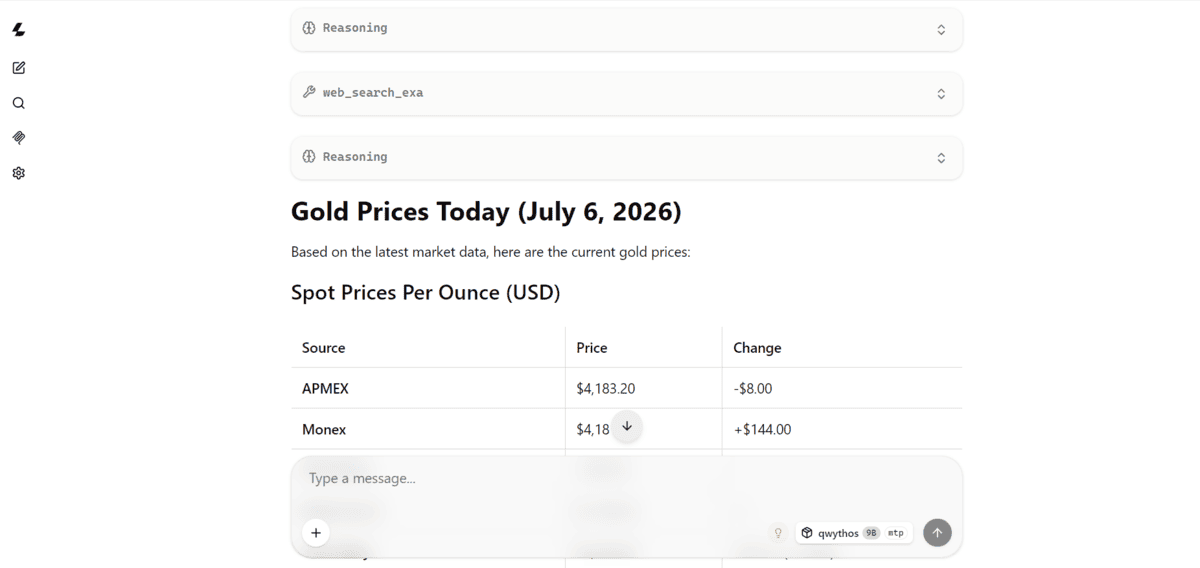
Experiment A: The "Beat the AI" Browser Game
The model was tasked with creating a browser-based game using only HTML, CSS, and vanilla JavaScript. The requirements were specific: a 30-second countdown, score tracking, and varied question logic. The model successfully generated a single-file solution that was both functional and aesthetically polished, demonstrating its ability to handle front-end logic and state management without external dependencies.
Experiment B: The CSV-to-Excel CLI Tool
The second test involved the creation of a robust Python CLI. The model was required to accept arguments, handle file validation, and perform data conversion. Not only did the model produce a functional script, but it also generated dummy data for testing and verified the output, effectively acting as an autonomous software engineer.
Implications for the Future of Development
The ability to host a reasoning-capable coding agent locally carries profound implications for the software development industry:
- Data Sovereignty: By running models locally, companies and developers can ensure that sensitive codebases, proprietary logic, and internal API keys never leave their hardware. This is a crucial requirement for enterprise security compliance.
- Cost Efficiency: While cloud-based LLMs incur per-token costs, local models effectively become "free" after the initial hardware investment. This allows for unlimited experimentation and iterative development without the "tax" of API billing.
- Resilience and Reliability: Local workflows are not dependent on internet connectivity or the uptime of third-party model providers. If a major cloud provider experiences an outage, the local developer remains productive.
- Democratization of Agentic Workflows: The tools showcased here—
llama.cppandPi—are open-source and accessible. They lower the barrier to entry for developers who wish to utilize agentic coding assistants but cannot afford enterprise-grade subscription tiers.
Conclusion
The combination of the Qwythos-9B-Claude-Mythos model and the local execution stack represents a shift toward more resilient and private development environments. While cloud-based giants continue to dominate the headlines, the true innovation for the average developer is occurring on the local terminal. As speculative decoding and quantization techniques continue to evolve, we can expect even smaller, faster, and more capable models to emerge, further cementing the role of the local AI agent as an indispensable member of the modern developer’s toolkit.
For those looking to deepen their integration, exploring additional frameworks like Context7 or advanced Pi agent configurations will further expand the capabilities of this setup, creating a truly sovereign and automated coding ecosystem.

 Ali Ikhwan
 Nana
Nana