Siti Muinah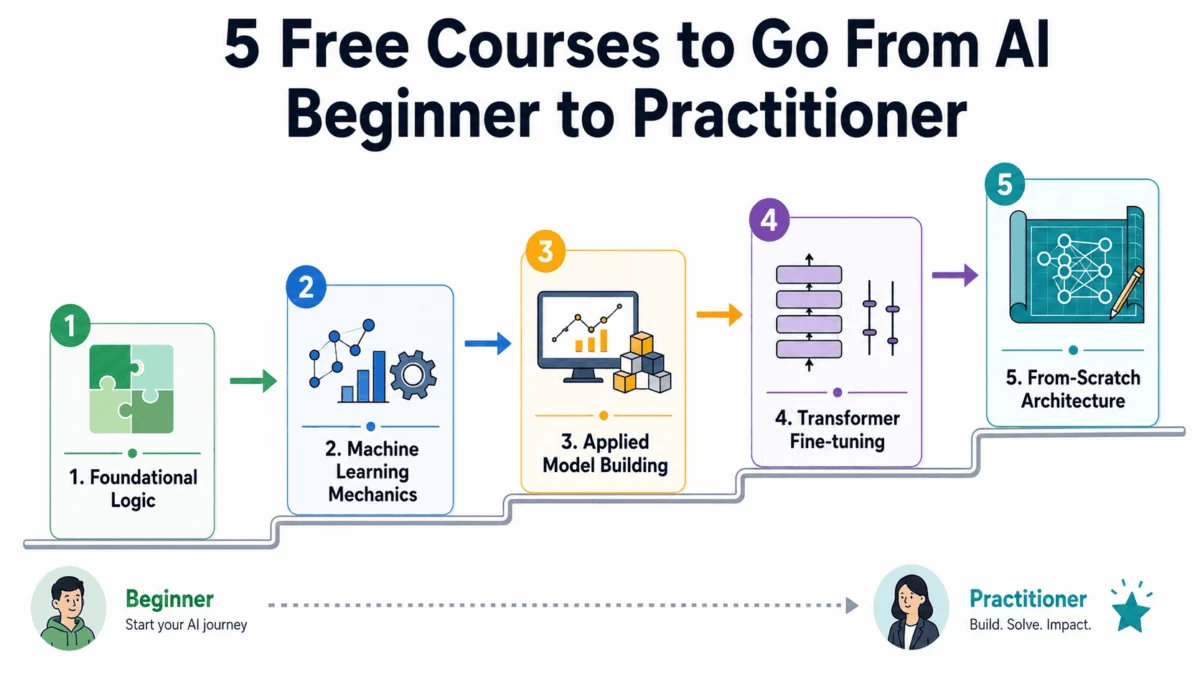
The barrier to entry for mastering artificial intelligence has arguably never been lower, yet for the aspiring practitioner, the "signal-to-noise" ratio has never been more distorted. A digital marketplace crowded with high-priced bootcamps and subscription-based "AI certifications" promises mastery in a weekend, often for thousands of dollars. However, the industry’s best-kept secret in 2026 is that the most rigorous, respected, and up-to-date AI education is entirely free.
The organizations defining the state-of-the-art—from Harvard University to the engineers at OpenAI and Google—have democratized their curricula. For those possessing a foundational grasp of Python, the transition from software developer to AI practitioner requires no expensive degree; it requires a structured, meritocratic roadmap.
The Architecture of Learning: A Sequential Approach
To become an effective AI engineer, one must move beyond the superficial act of calling APIs. True expertise requires a deep, layered understanding of how AI systems reason, learn, and generalize. This guide outlines a five-course, sequential roadmap designed to take a learner from foundational algorithmic logic to the sophisticated engineering required to build Large Language Models (LLMs) from scratch.
Layer 1: The Logical and Mathematical Foundation
The primary pitfall for self-taught practitioners is skipping the "why" in favor of the "how." Without a mental model of how an AI reasons, developers often find themselves trapped in "tutorial hell," unable to debug models that fail in production. The first two courses in this sequence focus on logical problem-solving and the mathematical bedrock of machine learning.
Layer 2: Practical Implementation and Deployment
Once the theoretical framework is established, the transition shifts to iteration. Theoretical knowledge is inert without the ability to ship. The middle stage of this roadmap focuses on the "top-down" approach: building, evaluating, and deploying models on custom datasets.
Layer 3: Engineering from First Principles
The final stage of the transition separates the "library users" from the "AI architects." By stripping away high-level abstractions, the final course in this series teaches the student to reconstruct neural architectures from the ground up, providing the clarity required to innovate at the cutting edge.
1. Harvard’s CS50: Introduction to AI with Python
The Logical Gateway
Before one touches a neural network, one must understand the heuristics of search and decision-making. Harvard’s CS50 AI course provides the definitive bridge between traditional computer science and modern intelligence. It focuses on how AI systems—specifically in the context of graph search, constraint satisfaction, and probabilistic reasoning—process information.
- Key Modules: The course covers adversarial search, logic-based knowledge representation, and Markov models.
- Why It Matters: Most modern LLMs rely on complex probability distributions. By starting with the logic of Bayesian inference and game theory, students gain an intuition for how computers navigate uncertainty.
- Access: Available via the CS50 portal, this course is widely recognized by hiring managers as the gold standard for foundational AI logic.
2. Google’s Machine Learning Crash Course
The Mathematical Engine
After establishing logic, the learner must master the mechanics of data-driven learning. Google’s Machine Learning Crash Course is the industry’s most efficient primer on the mathematics of modern ML. This is not an academic lecture series; it is the internal training material used by Google’s own engineers to maintain their technical edge.
- Key Modules: The course dives into gradient descent, loss functions, regularization, and the fundamental mechanics of neural networks.
- The "Colab" Factor: The course is built around interactive Google Colab notebooks, allowing users to manipulate code and observe the impact of hyperparameter tuning in real-time.
- Professional Implications: Mastering the content here ensures you understand the "Black Box" of machine learning, preventing the common error of treating neural networks as magic rather than mathematical functions.
3. Fast.ai: Practical Deep Learning for Coders
The Practitioner’s Leap
Jeremy Howard’s fast.ai is widely considered the most influential course in the open-source AI community. It rejects the traditional "math-first" approach in favor of a "code-first" methodology. Students are tasked with training state-of-the-art models in the very first lesson, learning the underlying theory only after they have seen the results.
- Why It Works: By training an image classifier in the first hour, the fear of complexity is removed. The course subsequently peels back the layers of the PyTorch framework, explaining exactly how deep learning models digest data.
- Industry Standards: Fast.ai emphasizes modern best practices, including data augmentation, learning rate schedulers, and transfer learning—techniques that are essential for any professional working in the field today.
- Access: All lectures and notebooks are available for free at fast.ai.
4. The Hugging Face NLP Course
The Generative AI Ecosystem
In the current landscape, the Transformer architecture is the engine of the AI economy. Hugging Face has become the "GitHub of AI," and their official NLP course is the definitive guide to the transformer ecosystem.
- Key Takeaways: This course moves beyond theoretical NLP into the practical application of Transformers. You will learn how to download, fine-tune, and deploy models from the Hugging Face Hub.
- Practical Skills: It covers tokenization, attention mechanisms, and the nuances of training LLMs for specific tasks, such as sentiment analysis, summarization, and question-answering.
- Strategic Value: Given that most modern AI applications are built on top of the Hugging Face ecosystem, this course is arguably the most "market-ready" skill set on this list.
5. Andrej Karpathy’s "Neural Networks: Zero to Hero"
The Architect’s Path
The final level of mastery involves moving from a user of frameworks to a designer of architectures. Andrej Karpathy, former Director of AI at Tesla and a founding member of OpenAI, created this series as a masterclass in transparency.
- The "Zero to Hero" Philosophy: Karpathy forces the learner to write code from scratch. You will build a multi-layer perceptron, implement backpropagation, and eventually construct a GPT-level language model without relying on massive libraries.
- The Clarifying Effect: By building these components from first principles, the "magic" disappears. You will understand exactly why models fail, why they converge, and how to optimize them for specific hardware.
- Expert Consensus: This series is consistently cited by industry leaders as the single most effective way to understand the architecture of modern AI.
Implications for the Future Workforce
The democratization of AI education creates a significant shift in the labor market. Hiring managers are increasingly looking for "demonstrable output" rather than pedigree. A candidate who can point to a GitHub repository featuring a custom-built Transformer or a deployed model trained via fast.ai techniques carries more weight than a candidate with a generic certification.
The Self-Taught Advantage
The primary implication of this curriculum is the removal of the "resource barrier." In previous decades, high-level AI expertise was gated by university research budgets. Today, with cloud-based compute credits (often available through Colab) and open-source models, the only barrier is the discipline to study.
The Role of the Practitioner
As the industry matures, the value of the "AI Engineer"—someone who can integrate, tune, and maintain models—will eclipse the value of the "AI Researcher." This roadmap is specifically designed to produce the former. By combining the logical rigors of Harvard with the engineering prowess of fast.ai and Karpathy, the learner develops a T-shaped skill set: broad enough to understand the entire stack, but deep enough to fix it when it breaks.
Conclusion: A Call to Discipline
Becoming an AI practitioner in 2026 requires roughly three to five months of part-time, dedicated study. The path is challenging, but it is clear.
- Start with CS50 to build your logical foundation.
- Move to Google to master the mathematical mechanics.
- Engage with fast.ai to bridge the gap between theory and execution.
- Master Hugging Face to become proficient in modern NLP.
- Finish with Karpathy to achieve a deep-level architectural understanding.
The information is free, the tools are open, and the demand for skilled practitioners is at an all-time high. The only remaining variable is your own commitment to the process. By following this roadmap, you are not just learning AI—you are preparing to build the infrastructure of the next decade.

 Ali Ikhwan
 Nana
Nana