Rifan Muazin
In the modern data landscape, the phrase "garbage in, garbage out" serves as the foundational warning for every analyst, engineer, and data scientist. While the allure of machine learning models and advanced predictive analytics often dominates the conversation, the reality of the profession is far more grounded: the vast majority of a data practitioner’s time—often estimated at 70% to 80%—is consumed by the arduous, yet essential, task of data cleaning.
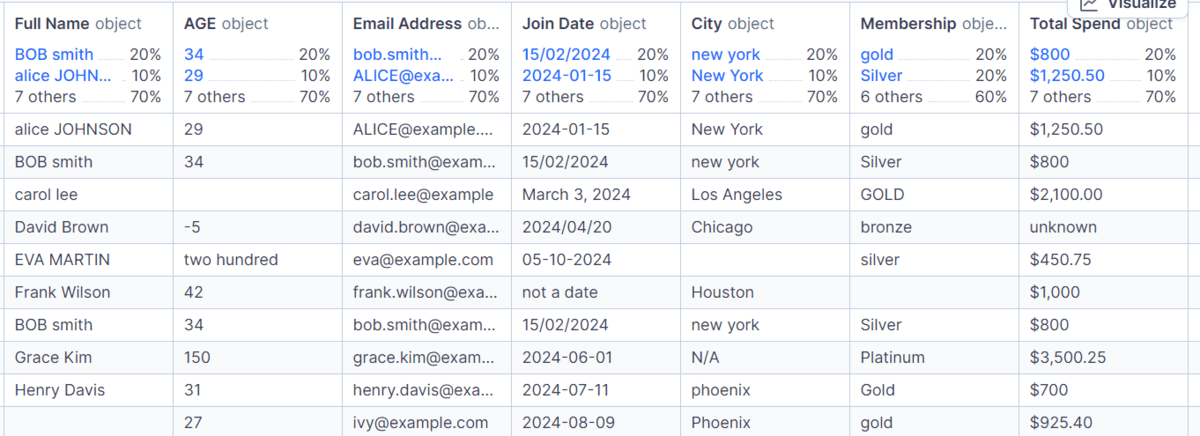
Raw data, particularly when exported from legacy systems or collected via user-input forms, is rarely ready for prime time. It is inherently "noisy," riddled with inconsistencies, structural anomalies, and incomplete entries. To transform this raw material into actionable insights, one must master the programmatic sanitization of data. This guide explores a systematic, professional-grade workflow using Python and the pandas library to transform a chaotic, real-world customer dataset into a pristine, analysis-ready asset.
1. The Core Philosophy of Data Sanitization
Data cleaning is not merely a technical chore; it is an act of verification. Before a single model can be trained or a single dashboard populated, the analyst must ensure that the dataset reflects reality. Common issues include:

- Structural Defects: Inconsistent column naming conventions and trailing whitespace.
- Data Integrity Issues: Duplicate records that skew statistical outcomes.
- Type Mismatches: Numeric figures stored as strings or dates represented in incoherent formats.
- Logical Anomalies: Impossible values (e.g., negative ages) or out-of-bounds categorical data.
By adhering to a standardized pipeline, professionals can reduce the risk of human error and ensure that their downstream analysis is reproducible and robust.
2. Chronology of the Cleaning Workflow
To effectively manage a messy dataset, one must approach the task with a chronological mindset—moving from macro-level structural fixes to micro-level data validation.
Phase I: Initial Inspection and Structural Normalization
The first step is always the "audit." Loading the data into a pandas DataFrame allows us to perform an initial shape and type check. Using commands like df.shape and df.dtypes provides the first glimpse into the mess.
Standardizing Column Names:
Messy column names—often containing inconsistent casing, spaces, or special characters—are the primary obstacle to efficient indexing. A professional approach involves:
- Stripping whitespace: Removing leading and trailing spaces.
- Case conversion: Forcing all headers to lowercase for uniform referencing.
- Snake-casing: Replacing spaces with underscores, which is the standard convention in Python-based data pipelines.
Phase II: The "Placeholder" Hunt
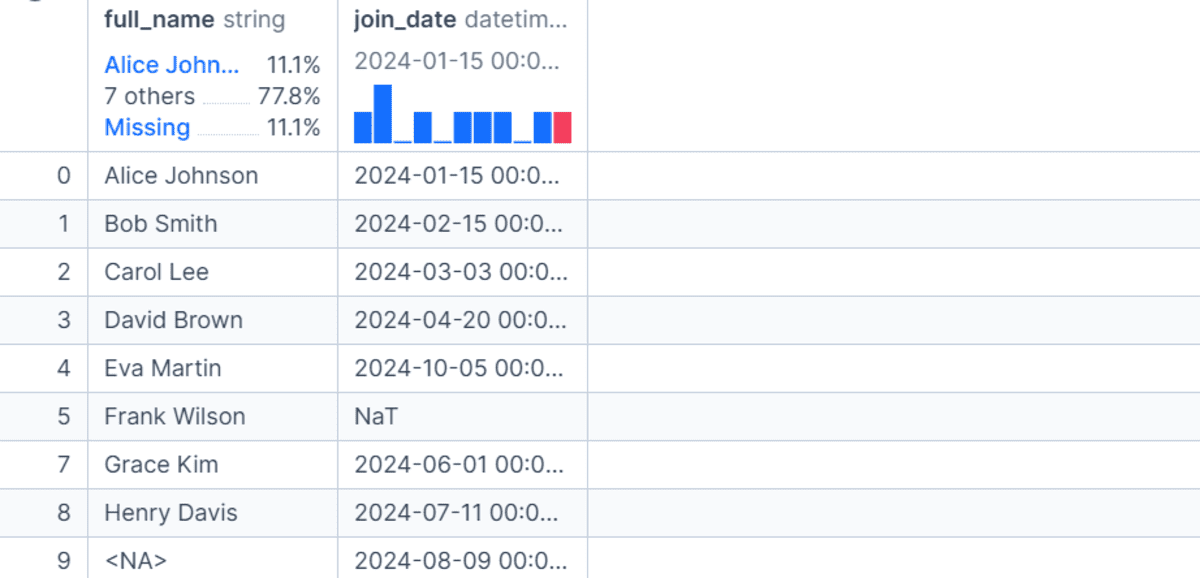
Real-world data often hides missing values behind human-readable labels like "unknown," "N/A," or even empty strings. If these are not converted to pd.NA (the pandas missing value sentinel), they will be treated as valid data, causing significant bias in calculations. By using regex-based replacement, we map these diverse placeholders into a uniform missing-value format, allowing for efficient identification and imputation later.
Phase III: Deduplication and Text Normalization
Duplicate rows are silent killers of accuracy. Whether caused by logging errors or system glitches, duplicates must be purged immediately. Following deduplication, text columns—such as names or cities—must be standardized. Applying str.title() or str.lower() ensures that New York and new york are treated as the same entity. This is crucial for categorical aggregation and grouping operations.

3. Supporting Data: Transforming Types and Validating Logic
Once the data is uniform, we shift our focus to data types and logical constraints.
The Numeric and Temporal Shift
A frequent error is storing numeric data (like total spend) or dates as text objects.
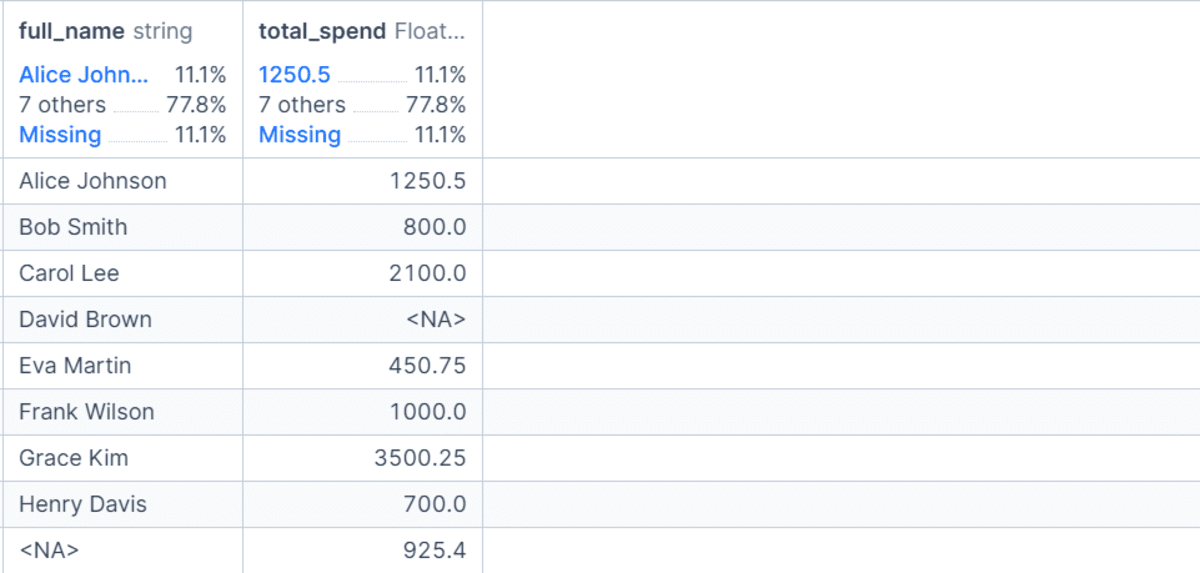
- Numeric Conversion: We strip currency symbols and commas, then cast the column to numeric. Any value that cannot be coerced into a number is replaced with
NaN, ensuring that math functions do not crash. - Datetime Parsing: Dates are notoriously difficult due to mixed formats. By utilizing
pd.to_datetimewith theformat='mixed'parameter, we can handle multiple date structures in a single column, standardizing them into a machine-readable format.
Categorical and Logical Validation
If a column has a fixed set of allowed values (e.g., membership tiers like Bronze, Silver, Gold), any value outside this set is a data quality failure. We use Boolean indexing to identify and isolate these outliers, effectively "cleaning" the categorical space. Similarly, we apply logical bounds to variables like age, ensuring that no individual is recorded as being 200 years old or having a negative age.

4. Addressing Missing Values: The Professional Strategy
Once the data is cleaned, we are left with missing values. The "blind" approach—deleting every row with a missing value—is rarely appropriate in a business context. Instead, we apply context-specific strategies:
- Identity Rows: If a
customer_idis missing, the row is useless and should be dropped. - Imputation: For missing ages, filling with the median is a common, statistically sound practice that minimizes the impact of outliers.
- Defaulting: For text fields like "city," a placeholder like "Unknown" ensures the data remains intact without misrepresenting the customer’s location.
5. Implications: The Final Validation Gate
Before a dataset is finalized, it must pass a "validation gate." Using assert statements allows the developer to enforce business rules programmatically.
For example:
assert df["total_spend"].ge(0).all()ensures no negative spending exists.assert df["customer_id"].is_uniqueverifies that no duplicate IDs remain.
If these tests fail, the code alerts the user before the "clean" file is ever saved. This is the hallmark of a senior data engineer: creating systems that fail loudly and early rather than propagating silent errors into the final analysis.
6. Conclusion: A Reusable Framework
The process described here is not a one-off solution; it is a blueprint. In every data project, the specific variables will change, but the methodology—Load → Inspect → Normalize → Validate → Impute → Export—remains the industry standard.
By investing time in writing clean, modular cleaning scripts, data scientists ensure that the time spent on model building is grounded in truth. The ultimate goal of data cleaning is not just to reach a "clean" file, but to build confidence in the evidence. When a data professional can guarantee that the column names are standard, the types are correct, and the logic is validated, they transform raw data into a reliable foundation for enterprise decision-making.
As you progress in your data science career, remember that the most complex AI model is only as effective as the data feeding it. Mastery of these fundamental cleaning techniques is what separates the novices from the professionals who can deliver consistent, reliable, and high-impact results in any industry.
About the Author:
Abid Ali Awan is a certified data scientist and technical content creator focused on machine learning, data engineering, and AI development. With a background in telecommunications and technology management, he is dedicated to building robust AI solutions and mentoring the next generation of data professionals.


 Ali Ikhwan
 Nana
Nana