Evan Lee Salim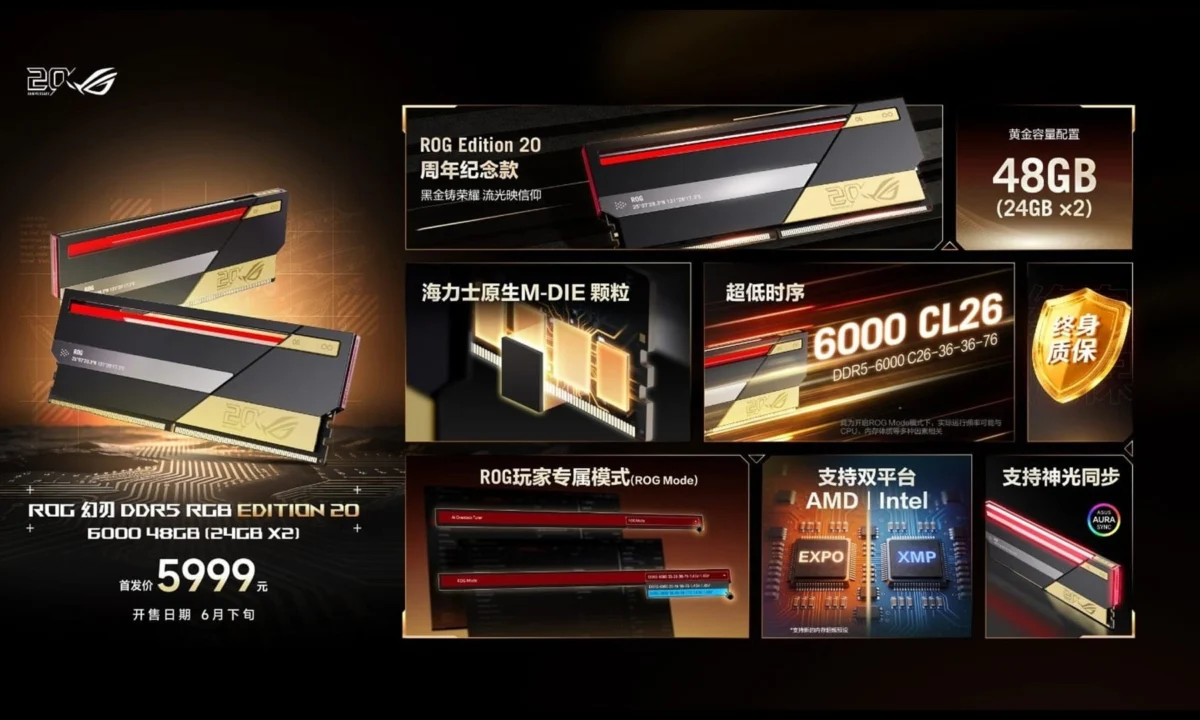
For the better part of two decades, the Republic of Gamers (ROG) sub-brand has served as the vanguard of the ASUS hardware empire. It has successfully colonized every corner of the enthusiast’s desk: gaming laptops, high-refresh-rate monitors, motherboards, GPUs, liquid coolers, power supplies, routers, and mechanical keyboards. Yet, despite this comprehensive dominance, one critical component remained absent from the ROG lineup: the system memory.
That final gap has officially been closed. To commemorate the brand’s 20th anniversary, ASUS has launched the ROG DDR5 RGB Edition 20, a premium memory kit that is as much a statement of intent as it is a functional piece of silicon. While it promises bleeding-edge performance, it also serves as a litmus test for the modern hardware industry: how much are consumers willing to pay for total aesthetic and functional ecosystem cohesion?
The Specifications: Performance Meets Premium Engineering
The ROG DDR5 RGB Edition 20 arrives in a 2x24GB configuration, totaling 48GB of high-speed memory. Out of the box, the kit is rated for DDR5-6000 speeds with extremely aggressive, low-latency timings of CL26-36-36-76.
Beneath the signature metallic heat spreaders, ASUS has opted for high-binned SK hynix M-die chips. These modules are widely regarded as the "gold standard" among extreme overclockers for their voltage tolerance and stability at high frequencies. However, the true party trick lies in the software integration. ASUS has introduced an exclusive "ROG Mode," accessible only through compatible ROG-branded motherboards.

When enabled via the BIOS, this mode pushes the kit to a blistering DDR5-8000 profile with 36-48-48-110 timings at 1.40V. This is not merely "plug and play" memory; it is a meticulously tuned overclocking solution designed to extract every possible frame from a high-end CPU and GPU pairing. The modules are, of course, adorned with heavy-duty aluminum heatsinks and integrated Aura Sync RGB lighting, ensuring they match the aggressive industrial design language of the broader ROG catalog.
A Chronology of the "ROGification" of the PC
The journey toward this release was not sudden. It has been a decade-long incremental encroachment into every facet of the PC build process.
- 2006–2010: The early years focused on motherboards and high-end GPUs. ROG established itself as a luxury tier for enthusiasts who demanded the best overclocking headroom.
- 2011–2015: Expansion into peripherals and displays. ASUS began building a "lifestyle" brand, moving beyond internal components into monitors and keyboards.
- 2016–2020: The "Ecosystem" shift. The introduction of standardized RGB control (Aura Sync) allowed users to unify their entire rig’s lighting. During this period, ROG entered the cooling and power supply markets, essentially allowing users to build a PC where nearly every part featured the same logo.
- 2021–2025: The "Total Integration" phase. With the launch of the ROG-branded RAM, the loop is finally closed. The company now offers the ability to build a computer where the memory, motherboard, and cooling solution are all tuned to operate in perfect harmony via a single BIOS interface.
The Cost of the "Full ROG" Dream
The most contentious aspect of this launch is undoubtedly the price. In the Chinese market, the kit is listed at 5,999 yuan, which translates to roughly $900 USD. To put that in perspective, that price point rivals the cost of a mid-to-high-end dedicated graphics card, such as an NVIDIA GeForce RTX 5070 Ti.
For the average consumer, the math is difficult to justify. High-performance kits from competitors like G.Skill, Corsair, or Kingston—offering similar, if not identical, speeds and capacities—can often be found for half the price.

However, ASUS is not targeting the "average" consumer. They are targeting the "completionist" enthusiast—the builder who values the stability of a single-vendor ecosystem, the aesthetic uniformity of a matching build, and the "peace of mind" that comes from buying components engineered to work together.
Ecosystem Lock-in: The Strategic Implications
Why would a hardware giant like ASUS move into the saturated RAM market? The answer lies in the concept of "ecosystem lock-in."
In the past, building a PC was a heterogeneous experience. You would mix and match parts from various manufacturers to get the best price-to-performance ratio. Today, the industry is shifting toward the "Apple-fication" of the PC. By controlling the motherboard, the BIOS, the RGB software, and now the RAM, ASUS can guarantee a level of compatibility and performance that is difficult to replicate with third-party components.
When a user enables "ROG Mode," they aren’t just getting higher speeds; they are getting a verified, tested, and supported performance profile that requires zero manual tweaking. For the user who wants the "best" but lacks the time or expertise to spend weeks tuning sub-timings, this represents a significant value proposition.

The Future of Component Manufacturing
The launch of the ROG DDR5 kit suggests that the PC hardware industry is moving away from a commodity-based model. Memory, which was once viewed as a simple utility, is being rebranded as a high-performance fashion accessory.
This trend is not without its risks. By moving toward a "total ecosystem" model, ASUS and its peers risk alienating the traditional "DIY" crowd, who may feel that the cost of entry is becoming artificially inflated by brand premiums. Furthermore, it raises questions about repairability and cross-platform compatibility. If the "best" features of a RAM kit are locked behind a proprietary BIOS setting, does that stifle the innovation that comes from open-standard hardware?
Official Responses and Industry Outlook
While ASUS has remained relatively quiet on the international pricing and global release date, the company has emphasized that the "Edition 20" branding signifies a commitment to high-end, limited-run hardware.
Industry analysts suggest that this move is a defensive play against the rise of pre-built, boutique gaming PCs. If a user can buy a high-performance, fully-tuned, branded system from a boutique builder, ASUS needs to provide a compelling reason for that user to stick with the "DIY" route. Providing a "premium tier" of components that offer a "guaranteed" top-tier experience is one way to keep the DIY spirit alive while capturing the high-margin market.

Conclusion: The Premium Tax
The ASUS ROG DDR5 RGB Edition 20 is an engineering marvel, but it is also a sign of the times. We have reached a point where the PC enthusiast market is bifurcated: on one side, a pragmatic, value-oriented sector focused on performance per dollar; on the other, a lifestyle-oriented sector that prioritizes brand identity, aesthetic consistency, and ease of use.
Whether this $900 memory kit is worth the price is a question that will be answered by the market. If it sells out, it confirms that for a significant segment of the gaming population, the "ROG" brand has transcended hardware to become a standard of quality and status. If it sits on shelves, it may signal that even the most dedicated enthusiasts have a limit to how much they will pay for a logo—even one as iconic as the Republic of Gamers.
Ultimately, the ROG DDR5 kit represents the culmination of a twenty-year journey. ASUS has successfully built a world where you can live, work, and play entirely within their ecosystem. It is an impressive, if undeniably expensive, achievement in corporate vertical integration. For the power user, it represents the final piece of the puzzle. For the rest of the market, it serves as a reminder that in the world of high-end PC gaming, you are rarely just paying for the silicon—you are paying for the badge, the ecosystem, and the dream of a perfectly synced machine.


 Ammar Sabilarrohman
 Asro
Asro