Muslim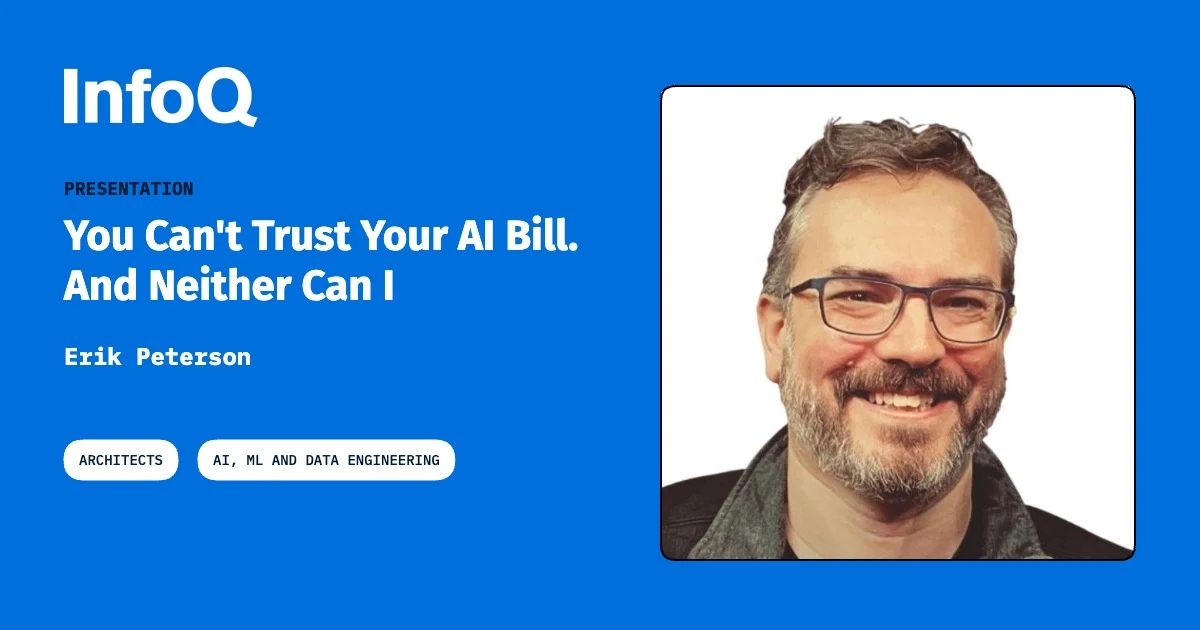
In the rapid-fire evolution of modern technology, a new, volatile variable has emerged: the invisible, escalating cost of artificial intelligence. Erik Peterson, CTO and founder of CloudZero, recently delivered a sobering assessment of the current AI landscape, arguing that while the industry is currently in the midst of a "forced promotion" toward total automation, the fiscal reality of this transition is far from sustainable. As companies scramble to integrate LLMs into every facet of their workflows, the traditional cloud billing model is being eclipsed by a chaotic, opaque, and increasingly expensive AI-driven expenditure.
The Financial "Mess": A Return to Analog Obscurity
For over a decade, cloud computing offered businesses a degree of transparency; while complex, an AWS or Google Cloud bill provided an itemized breakdown of services like EC2, S3, and data transfer. Peterson notes that the rise of AI has effectively reversed this progress, dragging the tech industry back to the "power company" model of the 1900s.
"We are back to where we were 100 years ago," Peterson explained. "I get a bill that is the equivalent of: you spent $500 on 10,000 kilowatt-hours. Doing what? Providing what? I don’t know."
This lack of granularity, compounded by inconsistent vendor schemas and the "invisible" nature of inference costs, has created a management nightmare. Researchers at the University of Maryland have even coined the term "CoIn" (Cost of the Invisible) to describe the hidden expenses—often tied to model fluctuations or backend infrastructure changes—that organizations pay without ever seeing a clear line-item explanation.
Chronology of the "Tokenmaxxing" Fever
The current state of affairs can be traced back to early 2024, when the industry entered what Peterson calls the "tokenmaxxing" universe—an era defined by the frantic, often unmonitored consumption of AI tokens.
- Q1 2024: The term "tokenmaxxing" gains traction, fueled by C-suite directives that equated high AI spend with high innovation.
- May 2024: Despite claims that the trend had peaked, the "AI gold rush" continued to accelerate, with enterprises rushing to implement every new model regardless of cost-to-value ratios.
- Late 2024: The emergence of "vibe coding"—using LLMs to generate codebases without deep human oversight—led to massive, uncontrolled spikes in compute costs.
- Early 2025: A growing number of CFOs began noticing a stark inversion: the cost to build (the R&D and compute associated with AI) has now surpassed the cost to serve (the actual delivery of products to customers).
Supporting Data: The Jevons Paradox in Action
The economic strain is best understood through the lens of Jevons Paradox, an 1865 observation that as technology becomes more efficient, the total consumption of that resource increases rather than decreases.
CloudZero’s internal data reveals a disturbing trend: while the cost per token has plummeted by nearly 1,000% over the last year, enterprise AI spend has simultaneously surged by 222%. This inverse relationship suggests that companies are not using efficiency gains to save money; they are using them to expand their consumption exponentially.
"Every AI startup combined is still eight times short of the total AI CapEx spend of all the cloud providers," Peterson noted, highlighting the massive capital imbalance. Furthermore, the reliance on high-cost, high-performance models (like OpenAI’s o1) persists even when more cost-effective models would suffice for the task, often because organizations lack the internal governance to distinguish between "necessary intelligence" and "vanity compute."
The "Denial-of-Wallet" Threat
Perhaps the most alarming implication of this unchecked spending is the security vulnerability known as "Denial-of-Wallet." In this scenario, an attacker gains access to a company’s cloud environment—specifically targeting services like Amazon Bedrock—and begins executing massive, expensive AI queries.
Unlike a traditional DDoS attack, which attempts to take a site offline, a Denial-of-Wallet attack seeks to bankrupt the target by leveraging their own automated infrastructure against them. Because many companies have failed to implement strict budget caps or per-user usage limits, an attacker can theoretically spend a company’s entire quarterly budget in a matter of hours.
The Evolution of the Developer Role
The human cost of this technological shift is as profound as the financial one. Peterson argues that the role of the software engineer is undergoing a "forced promotion." The days of the "perfect craftsperson" obsessing over individual lines of code are numbered. Instead, the future engineer will act as a manager of agents—a "driver of the tractor," as Peterson puts it.
This transition, however, is not without its casualties. The "friendly typewriter operators" of the past, displaced by the arrival of the computer, now serve as a historical mirror for today’s developers. The skill set required to survive is shifting away from pure syntax and toward "taste"—the ability to curate, validate, and guide AI-generated output. If a developer cannot articulate the business value of their code in terms of unit economics—the cost per transaction or the cost per outcome—they are at risk of obsolescence.
Implications for Corporate Strategy
As the industry moves toward 2027, Peterson predicts a "fully autonomous cloud" where AI writes, deploys, and manages the code it runs on. To survive this transition, companies must adopt several key strategies:
1. Shift from Dashboards to Unit Economics
Stop relying on generic budget alerts, which are often ignored until the damage is done. Instead, focus on unit economics. If you cannot identify the cost of a specific feature or business outcome, you are flying blind. Finance and engineering must bridge the gap; the language of the CFO (P&L, margins, unit costs) must become the second language of the CTO.
2. Treat Every Decision as a Buying Decision
The era of "free" exploration is over. Whether it is a research query in Perplexity or a code generation prompt in Claude, every interaction has a cost. Companies must move away from the "open bar" approach to AI tools and toward a culture of intentional consumption.
3. Implement Governance as Code
Just as we have automated testing, we need automated governance. This includes hard limits on token consumption per user, per project, and per department. If the system is capable of infinite spending, the human guardrails must be equally robust.
4. Embrace the "Outcome-First" Metric
The obsession with cost-per-token is a trap. Organizations should instead focus on the value generated per dollar spent. Is the AI agent producing a 10x output for 5x the cost? If the answer is yes, the investment is justified. If the answer is unknown, the system is failing.
Conclusion: The Path Forward
The "tokenmaxxing" fever will eventually break, but it will leave behind a fundamentally altered tech landscape. The companies that succeed will be those that transition from being "builders" of raw code to "curators" of automated value.
"The cost of knowledge is rapidly approaching zero, but the cost of wisdom is going to go near infinite," Peterson concluded. By mastering the economics of AI—understanding not just what we are building, but why we are building it and at what cost—engineers can secure their place in a future where AI handles the drudgery, leaving the high-level strategy and taste to human architects. The bill is coming due, but for those who learn to "drive the tractor," the promotion is well worth the price.


 Basiran
 Lina Irawan