
 Basiran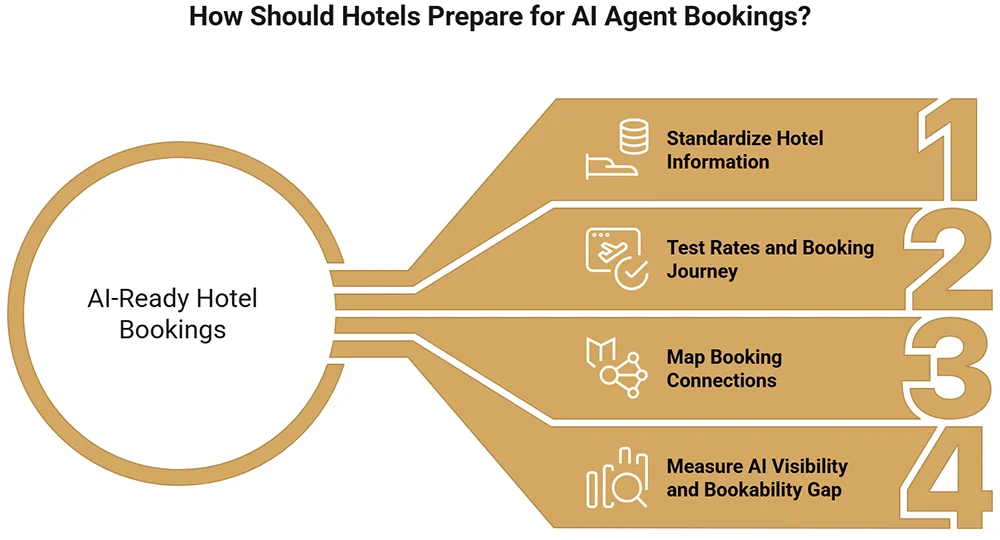
The landscape of travel distribution is undergoing a fundamental shift. For decades, the digital booking journey was defined by a linear path: a traveler visits a website, searches for a hotel, compares prices, and manually completes a transaction. Today, that process is being disrupted by "agentic" technology. An agentic hotel booking is not merely a recommendation engine; it is an AI-driven reservation process where an autonomous system interprets a traveler’s complex needs, searches across vast databases, evaluates suitability, and facilitates a direct booking—all while the traveler retains final oversight and payment authorization.
With the recent integration of checkout capabilities into Google’s AI Mode and the proliferation of AI assistants like ChatGPT and Meta Muse, the hospitality industry faces a critical turning point. For hoteliers, this is no longer a futuristic concept—it is an operational reality that demands immediate attention to property data integrity, rate parity, and digital distribution strategy.
Understanding the "Agentic" Shift
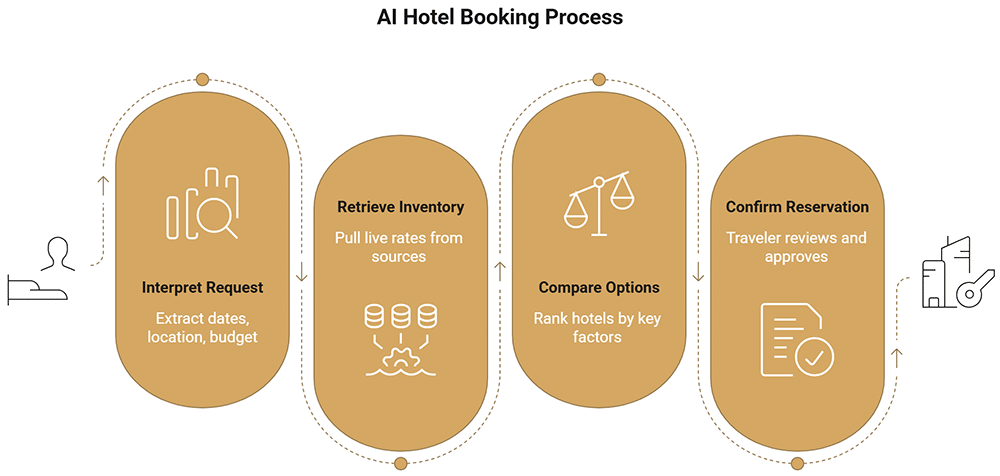
The term "agentic" signifies an AI system’s ability to take autonomous action toward a specific goal. Traditional chatbots operate on a reactive model; they answer questions based on pre-programmed knowledge bases. In contrast, an AI booking agent operates on an active model. If a traveler asks for "a pet-friendly hotel in downtown Chicago with a gym and breakfast under $300 for next weekend," the agent does not simply provide a list of links. It interprets the criteria, scans live inventory, checks real-time availability, verifies pricing, and guides the user through a checkout flow.
This shift represents a transition from information retrieval to transactional execution. The agent acts as a digital concierge, bridging the gap between a vague intent and a confirmed reservation. However, this capability is heavily reliant on the "tools" the AI has at its disposal—specifically the APIs, booking partners, and payment protocols it can access.
Chronology of the AI Booking Revolution
The rapid evolution of this technology has been marked by several key milestones:
- October 2025: The launch of booking integrations within ChatGPT via partners like Booking.com and Expedia signaled the first major move toward conversational commerce in travel.
- March 2026: OpenAI refined the user experience by moving the final checkout process directly into the partner’s app, ensuring a more secure and standardized transaction environment.
- May 2026: Google reported an 80% surge in planning-related queries within its AI Mode, highlighting that users are increasingly comfortable delegating the research phase to machines.
- August 27, 2026: Google officially began rolling out integrated hotel booking within AI Mode in the U.S. This update allows travelers to select a room and pay via Google Pay without ever leaving the search interface, effectively shortening the path from discovery to conversion.
- September 2026: Meta announced "Muse," an AI agent designed to integrate with Expedia’s inventory, further cementing the trend of social and search platforms becoming primary booking engines.
Supporting Data and the "Trust Gap"
Despite the technological prowess of these agents, adoption is not purely a matter of technical capability—it is a matter of psychology. According to research from the Expedia Group, there remains a significant "AI Trust Gap." Surveying over 5,700 adults across the U.S., U.K., and India, the study revealed that 68% of travelers still prefer to book through a trusted, recognized travel brand rather than a generic AI interface, even when agentic booking is readily available.
This suggests that while the AI may handle the legwork of searching and comparing, the final "seal of approval" remains tethered to brand recognition. For hotels, this presents a unique challenge: the AI might suggest your property, but the traveler might navigate away to your direct site if they perceive the AI platform as untrustworthy or lacking in customer service support.
The Role of Universal Commerce Protocol (UCP)
The engine behind Google’s move into agentic booking is the Universal Commerce Protocol (UCP) for Lodging. James Byers, Group Product Manager for Google Search, has noted that UCP acts as the common language allowing AI to interact with disparate hotel systems. By utilizing UCP, along with the Agent Payments Protocol (AP2) and Model Context Protocol (MCP), Google is building a scalable infrastructure that connects the AI to real-time, bookable hotel inventory.

For the hotelier, this means that the ability to appear in these AI-driven results is no longer just about SEO; it is about interoperability. Hotels that remain disconnected from these modern communication protocols risk falling into a "visibility vacuum," where they are ignored by the very agents that are increasingly controlling the top-of-funnel traffic.
Implications for Revenue Management and Strategy
Ric van Holthe tot Echten, Founder of Revenue Guru, highlights the double-edged sword of this transparency. "AI will make the market significantly more transparent," he explains. "Pricing mistakes, rate disparities, and inventory errors will be exposed in seconds. If your direct website is selling a room for $220, but an OTA is pushing the same room for $205 through an AI agent, the agent will naturally steer the customer toward the cheaper option. This not only destroys your margin but also erodes the power of your direct channel."
The Strategic Necessity of Rate Parity
The rise of agentic booking reinforces the classic need for strict rate parity. Because AI agents are built to optimize for the user’s constraints—namely price and convenience—they are the ultimate arbiters of your distribution health. If your rate structure is inconsistent across channels, the AI will expose it, often leading to a permanent shift in how your property is ranked and presented by the algorithm.
The "Bookability Gap" Audit
Hotels must now track their "Bookability Gap"—a metric defined as the percentage of AI-generated mentions that do not offer a direct booking path. If a traveler searches for your hotel in an AI environment and the only options presented are third-party OTAs, you are losing control of the guest relationship.
How Hotels Should Prepare: A Four-Step Framework
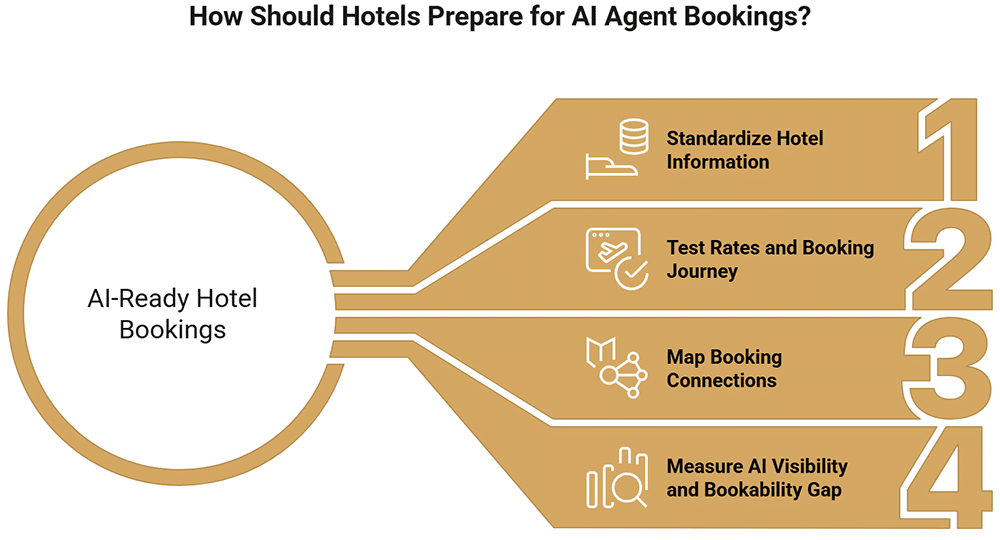
1. Standardize Property Information
AI models are trained on data, not intuition. If your pet policy is listed differently on your website than it is on your Google Business Profile or your GDS, the AI will likely hallucinate or present outdated information. Create a "single source of truth" for all descriptive property facts and ensure that this record is pushed consistently to all distribution channels.
2. Audit the Booking Path
Perform a monthly "AI audit." Use various prompts in Google’s AI Mode to see how your property is surfaced. Test the journey from the AI chat window to the payment screen. Are the taxes and mandatory fees clearly displayed? Does the checkout flow on mobile devices work seamlessly? Remember that the AI is judging your UX by its ease of use; a clunky, non-responsive booking engine will be penalized by the agentic interface.
3. Leverage Existing Connections
You do not necessarily need to be a large chain to benefit from UCP. Ensure your channel manager or booking engine provider is actively communicating their strategy for AI-integrated booking. Ask your partners: "How are we currently feeding our inventory into UCP, and what is our status for integrated checkout?"
4. Focus on Service Ownership
The biggest risk of agentic booking is the confusion regarding who owns the guest experience. When a booking occurs through an AI agent, it is vital that the guest receives clear confirmation and understands whom to contact for modifications, cancellations, or refunds. If the booking is OTA-led, the OTA is the merchant of record. Ensure your operational staff is trained to handle these "AI-originated" guests with the same level of care as those who book directly.
Conclusion: Embracing the Agentic Future
The rise of agentic hotel booking is not a death knell for direct sales; it is a wake-up call for operational excellence. As AI becomes the primary interface through which travelers interact with the world, the hotels that win will be those that have mastered the technical and strategic requirements of this new era.
By maintaining rigorous data hygiene, enforcing strict rate parity, and auditing the "bookability" of their digital presence, hoteliers can ensure that when an AI agent goes to work for a traveler, their property is the one that gets the reservation. The goal is simple: make your property the most accurate, the most reliable, and the easiest to book—even for a machine.


 Reynand Wu
 Nana Wu




