
 Nila Kartika Wati
In the modern hospitality landscape, the battle for a guest’s attention begins the moment they step across the threshold. While traditional printed signage and static lobby displays have served their purpose for decades, they are increasingly failing to engage the modern, digitally native traveler. Today, the most forward-thinking hotels are turning to a more dynamic solution: the LED video wall.
Far from being a mere aesthetic upgrade, a well-planned LED video wall is a multifunctional asset that serves to welcome guests, elevate brand storytelling, streamline event logistics, and drive ancillary revenue. As properties look for ways to modernize their physical spaces, this guide examines how LED technology is reshaping the guest experience and how hoteliers can implement these systems without falling into common, costly traps.
Understanding LED Video Wall Technology
At its core, an LED video wall is a seamless, large-format display composed of modular cabinets that lock together to form a singular, cohesive image. Unlike traditional television grids—which are plagued by thick black bezels that interrupt visual flow—LED video walls offer a "canvas" approach. Because they are modular, they can be scaled to fit almost any architectural requirement, from a compact, high-definition feature behind a reception desk to a massive, cinematic backdrop in a grand ballroom.
The technology relies on two primary specifications that determine quality: pixel pitch and brightness (nits). Pixel pitch refers to the distance between the center of one LED pixel to the next, measured in millimeters. A lower pixel pitch results in a higher density of LEDs, providing sharper imagery at closer viewing distances. Brightness, measured in nits, ensures that the display remains legible even in environments with high ambient light, such as sun-drenched lobbies or outdoor-facing restaurant patios.
The Evolution: From Static Signage to Dynamic Engagement
The transition toward digital displays in hospitality has not happened overnight. It is part of a broader shift in experiential design that began in the early 2010s.
- Phase 1 (The Static Era): Hotels relied on printed posters, vinyl banners, and static wayfinding signs. Updates were slow, expensive, and often looked "tired" after just a few weeks.
- Phase 2 (The Consumer TV Era): Properties installed grids of standard commercial TVs. While an improvement, the visible bezels created a fragmented image that lacked sophistication.
- Phase 3 (The LED Revolution): Starting around 2018, the cost of high-quality LED panels dropped, and their resolution improved, allowing hotels to install "digital art" and high-impact messaging that felt integrated into the hotel’s architecture rather than "tacked on."
Today, we are in the era of integration, where video walls are synced with property management systems (PMS) to provide real-time updates on meeting room availability, local transit, and personalized guest greetings.
Supporting Data: The ROI of Digital Presence
The business case for LED video walls is increasingly grounded in measurable data. According to recent hospitality industry surveys, properties that utilize dynamic digital displays see a 20–30% increase in engagement with on-property services, such as dining and spa offerings.
Furthermore, in the events space, the shift toward permanent LED installations has significantly reduced the "friction" of AV rentals. A hotel that offers a built-in, high-definition LED wall for conferences can charge a premium for meeting space rentals, as it removes the need for clients to outsource expensive, temporary projector and screen setups. This creates a "sticky" revenue stream, as event planners are more likely to book a venue that provides a seamless, high-end technical solution out of the box.
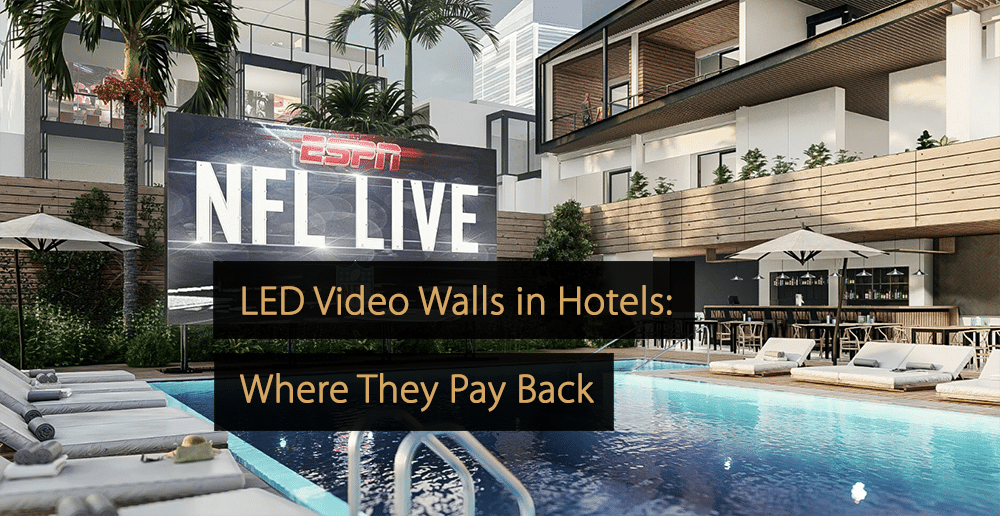
Strategic Implementation: Where the Investment Pays Off
To maximize return on investment (ROI), hoteliers must be surgical about where they install these displays. The following areas represent the highest impact zones:
1. The Lobby and Reception: The First Impression
This is your most valuable real estate. A video wall here should not function as a billboard, but as a digital concierge. Use it for elegant, high-resolution destination imagery, welcome messages for large groups, or brand storytelling that reinforces the hotel’s ethos. The key is subtlety; the content should be slow-moving and atmospheric, enhancing the lobby’s ambiance rather than distracting from it.
2. Ballrooms and Meeting Spaces
This is where the technology pays for itself. A permanent LED wall provides a massive advantage over standard projection. It looks sharper in brightly lit rooms, eliminates the "shadow" issues caused by speakers walking in front of a projector beam, and allows for rapid setup times. When sourcing these, prioritize front-serviceable cabinets, which allow technicians to swap out a single malfunctioning module without dismantling the entire wall.
3. Food and Beverage Outlets
Restaurants, bars, and rooftop lounges often struggle to maintain a consistent atmosphere from morning to night. A video wall allows a space to pivot from a bright, aesthetic morning café to an high-energy, sports-focused sports bar or a sophisticated, moody lounge in the evening, simply by changing the digital content.
4. Wayfinding and Retail
In expansive resorts or complex conference hotels, high-traffic areas near elevators and main thoroughfares are perfect for digital wayfinding. By providing interactive or clear, rotating directions to amenities, restaurants, and event halls, hotels can significantly reduce the burden on front desk staff, allowing them to focus on high-value guest interactions.
Planning Your Installation: A Step-by-Step Guide
The failure of many digital projects stems from poor planning. Before the first cabinet is mounted, hotel leadership must address the following technical requirements:
The "Viewing Distance" Rule
A common mistake is choosing a pixel pitch that is too coarse for the space. A simple heuristic is: the pixel pitch in millimeters should equal the minimum viewing distance in meters. If your guests are standing two meters away from a lobby display, you need a 2mm pitch. Using a 4mm pitch in that scenario would result in a pixelated, unprofessional image.
Infrastructure and Structural Integrity
Do not underestimate the weight of an LED wall. It requires a dedicated, reinforced mounting structure and sufficient electrical capacity. A comprehensive site survey is mandatory. You must also ensure that data cabling (Cat6 or fiber) is routed to a centralized, climate-controlled server room to protect the video controller.
The Lifecycle of Content
The hardware is only 50% of the project. The other 50% is content management. You must determine:
- Who creates the content? (In-house marketing or an external agency?)
- How often does it change? (Static loops vs. real-time dynamic data.)
- Integration: Can the screen pull data from your event management software to automatically update meeting room schedules?
Perspectives from Industry Leaders
According to experts in hospitality technology, the most common pitfall is viewing an LED wall as a "set and forget" purchase.
"Many hotels buy the hardware and then leave it displaying a static image of their logo for three years," says one industry consultant. "That’s a wasted opportunity. The value lies in the agility of the medium. The best hotels use these walls to celebrate local culture, display live weather and transit data, and even feature ‘Instagrammable’ moments that encourage guests to share their experience on social media."
Furthermore, manufacturers emphasize the importance of "batch matching." LED modules are manufactured in batches, and there are subtle color variations between them. Always order 5–10% more modules than you need for the initial installation. This ensures that if a module fails three years from now, you have a replacement from the original batch that matches the color and brightness of the rest of the wall perfectly.
Avoiding Costly Mistakes: A Checklist for Success
To protect your long-term investment, keep these red flags in mind:
- Ignoring Servicing: If a wall is flush-mounted against a wall with no access to the rear, ensure you buy front-serviceable panels. If you don’t, you will have to tear out the wall to fix a single dead pixel.
- Neglecting the Content Budget: Don’t spend $100,000 on the screen and $0 on the content. A low-resolution video on a high-resolution wall looks worse than a high-resolution video on a lower-end wall.
- Lack of Professional Management: If the content is "too busy" or "too loud," it will alienate guests rather than impress them. Invest in professional graphic design for your content loops.
- Short-term Thinking: Look for suppliers who offer long-term warranties and software updates. A display that cannot be updated as new protocols emerge will become an expensive paperweight within five years.
Conclusion: The Path Forward
The integration of LED video walls into the hotel environment is more than a trend; it is a fundamental shift in how physical spaces interact with the digital world. By transforming static walls into dynamic, responsive, and revenue-generating assets, hotels can create a more seamless and personalized guest journey.
Start small. Identify one high-impact area—perhaps the main lobby or a flagship meeting room—and monitor the impact on guest satisfaction and event revenue. Once the return on investment is validated, scale the strategy across the property. In a world where guest attention is the scarcest commodity, an LED video wall is perhaps the most powerful tool a hotelier has to capture it.


 Reynand Wu
 Nana Wu




