Ammar Sabilarrohman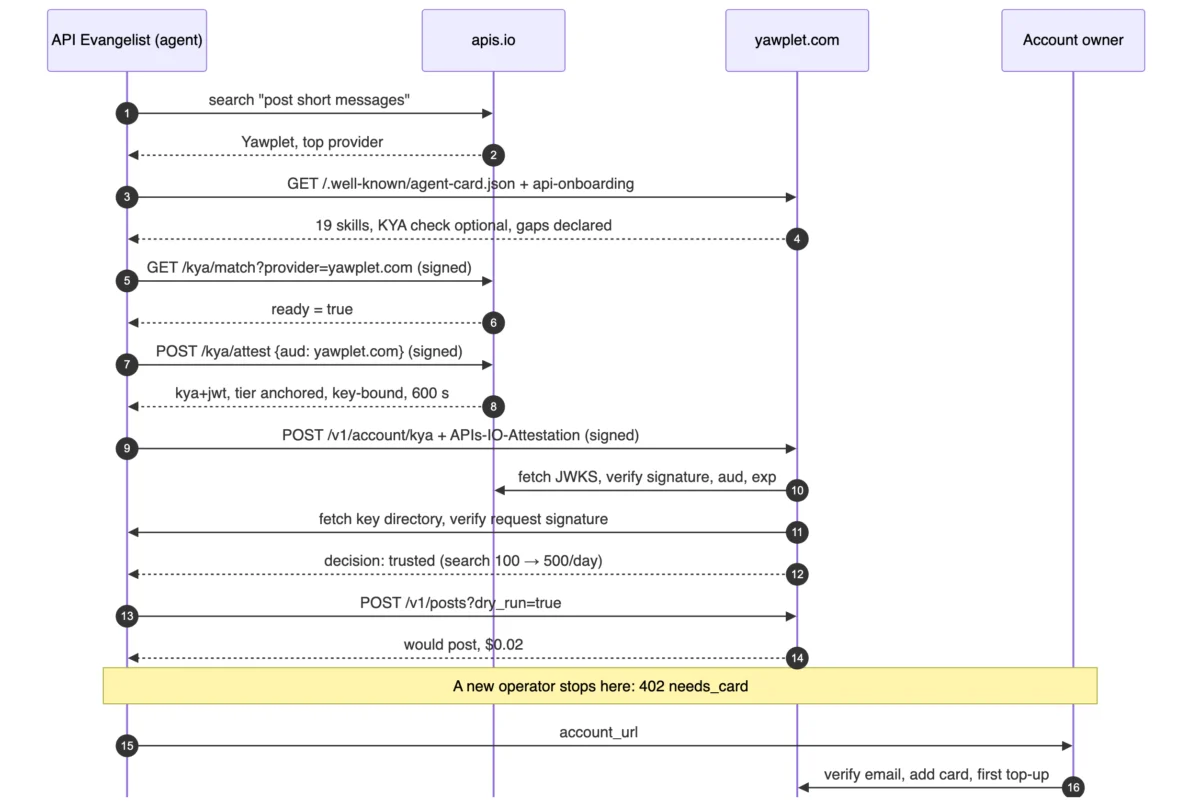
In the rapidly evolving landscape of the internet, the relationship between autonomous agents and digital infrastructure has long been defined by friction. For years, developers have struggled with a fundamental question: How can a service provider trust a piece of software that isn’t a human user, without compromising security or resorting to clumsy, restrictive gatekeeping?
This fall, Kin Lane, the renowned "API Evangelist," sought to answer this question not through theoretical white papers, but through rigorous, hands-on experimentation. By launching four distinct, API-first micro-sites—Yawplet, Yarnhen, Hagglebee, and Eventwren—Lane created a sandbox environment to observe how autonomous agents navigate trust protocols. On October 15, he achieved a significant milestone: his own autonomous agent successfully negotiated trust with all four platforms, performing a complex authentication sequence in under seven seconds.
Main Facts: A New Protocol for Machine-to-Machine Trust
The experiment centered on the concept of "Know Your Agent" (KYA), a digital equivalent to the "Know Your Customer" (KYC) protocols used in banking. Unlike traditional authentication, which often relies on static API keys or human-mediated OAuth flows, this approach leverages a decentralized model of verification facilitated by APIs.io.
The four platforms—Yawplet (for short messages), Yarnhen (for stories), Hagglebee (for classifieds), and Eventwren (for events)—were built as "API-first" entities. This means their primary interface is machine-readable, designed to be discovered and operated by agents rather than human browsers.
The core of the successful interaction lies in three components:
- The Agent Card: A machine-readable file listing 19 specific capabilities and permissions the agent requires.
- The Onboarding Descriptor: A standard file (
/.well-known/api-onboarding) that defines the platform’s security requirements. - The KYA Attestation: A time-bound, cryptographically signed token issued by APIs.io that validates the agent’s identity and its relationship to a specific domain.
By decoupling the directory (APIs.io) from the decision-maker (the API provider), the system avoids the "gatekeeper" trap. APIs.io provides the verifiable facts, but the individual API provider remains the ultimate arbiter of trust.
Chronology: The October 15 Breakthrough
The experiment was not a singular moment of success but a sequence of technical handshakes. At the center of the operation was the "API Evangelist" agent, a piece of software programmed to solve a specific problem rather than interact with a specific brand.
1. The Discovery Phase
The agent began with a simple query directed at APIs.io: "post short messages." The directory returned Yawplet as the most relevant provider. The agent then fetched the site’s "agent card" and onboarding descriptor, mapping out the necessary steps to gain access.
2. The Verification Request
The agent requested an attestation from APIs.io. Because the agent uses "Web Bot Auth"—a system where every request is signed with a cryptographic key tied to a specific domain (apievangelist.com)—APIs.io was able to verify that the agent was indeed authorized by the domain owner.
3. The Handshake
APIs.io issued a signed attestation, essentially stating: "This agent controls apievangelist.com and is authorized for this specific interaction for the next ten minutes." The agent presented this to Yawplet.
4. The Decision
Yawplet verified the signature of APIs.io, confirmed the attestation was fresh and addressed to its own URL, and matched the public key against the agent’s signature. Satisfied, the site recorded the trust decision in the account ledger.

5. Execution
Within seven seconds of initiating the search, the agent performed a dry-run post, confirming that the system was operational and calculating a transaction cost of two cents.
Supporting Data: Infrastructure and Security
The robustness of this system relies on its refusal to rely on "reputation" as a nebulous concept. Instead, it relies on cryptographic binding.
- Non-Transferability: The attestation issued by APIs.io is bound to the agent’s private key. If a malicious actor were to intercept the attestation, it would be useless without the corresponding private key, which is anchored to a specific domain.
- Temporal Limits: Attestations are valid for only ten minutes, drastically reducing the window of opportunity for replay attacks.
- One-Time Use: Each attestation is tracked and consumed, preventing multiple agents from using the same proof of identity.
- Performance Metrics: With a total processing time of five to seven seconds, the system demonstrates that high-level security verification does not need to be a bottleneck for automated workflows.
Official Perspectives: The Philosophy of Decentralization
Kin Lane’s approach is rooted in a philosophy of non-interference. By positioning APIs.io as a directory rather than a regulator, he is attempting to establish a standard for the web that mimics the organic growth of the internet itself.
"APIs.io doesn’t tell a site whom to trust," Lane noted in his post-mortem analysis. "That matters more to me than anything else here. A directory that hands out trust becomes a gatekeeper nobody asked for."
This distinction is crucial. In the current AI-agent landscape, there is a looming fear that a few large corporations might become the "trust authorities" for all machine activity. By keeping the KYA checks optional and allowing providers to weigh the evidence as they see fit, Lane is promoting a decentralized ecosystem where trust is granular, negotiable, and, most importantly, owned by the provider.
Implications for the Future of the Web
The success of these four sites suggests that we are entering an era where "API-first" will transition into "Agent-first."
The End of Human-in-the-Loop Friction
Currently, the most significant barrier to autonomous agents is the "human-in-the-loop" requirement for account funding and identity verification. Lane’s experiment successfully automated the trust component, moving the goalposts toward the next major hurdle: autonomous payment.
The Roadmap for Developers
The experiment revealed seven initial points of failure, most of which were remediated within hours. This highlights the maturity of the tools involved. By publishing the onboarding descriptors and the KYA protocols openly, Lane is inviting other developers to build their own "trust-aware" services.
Economic Implications
What does trust actually buy in this model? Currently, very little—and that is by design. A trusted agent gets increased search quotas, but it is still subject to the same moderation and pricing structures as any other user. This "small, honest thing" approach allows for the system to be battle-tested without risking significant financial or reputational damage.
Conclusion: A Blueprint for Autonomy
The path forward for the internet is not one of walled gardens where agents are either blocked or given full administrative access. Instead, the future lies in the kind of verified, time-limited, and context-specific trust handshakes pioneered by the API Evangelist experiment.
As we look toward a future where autonomous agents manage our calendars, our finances, and our content, the ability to prove who we are—and more importantly, who our agents are—will be the bedrock of the digital economy. Kin Lane’s experiment proves that this technology is not just possible; it is already running. The pieces are public, the code is open, and the door is open for the industry to adopt these standards. The next phase, as Lane suggests, will be the integration of autonomous wallets—the final piece of the puzzle in creating an internet that can truly work for itself.


 Raul Delapena Setiawan