 Laily UPN
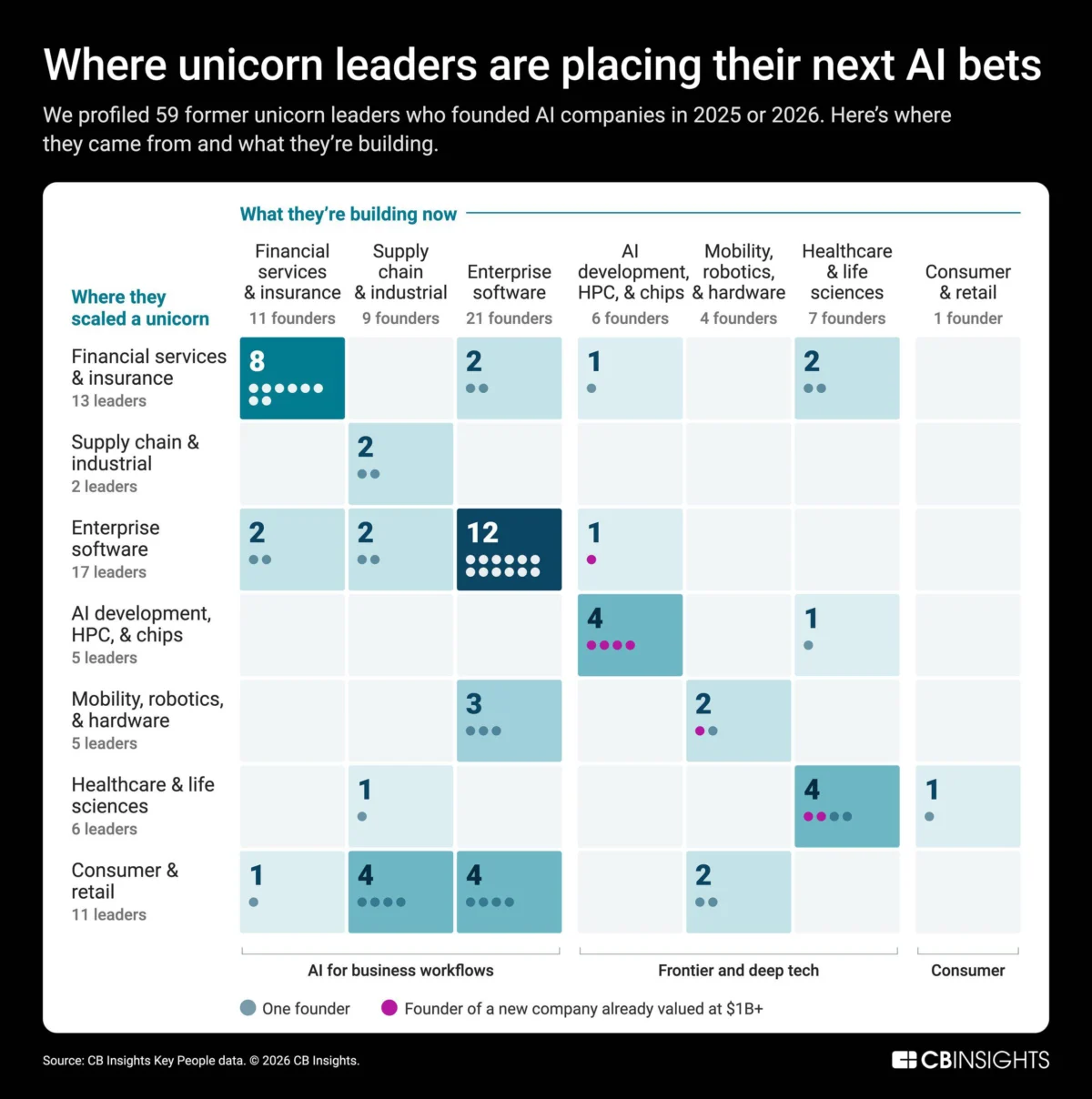
The global technology landscape is undergoing a profound structural shift as the architects of the previous decade’s "unicorn" boom transition into the next frontier: Artificial Intelligence. A recent deep-dive analysis by CB Insights, which tracked 59 high-profile founders and executives across 48 emerging ventures, reveals a clear trend. These seasoned leaders, having previously scaled businesses to billion-dollar valuations, are not merely dabbling in the AI gold rush—they are aggressively pivoting to redefine enterprise infrastructure, industrial automation, and deep tech.
Main Facts: The New Wave of "Unicorn" Founders
The data indicates that the "second act" for these veteran leaders is rarely a departure from their core competencies. Instead, it is an application of AI to solve the systemic inefficiencies they encountered while building their first billion-dollar companies.
Take, for instance, Lunar co-founders Ken Villum Klausen and Peter Andreasen. Having successfully disrupted the banking sector, they are now applying their financial expertise to Repodo. The venture utilizes AI to streamline the labor-intensive processes of audit record preparation and documentation, effectively bridging the gap between automated efficiency and the human oversight required for final certification.
This trend is not isolated. A significant portion of the cohort is moving from consumer-facing marketplaces or payroll systems into highly technical domains like autonomous systems, security video analytics, and computational infrastructure. The pattern is clear: these founders are leveraging their hard-won operational experience to address "unsexy" but essential business problems that AI is uniquely positioned to solve.
A Chronological Shift: From Scaling to Automating
The transition of these founders follows a distinct timeline. During the 2010s and early 2020s, the focus for these leaders was hyper-growth—hiring in the hundreds, expanding into new geographies, and capturing market share.
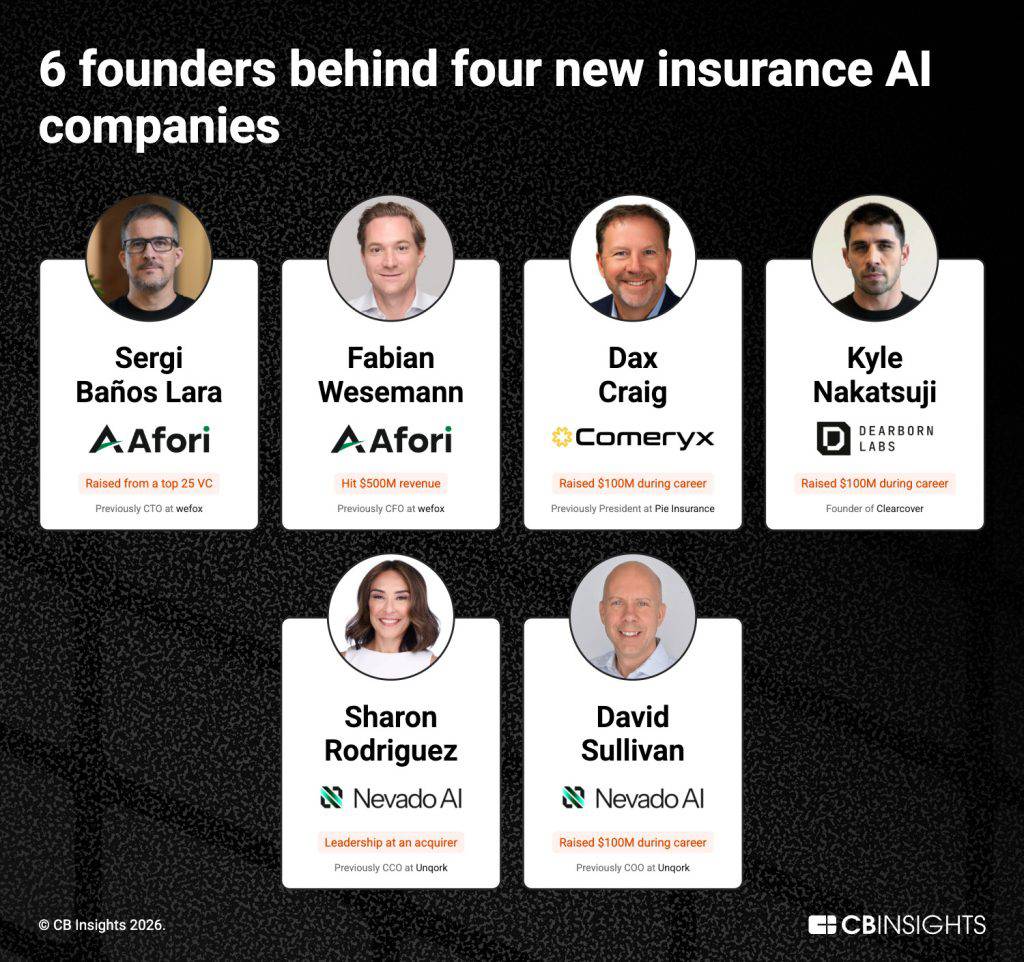
In the 2025–2026 cycle, however, the strategy has shifted toward "capital-efficient scaling." As David Sullivan, COO of the AI-driven insurance firm NevadoAI, noted in a recent interview, the approach to team building has fundamentally changed. "Previously, we were hiring tens and hundreds of people in a quarter," Sullivan remarked. "We don’t feel like we need as many people in order to do what we’re doing."
This philosophy—automating back-office operations to funnel capital directly into high-leverage areas like engineering and customer acquisition—is the hallmark of this new generation of founder-led AI companies. By prioritizing lean, AI-augmented teams, these leaders are bypassing the "bloat" that often plagued their previous ventures.
Supporting Data: The Heatmap of Industry Migration
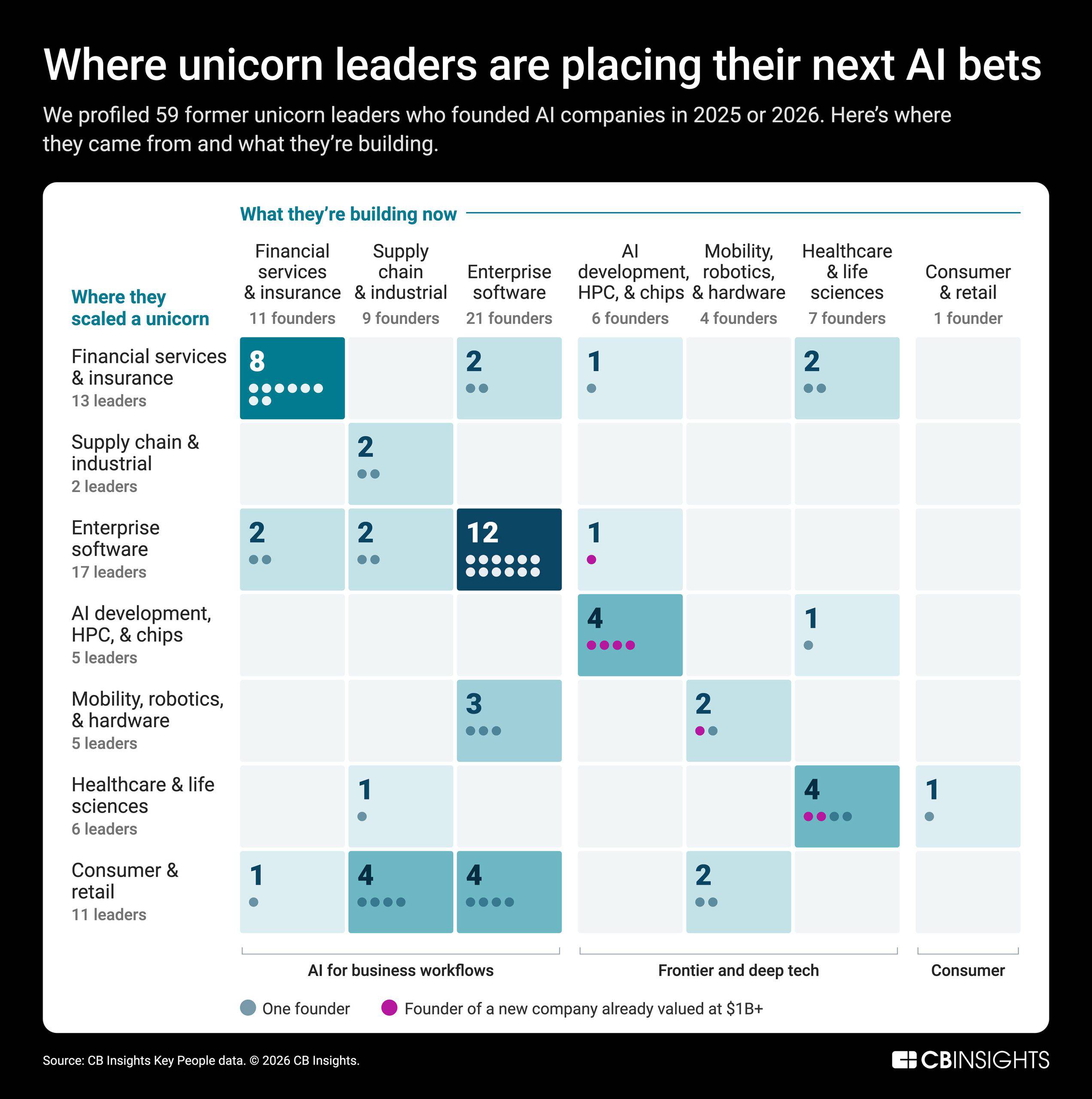
The movement of these 59 leaders is not random; it is highly correlated with their previous domains. Our analysis of the migration patterns reveals three key clusters:
1. The Continuity Cluster
A majority of leaders from enterprise software (12 out of 17) and financial services (8 out of 13) are choosing to remain within their home industries. They are utilizing their intimate knowledge of industry-specific pain points to build specialized AI tools. This reduces the "learning curve" and allows for faster product-market fit.
2. The Frontier and Deep Tech Surge
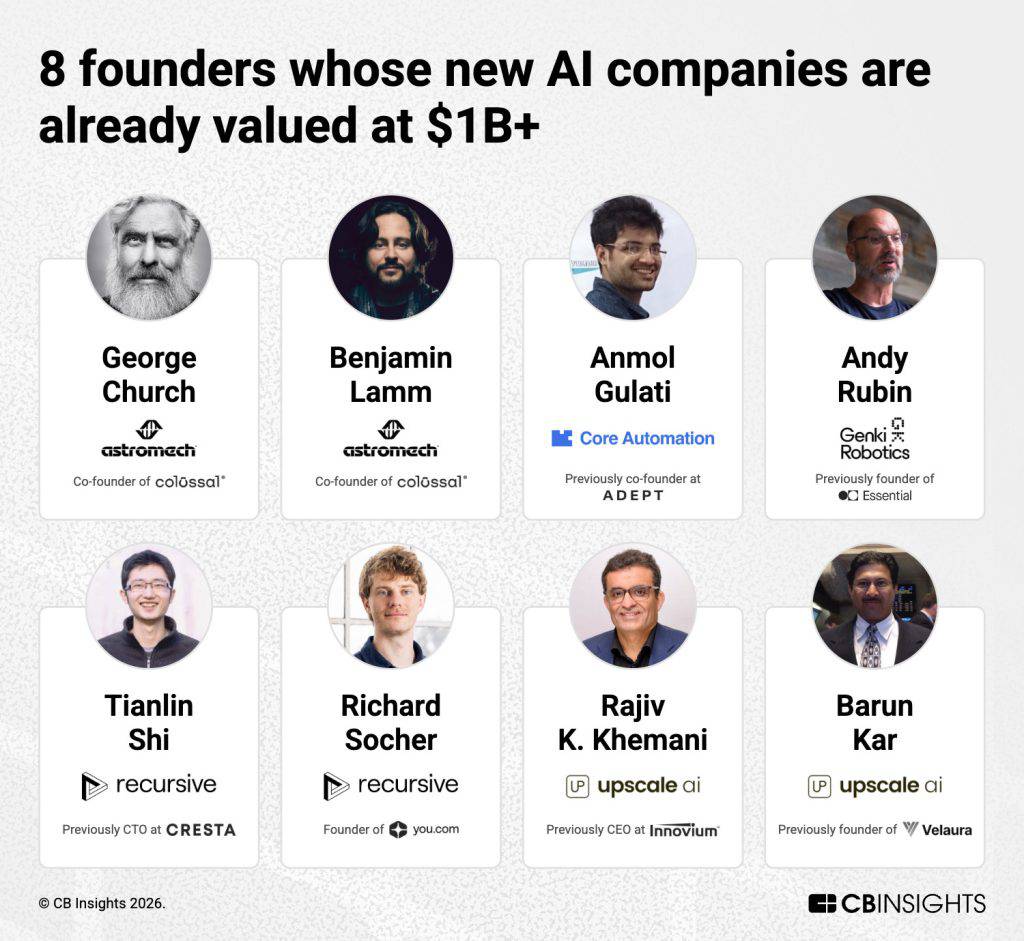
Perhaps the most striking development is the emergence of five new companies that have achieved unicorn status almost immediately:
- Recursive Superintelligence
- Core Automation
- Astromech
- Upscale AI
- Genki Robotics
These companies are not just software layers; they are building foundational computing infrastructure, robotics, and scientific research capabilities. This suggests that the current investment climate is favoring "hard tech" that promises to move the needle on global productivity, rather than just incremental software improvements.
3. The Pivot to B2B
There is a notable exodus from the consumer and retail sectors. Of the 11 leaders who built their reputations in consumer-facing markets, none have returned to that space. Instead, they are pivoting to B2B operations, applying the logistical and operational lessons learned from high-volume consumer businesses to enterprise software. By building software for other operators, they are essentially "selling the picks and shovels" to the businesses they once competed against.

Official Responses and Strategic Shifts
The discourse among these leaders highlights a shared skepticism toward the "growth at all costs" mentality of the past. The consensus among the cohort, based on interviews and strategic moves, is that AI represents the first time in a generation that a company can truly decouple revenue growth from headcount growth.
David Sullivan of NevadoAI serves as the archetype for this shift. By focusing on automating the "boring" parts of the insurance business, the company is able to concentrate its human capital on high-value, customer-facing interactions. This is a direct response to the market pressure for profitability and sustainable margins that defined the end of the previous unicorn cycle.
Furthermore, leaders like Reid Hoffman (Manas AI) and others in the table are focusing on infrastructure and "Physical AI"—machines, robot training data, and real-world task software. This represents a strategic departure from the abstract, large-language model hype toward tangible, ROI-driven deployments.
Implications: What This Means for the Future
The migration of 59 billion-dollar-proven leaders into AI has several profound implications for the venture capital ecosystem and the broader economy:
The "Experienced Founder" Premium
Investors are increasingly betting on the "repeat founder." The data shows that when a leader who has already built a billion-dollar business starts a new company, the market responds with significant capital, often propelling these firms to unicorn valuations within months rather than years. This "experience premium" is reshaping the fundraising landscape.
Consolidation of Talent
As these leaders recruit, they are creating a talent magnet effect. Engineers and product managers are flocking to these companies not just for the compensation, but for the opportunity to work under founders who have already successfully navigated the "zero to one" and "one to one hundred" phases of business growth.
The Death of the "Generalist" AI Startup
The trend toward vertical-specific AI—audit firms, insurance bots, robotics for specific industrial tasks—suggests that the market is moving away from general-purpose AI toward specialized, domain-expert solutions. The winners of this next wave will not be the companies with the most generic data, but those that leverage the deep, industry-specific expertise of their founders to build proprietary, high-moat products.
A New Era of Operational Efficiency
If the 2010s were defined by the "Move Fast and Break Things" mantra, the 2025–2026 cycle is being defined by "Build Smart and Automate Everything." By integrating AI into the very foundation of their organizations, these 59 leaders are creating a new blueprint for what a modern, high-growth company looks like.
Conclusion
The data from CB Insights provides a roadmap of where the smartest minds in technology are placing their bets. As these founders turn their attention to the challenges of the physical world, the complexities of automated finance, and the nuances of enterprise infrastructure, the resulting wave of innovation is likely to be more durable and more profitable than the software-only trends of the past.
For the broader market, the lesson is clear: the most successful AI companies of the next five years will be built by those who understand the friction of the old world well enough to replace it with the efficiency of the new. Whether through Repodo in the audit space or Genki Robotics in the industrial sector, the common thread is the pursuit of tangible utility. As we look toward the remainder of the decade, the question is no longer who is building AI, but who is building the infrastructure that will power the next generation of global commerce.


 Rifan Muazin

 Lina Hope