Rifan Muazin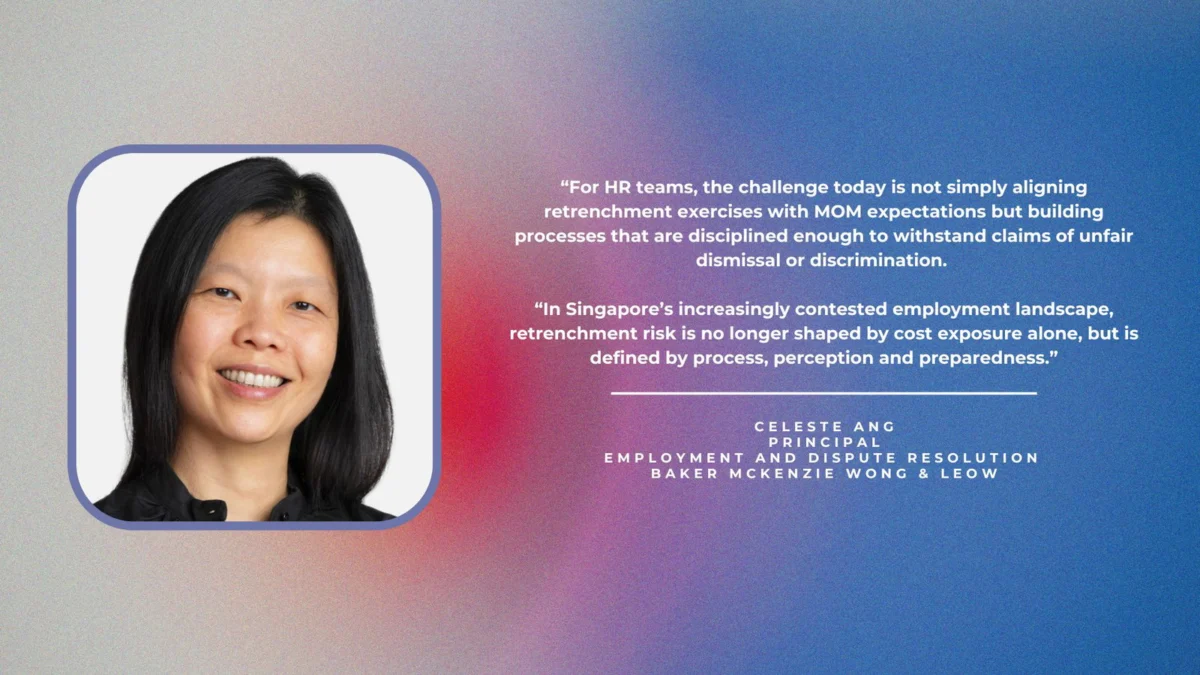
In the modern Singaporean corporate landscape, the act of workforce restructuring has undergone a fundamental transformation. What was once viewed strictly through the lens of operational efficiency and commercial necessity is now an exercise subject to intense, multi-layered scrutiny. As regulatory oversight tightens and the public eye sharpens, employers can no longer rely on the simplicity of "at-will" or contractual termination clauses to shield them from the fallout of a poorly managed layoff.
Celeste Ang, Principal of Employment and Dispute Resolution at Baker McKenzie Wong & Leow, warns that the primary risk to modern organizations is no longer just the immediate financial cost of severance, but the reputational and legal aftermath of a process that lacks perceived fairness.
The Shift: From Routine Management to Regulatory Scrutiny
Historically, Singapore’s labor laws have been characterized by their flexibility, granting employers significant autonomy in managing their workforces. While it remains true that there is no statutory mandate for redundancy payments in the traditional sense, the landscape has shifted toward a "compliance by expectation" model.
Today, the Tripartite Partners—comprising the Ministry of Manpower (MOM), the National Trades Union Congress (NTUC), and the Singapore National Employers Federation (SNEF)—maintain a watchful eye over how retrenchments are executed. The focus has moved from the legality of the decision to the integrity of the process. Employers are now expected to demonstrate that their selection criteria were objective, their communication was transparent, and their efforts to support displaced workers were robust.
Chronology and Regulatory Milestones
The current regulatory environment is the result of years of incremental shifts in employment policy:
- Pre-2020: Retrenchment was largely treated as a private commercial matter, with minimal government intervention beyond basic statutory notice periods.
- 2020-2022: The COVID-19 pandemic acted as a catalyst for more stringent guidelines. As layoffs surged, the MOM, NTUC, and SNEF increased their collaborative efforts to ensure that businesses did not use the pandemic as a cover for discriminatory or arbitrary firing.
- January 20, 2023: The Tripartite Partners released an updated Advisory on Managing Excess Manpower and Responsible Retrenchment. This document serves as the "gold standard" for conduct, outlining expectations for notification, selection, and support.
- 2025: The passing of the Workplace Fairness Act (WFA) marked a historic shift. For the first time, workplace discrimination is set to be codified into comprehensive law, moving from guidelines to statutory requirements.
- 2027 (Expected): Full implementation of the WFA, which will provide a clear legal framework for employees to seek redress for discriminatory practices, including those embedded in retrenchment exercises.
The Compliance Landscape: Advisory vs. Statute
For many HR practitioners, the distinction between "advisory" and "statute" has been a source of confusion. While the Tripartite Advisory on Managing Excess Manpower and Responsible Retrenchment does not technically carry the force of law, its practical influence is immense.
The Role of TAFEP and the TGFEP
The Tripartite Guidelines on Fair Employment Practices (TGFEP), overseen by the Tripartite Alliance for Fair and Progressive Employment Practices (TAFEP), set the tone for corporate culture. While non-binding in a strict sense, TAFEP acts as a gatekeeper. Reports of discriminatory retrenchments—such as targeting employees based on age, nationality, or family status—are investigated by TAFEP and, if found credible, are escalated to the MOM.
This escalation process can lead to significant administrative hurdles, potential public disclosure of the company’s shortcomings, and loss of work pass privileges. In the court of public opinion, a TAFEP investigation is often synonymous with a reputational crisis.
Implications of the Workplace Fairness Act (WFA) 2025
The imminent implementation of the WFA represents the most significant change to the employment landscape in decades. By prohibiting discrimination based on protected characteristics, the Act effectively creates a statutory weapon for employees who feel they have been unfairly targeted during a downsizing event.
Key Implications for Organizations:
- Legal Recourse: Employees will have a clear, statutorily backed pathway to challenge their termination if they can prove discrimination was a factor.
- Penalties: The WFA introduces potential criminal liability and civil remedies, shifting the risk profile from "HR headache" to "Board-level liability."
- Documentation Standards: Companies will need to maintain meticulous records justifying why specific individuals were chosen for retrenchment. "Last-in, first-out" or performance-based metrics will need to be backed by verifiable data, not subjective manager feedback.
Managing Risk: Practical Steps for HR Leaders
To survive the scrutiny of the current and future landscape, Celeste Ang suggests that HR teams must treat retrenchment as a high-stakes legal project rather than a routine administrative task.
1. Mandatory Notification and Transparency
Employers with 10 or more employees are legally obligated to notify the MOM within five working days of informing the affected employees. Failing to do so is not just a breach of policy; it is a clear violation of statutory duty. Beyond the MOM, transparency with the workforce—and in some cases, the unions—is essential to maintaining morale and avoiding external escalation.
2. Objective Selection Criteria
Subjective selection is the leading cause of successful discrimination claims. HR must establish:
- Clear Metrics: Use data-driven performance reviews and objective business requirements.
- Consistency: Ensure the same criteria are applied across all departments.
- Neutrality: Ensure that the selection process is audited to ensure it does not inadvertently target specific demographics, which could trigger a WFA violation.
3. The "Process over Cost" Mindset
Organizations often focus exclusively on the cost-saving aspect of the layoff. However, the true cost is often found in the legal fees and time lost defending against unfair dismissal claims. By adopting a "fairness-first" approach, employers can minimize the likelihood of employees seeking intervention from unions or social media.
4. Supporting the Transition
The Tripartite Advisory emphasizes that responsible retrenchment includes providing support. This might include outplacement services, career coaching, or extended medical benefits. These gestures are not merely altruistic; they act as a buffer against litigation. A treated-well employee is significantly less likely to challenge the validity of their retrenchment.
The Cost of Public Perception
In the digital age, retrenchment is rarely a private affair. With the rise of platforms like LinkedIn, Glassdoor, and TikTok, an employer’s handling of a layoff can go viral in minutes. When an organization ignores the "spirit of the law" in favor of the "letter of the law," they invite public outrage.
The unions in Singapore are also increasingly active. They are no longer passive observers; they are prepared to voice concerns, demand transparency, and protect their members’ interests. Employers who ignore the tripartite spirit risk being labeled "unfair," a branding that can severely impact talent acquisition and retention for years to come.
Conclusion: Preparing for the 2027 Horizon
As Singapore moves toward the full implementation of the WFA in 2027, the "Wild West" days of workforce management are effectively over. The message from regulators is clear: the right to restructure is balanced by the obligation to treat employees with dignity and fairness.
For HR teams, the challenge is to build a culture of documentation and consistency today that will withstand the legal rigor of tomorrow. As Celeste Ang aptly notes, "In Singapore’s increasingly contested employment landscape, retrenchment risk is no longer shaped by cost exposure alone, but is defined by process, perception, and preparedness."
Organizations that view these regulations not as obstacles, but as a roadmap for ethical business conduct, will find themselves not only safer from a legal standpoint but also more resilient in the long run. The companies that thrive in the coming years will be those that prioritize the human element of the workforce, ensuring that even when difficult decisions are made, they are made with the integrity that the Singaporean market now demands.


 Ali Ikhwan
 Neng Nana