 Lina Irawan
Google is once again recalibrating its generative AI ecosystem. Shortly after rebranding the research-centric NotebookLM to better align with its broader AI portfolio, the tech giant is rolling out a significant update to how users manage their information. The introduction of "Collections" to Gemini Notebooks marks a shift from a simple, linear list of projects to a more sophisticated, user-centric workspace. This update arrives at a pivotal moment, as Google aggressively integrates these notebook capabilities into the core Gemini app and Google Search, turning a once-siloed research tool into a ubiquitous digital workspace.
The Core Problem: Managing AI-Driven Information Overload
For power users, researchers, and students, the primary challenge of generative AI tools has never been generation—it is curation. As users feed increasingly complex datasets into their notebooks—ranging from PDFs and Sheets to image-based research—the "My Notebooks" dashboard has become a cluttered, unmanageable space.
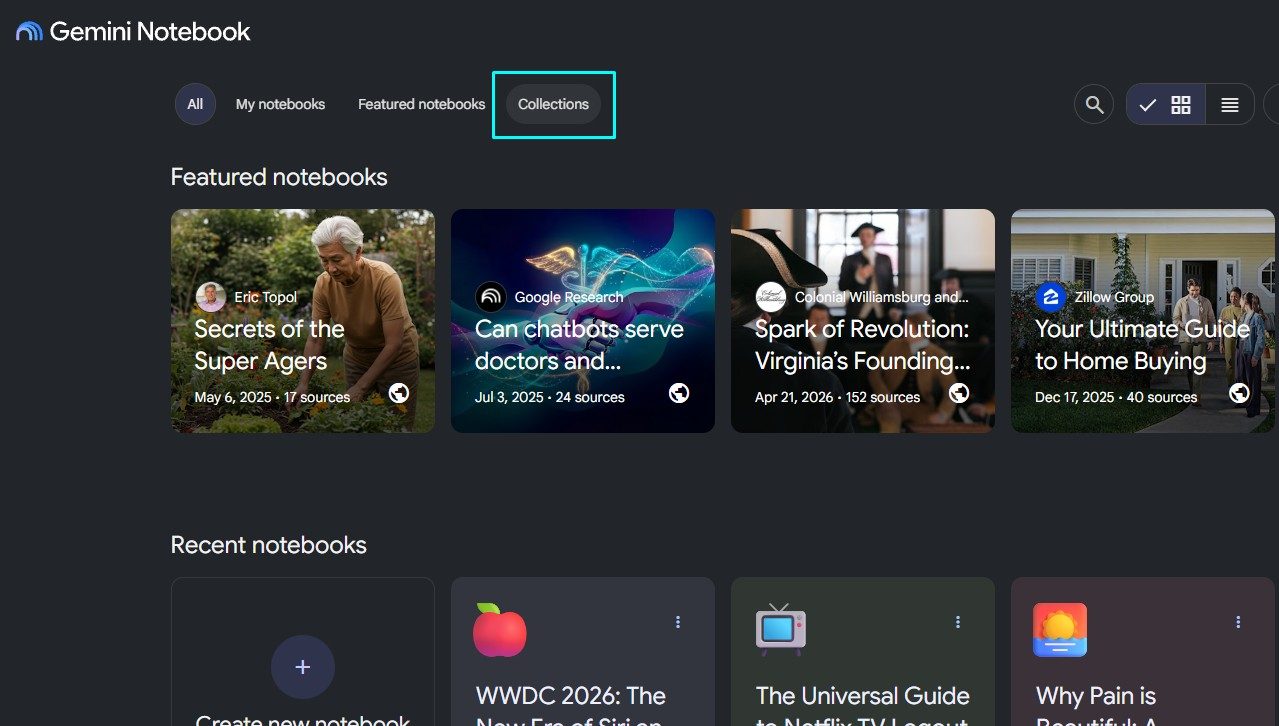
Previously, finding a specific project required scrolling through a growing, chronological list. With the launch of Collections, Google is offering a structural remedy. Collections allow users to group related notebooks, acting as virtual filing cabinets that prioritize visibility and ease of access. Crucially, this system is designed to be lightweight; it does not force users to overhaul their existing library or adhere to a rigid, hierarchical folder system that often hinders quick discovery.
Chronology of the Update
The evolution of Google’s notebook experience has been rapid, reflecting the company’s "all-in" strategy regarding AI integration:
- Initial Launch: NotebookLM launched as a standalone experiment, focused on "grounded" AI research—allowing users to upload sources and ask questions specific to those documents.
- The Rebrand: Google transitioned the tool into the Gemini Notebook branding, signaling its intent to unify the service under the Gemini ecosystem.
- Integration Phase: Over the past few months, these notebooks began appearing directly within the Gemini web and mobile interfaces, allowing users to cross-reference their research with ongoing AI chats.
- The "Collections" Rollout: As of late July 2026, the Collections feature has begun appearing for all Gemini Notebook users, providing the long-awaited organizational layer necessary for high-volume users.
How Collections Differ from Traditional File Management
The genius of the Collections feature lies in its flexibility. Unlike traditional operating system folders, which force a file into a single directory, a single Gemini Notebook can belong to multiple Collections simultaneously.
For instance, a user conducting research on "Renewable Energy Policy" could place that notebook in a "Work Projects" collection while also adding it to a "Climate Research 2026" collection. This eliminates the need for duplication, ensuring that the master version of the notebook remains the single source of truth. By functioning more like "playlists" in a music app than folders on a hard drive, Collections cater to the non-linear way that modern researchers think and work. Anything that doesn’t require specific sorting can remain in the default "My Notebooks" view, ensuring that organization is an optional utility rather than a mandatory chore.
The Broader Implications for the Gemini Workspace
The release of Collections is not merely a quality-of-life improvement; it is a tactical necessity for Google’s ecosystem expansion. Gemini Notebooks are no longer just a separate research app—they are being woven into the fabric of Google Search and the Gemini AI assistant.
Synergy with Google Search
Google is currently testing deep integration where relevant notebook entries can surface within Search results. As users accumulate hundreds of notebooks, the risk of "information dilution"—where the AI struggles to prioritize the right source material—increases. Collections allow the system to categorize information, potentially helping the Gemini engine better understand the context of a user’s library when performing cross-document analysis.
The "Unified Workspace" Vision
By bringing notebook projects into the main Gemini app, Google is competing directly with productivity suites like Notion, Obsidian, and Microsoft Loop. Users can now work with uploaded materials alongside their standard Gemini chats, custom instructions, and real-time web data. The ability to sync these projects across the web and mobile platforms means that the "workspace" is effectively becoming a persistent, AI-powered digital brain. Without an organizational layer like Collections, this vision would quickly become a user experience nightmare.

What is Still Missing? The Limits of the Current System
While Collections are a welcome addition, early feedback from the user community suggests there is still room for growth. Google has yet to introduce several features that "power users" have come to expect from sophisticated document management software:
- Nested Collections: Currently, the system is flat. Users cannot create sub-folders or sub-collections, which limits the ability to manage massive, multi-faceted projects.
- Automated Sorting: While Google has experimented with AI-driven document organization in other areas, Collections remain entirely manual. Users must drag and drop notebooks into their respective collections themselves.
- Advanced Metadata: There is no current functionality to tag, color-code, or add notes to the collections themselves, which limits the descriptive potential of the organizational structure.
Google’s decision to keep the system simple is likely intentional. By avoiding a steep learning curve, they ensure that the feature remains accessible to the average consumer. However, for professionals relying on Gemini for long-term research, the current implementation may still feel "basic" compared to dedicated knowledge management tools.
Official Stance and Community Feedback
Google has maintained a relatively quiet profile regarding the specific roadmap for Gemini Notebooks, preferring to let the updates speak for themselves through iterative releases. However, the company’s social media channels, specifically the @Gemini_Notebook account, have acknowledged that the update was a direct response to user feedback.

"We heard you loud and clear," the company stated in a brief announcement. By prioritizing the user’s request for structure, Google is signaling that it is listening to the community’s frustrations regarding the "wall of notebooks" effect. This is a critical development, as user retention in the AI space is heavily dependent on how effectively a platform can manage a user’s personal data.
The Future of AI-Powered Organization
Looking ahead, we can expect Google to continue iterating on this organizational framework. The next logical step would be the implementation of AI-suggested groupings. Imagine a scenario where, upon opening the dashboard, Gemini asks, "I noticed these five notebooks all contain data on ‘Macroeconomics.’ Would you like me to create a collection for them?"
Furthermore, as the company explores deeper integrations with Google Drive and Docs, the distinction between a "notebook" and a "file" may continue to blur. If Google successfully merges these ecosystems, the need for a robust, AI-assisted organizational layer will become even more pronounced.

Conclusion: A Step Toward Maturation
The introduction of Collections is a clear indicator that the Gemini Notebook platform is graduating from an experimental "research toy" to a professional-grade productivity tool. While the current feature set is limited, it solves the most pressing friction point for users: the clutter of an expanding, high-volume library.
For Google, this is about more than just organizing files; it is about building the infrastructure for the future of AI-assisted knowledge work. By ensuring that users can easily navigate their information, Google is making it easier for them to stay within the Gemini ecosystem, rather than migrating their research to third-party competitors.
For the average user, the takeaway is simple: your research library just got a little bit cleaner. Whether or not it evolves into the powerful, automated filing system that heavy researchers crave remains to be seen, but for now, the introduction of Collections is a necessary, and highly anticipated, step in the right direction. As Google continues to turn Gemini into a central workspace for the modern digital life, the ability to organize our AI-generated knowledge will prove to be just as important as the AI’s ability to generate it in the first place.


 Iffa Jayyana
 Pevita Pearce