
 Basiran
A severe security vulnerability, tracked as CVE-2026-39919, has been identified within the Ghostscript interpreter—a ubiquitous software component used by millions of systems globally to render and manipulate PostScript and PDF files. The discovery of this heap buffer overflow flaw has sent ripples through the cybersecurity community, as it potentially allows unauthenticated remote attackers to execute arbitrary code on servers simply by uploading a malicious, specially crafted PDF file.
The vulnerability was brought to light on August 23, 2026, by the security research team at Defiant, the company behind the popular Wordfence security platform. Leveraging their proprietary "Argus" AI-powered discovery system, researchers successfully reverse-engineered the flaw, demonstrating how an attacker could bypass standard security controls to seize control of a hosting environment.
The Mechanics of the Flaw: A Deep Dive into Heap Overflow
At its core, Ghostscript is a powerful suite of software that provides a PostScript interpreter and a PDF interpreter. It is frequently employed by backend systems to perform heavy-duty image processing, such as generating thumbnails for document previews, optimizing file sizes, or extracting metadata. In many Linux-based web environments, particularly those running WordPress, this process is automated via the PHP Imagick extension, which bridges the gap between the web application and ImageMagick, which in turn invokes Ghostscript to handle the rendering tasks.
CVE-2026-39919 manifests when Ghostscript processes a PDF file containing a JPEG 2000 image. Due to improper handling of low-bit-depth samples and mismatched component resolutions, the interpreter fails to allocate memory safely. Specifically, the researchers at Wordfence identified that an attacker could trigger a heap buffer overflow by forcing the engine to write 1,024 bytes of data into a buffer restricted to only 256 bytes. This discrepancy leads to memory corruption, which an adversary can then manipulate to redirect the execution flow of the software, effectively enabling Remote Code Execution (RCE).
Chronology of Discovery and Disclosure
The identification of CVE-2026-39919 represents a significant milestone in AI-assisted vulnerability research.
- August 23, 2026: Defiant’s Argus AI system flags suspicious patterns within the Ghostscript codebase, prompting a manual investigation by the security team.
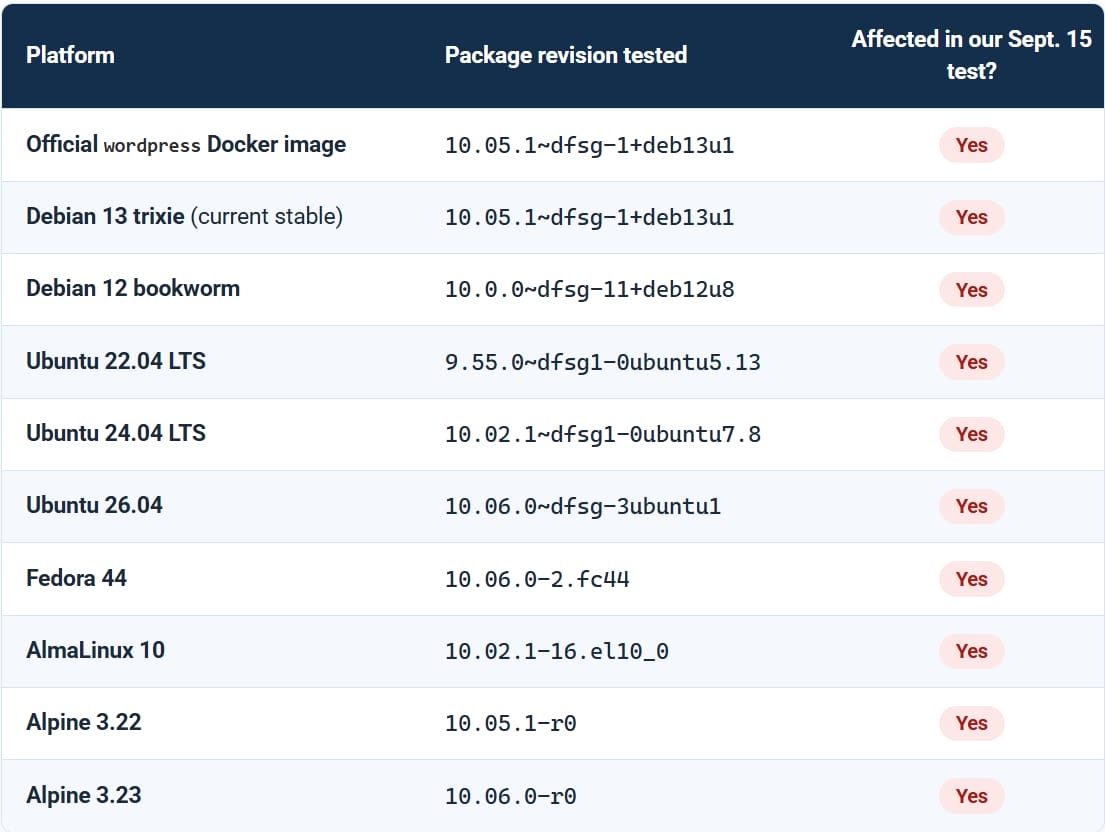
- Late August – Early September 2026: Researchers develop multiple Proof-of-Concept (PoC) exploits. Testing is conducted across a wide range of distributions, including Debian, Ubuntu, Fedora, Alpine, and AlmaLinux.
- September 8, 2026: Artifex, the primary maintainer of Ghostscript, releases version 10.08.0, which includes a comprehensive patch for the heap buffer overflow.
- Mid-September 2026: Patches are backported to various legacy versions of the software. Security advisories begin circulating among enterprise IT teams.
- October 2026: Public disclosure occurs as organizations move to patch their infrastructure against the threat.
Supporting Data and Environmental Impact
The scope of this vulnerability is vast, primarily because Ghostscript is often installed as a dependency without the system administrator’s direct knowledge. Wordfence’s investigation revealed that the vulnerability is not restricted to a single configuration. In their testing, they evaluated the exploitability across ten major Linux environments and the official WordPress Docker image.
Experimental Results
The researchers performed an exhaustive series of 10,240 exploit attempts in a controlled lab environment. While the initial attempts against standardized Linux packages did not yield consistent RCE, the team discovered that by fine-tuning the exploit—specifically by adjusting font configurations, language settings, and core system library dependencies—they could achieve successful execution.
This finding highlights a critical nuance in modern vulnerability management: "out-of-the-box" software might appear secure due to environmental hardening, but subtle variations in a server’s configuration can inadvertently remove those protections, making the server a viable target.
Prerequisites for WordPress Exploitation
While the vulnerability is global in nature, the researchers noted specific requirements for it to be weaponized against a standard WordPress installation:
- Authenticated Access: In a default WordPress installation, the platform does not allow anonymous users to upload files to the Media Library. Therefore, an attacker would generally need to possess a valid account with appropriate permissions (e.g., Contributor or Author) to initiate the file upload process.
- Ghostscript Integration: The server must be configured to use Ghostscript via ImageMagick for thumbnail generation.
- File Processing: The server must attempt to render the uploaded malicious PDF.
- Configuration Alignment: The environment must lack specific exploit mitigations that would otherwise cause the service to crash rather than execute the malicious payload.
Implications for the Global Digital Infrastructure
The implications of CVE-2026-39919 extend far beyond the WordPress ecosystem. Any application that accepts user-uploaded PDFs and uses Ghostscript to process them is potentially at risk. This includes enterprise document management systems, cloud-based file conversion services, and even specialized medical or legal software that handles heavy document processing.
The Danger of Implicit Trust
The reliance on third-party libraries like Ghostscript creates a "dependency chain" risk. Developers often trust that libraries are secure, yet when a vulnerability is found in a low-level engine, it can take weeks or months for that patch to propagate through the entire software supply chain. If a web application developer does not proactively monitor for updates to their underlying system libraries, they remain vulnerable even if their own application code is secure.
Official Responses and Remediation Steps
Artifex, the maintainer of Ghostscript, acted decisively by releasing version 10.08.0 shortly after notification. The industry consensus is that users must prioritize updating their systems.
Recommended Actions for Administrators:
- Immediate Patching: Ensure that the Ghostscript version installed on the host operating system is updated to 10.08.0 or higher. System administrators should verify the patch status through their package managers (e.g.,
apt-get,yum, ordnf). - Containerized Environments: For those utilizing Docker or other containerization platforms, updating the base image is insufficient if the image is cached. Administrators should force a rebuild of their images using a patched base version to ensure that the updated Ghostscript binary is included.
- Mitigation Strategies: If an immediate update is not feasible due to compatibility concerns, organizations should consider:
- Disabling PDF Rendering: Configure ImageMagick to block the processing of PDF files entirely if the feature is not strictly required.
- File Upload Restrictions: Implement stricter server-side validation to prevent the upload of malicious or unnecessary file types, particularly PDFs, until the system is patched.
- Sandboxing: Running Ghostscript within a restricted, sandboxed environment (such as a gVisor or Seccomp profile) can limit the impact of a successful exploit by restricting the attacker’s ability to interact with the underlying host OS.
The "Wild" Landscape
As of the latest reports from Wordfence, there is no evidence of active, in-the-wild exploitation of CVE-2026-39919. However, history suggests that once a PoC is understood and documented, the window of safety is limited. Attackers are likely already reverse-engineering the patch to develop reliable exploits, making immediate remediation essential.
Conclusion: The New Era of AI-Speed Attacks
The discovery of CVE-2026-39919 underscores the evolving nature of the threat landscape. The use of AI-powered systems like Argus to identify vulnerabilities at a speed that matches, or exceeds, traditional manual research, is becoming the new standard.
As defenders, the lesson is clear: relying on the assumption that "my server is too small to be targeted" is a dangerous fallacy. Automated scanners are constantly probing the internet for vulnerable software versions, and once a flaw is exposed, the time between disclosure and mass exploitation continues to shrink. Organizations must prioritize robust patch management cycles, adopt a "zero-trust" approach to third-party dependencies, and maintain continuous monitoring to ensure their digital perimeters remain secure against increasingly sophisticated, AI-driven threats.

 Raul Delapena Setiawan
 Lina Irawan





