Ammar Sabilarrohman
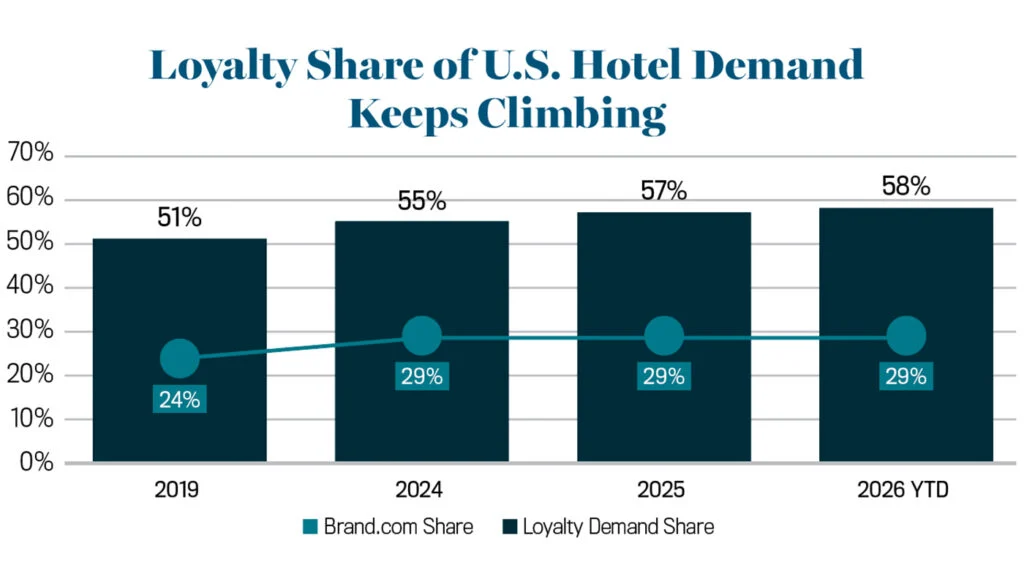
The landscape of U.S. hospitality is undergoing a quiet, yet seismic shift. For over a decade, hotel owners and brand executives have prioritized the "book direct" strategy, aiming to bypass the hefty commissions of third-party travel aggregators. As we move through the second half of 2026, the data finally confirms what industry leaders have long suspected: loyalty is no longer just a marketing "nice-to-have"—it is the primary engine of demand for the American hotel sector.
According to recent booking data from Kalibri, loyalty demand share—the portion of U.S. hotel room nights booked by program members—reached 58 percent during the first half of 2026. This represents a significant seven-point climb from the 51 percent recorded in 2019. This evolution in booking behavior is not merely a statistical anomaly; it is a direct result of sustained investment in digital infrastructure and the strategic pivot toward capturing the guest within the brand ecosystem.
The Financial Math of Direct Demand
The impetus behind this shift is grounded in basic, yet ruthless, economics. When a guest books through a brand’s native website—often tied to a loyalty account—the acquisition cost is drastically lower than a booking routed through an Online Travel Agency (OTA). Even after accounting for the overhead required to maintain a robust loyalty program, the margins on direct bookings are superior to those secured through third-party platforms that charge significant channel fees and commissions.
"Brand.com" bookings, which represent the digital storefronts of hotel chains, have risen to 29 percent of total demand, up from 24 percent in 2019. Perhaps most notably, this figure has held steady for three consecutive years, suggesting that while the initial growth was explosive, the channel has now matured into a stable, reliable pillar of revenue. For owners, this stability provides a hedge against the volatility of the broader travel market.
Chronology of the Shift: From Transaction to Relationship
The trajectory of the loyalty-driven model did not happen overnight. It is the culmination of a decade-long strategic transformation within the industry:
- 2016–2019: The "Book Direct" Campaigns. Brands launched aggressive marketing initiatives incentivizing guests to bypass Expedia, Booking.com, and other aggregators. These years were marked by the proliferation of "member-only rates" and simplified sign-up processes at the front desk.
- 2020–2022: The Pandemic Reset. As travel demand plummeted, the value of the "known guest" became paramount. Loyalty programs served as the lifeline for hotels trying to manage occupancy with limited resources.
- 2023–2025: Data Integration. Hotels began moving beyond simple point-earning systems. The focus shifted toward utilizing Guest Relationship Management (GRM) systems to personalize the guest experience, making the direct booking channel more attractive through customized perks.
- 2026: The Maturity Phase. We are now seeing the fruits of these investments. With loyalty demand at 58 percent, the industry has shifted from trying to acquire the customer to trying to retain the customer through high-value, member-only rate (LMR) incentives.
Supporting Data: The Growth of Member-Only Rates
While total U.S. room night demand has seen a modest increase of only 2 percent year-to-date in 2026, the underlying composition of that demand has changed drastically. The industry is currently experiencing a divergence between full-rate retail segments and loyalty-backed segments.

The most explosive category is the Loyalty Member Rate (LMR). As of the first week of July 2026, LMR bookings were up 19 percent year-over-year. It is critical to distinguish LMR from generic promotions; unlike a broad-based discount code or a point redemption, an LMR is a strategic price adjustment specifically earned by loyalty program status.
In contrast, other sectors are showing signs of stagnation or decline:
- OTA and Government Demand: Each up a mere 2 percent.
- Corporate Travel: Up 1 percent.
- Rack/BAR (Best Available Rate): Down 5 percent.
- Group Travel: Down 2 percent.
These figures illustrate a critical trend: the market is being driven by price-conscious, loyal travelers. The 6 percent climb in Average Daily Rate (ADR) across the industry, despite modest demand growth, suggests that hotels are successfully using member-only discounts to drive volume while protecting their core rate integrity—avoiding the "race to the bottom" often triggered by public OTA price wars.
The Human Element: Beyond the Script
While the data highlights the success of digital channels, industry experts emphasize that loyalty is fundamentally a human endeavor. A robust loyalty program is rendered useless if the "on-property" experience does not match the digital promise.
There is a distinct difference between a "scripted" guest interaction and a "systematic" guest recognition. For instance, a front desk agent greeting a guest by name is a hollow gesture if the next shift has no record of that guest’s preferences or previous stay issues. Truly successful properties integrate stay history into the operational workflow. When a guest’s request for a corner room or a note regarding a previous maintenance issue—such as a faulty air conditioning unit—is automatically flagged upon check-in, the loyalty becomes institutionalized.
Furthermore, empowerment is a key, yet often overlooked, lever. Managers who have the authority to resolve issues—such as waiving a parking fee or upgrading a room category without seeking corporate approval—create "memorable moments." These moments build deeper brand affinity than any point-based promotion ever could.

Alternative Paths for Independents
Smaller groups and independent hotels often feel disadvantaged by the marketing budgets of global brands. However, the current landscape offers several pathways for these operators to compete:
- Consortia Networks: Platforms like Stash Rewards allow independent properties to pool their loyalty efforts, providing guests with a broader ecosystem of participating hotels without requiring the hotel to build a program from scratch.
- Advanced Property Management Systems (PMS): Technology platforms like Mews have democratized access to sophisticated data, allowing smaller hotels to track guest preferences and automate personalization.
- AI-Driven Perks: Platforms like Laasie offer instant gratification. Instead of a points balance that takes years to accumulate, these platforms provide immediate perks or rewards for direct bookings, which can be far more compelling for the "occasional" traveler.
Strategic Implications for 2027
As we look toward the 2027 planning cycle, the message for hotel operators is clear: the plateau of the "Brand.com" channel at 29 percent is not a sign of failure, but a signal of maturity. The era of "easy growth" through digital enrollment has likely passed.
For the coming year, hotels that wish to gain market share must focus on recognition over rate. Investing in data transparency—ensuring that guest information is fluid across every department—is the next frontier. Properties that fail to invest in their direct booking engine or guest data infrastructure now will find themselves at a disadvantage by the first quarter of 2027.
The industry is moving toward a model where "loyalty" is defined by the ability to recognize and value the guest in real-time. With LMR bookings growing at nearly 20 percent annually, the properties that capture the most value will be those that treat every guest interaction as a data point in a broader, long-term relationship. The hotels that rely heavily on third-party channels remain the most exposed; should demand cool, they lack the direct connection to their customers that provides both the defense and the agility needed to survive a changing economic climate.
In short, the marketing reports of 2026 are already dictating the operational realities of 2027. The hotels that win will be those that have stopped viewing loyalty as a marketing expense and started viewing it as their most valuable asset.


 Rifan Muazin
 Evan Lee Salim