Sagoh
Sagoh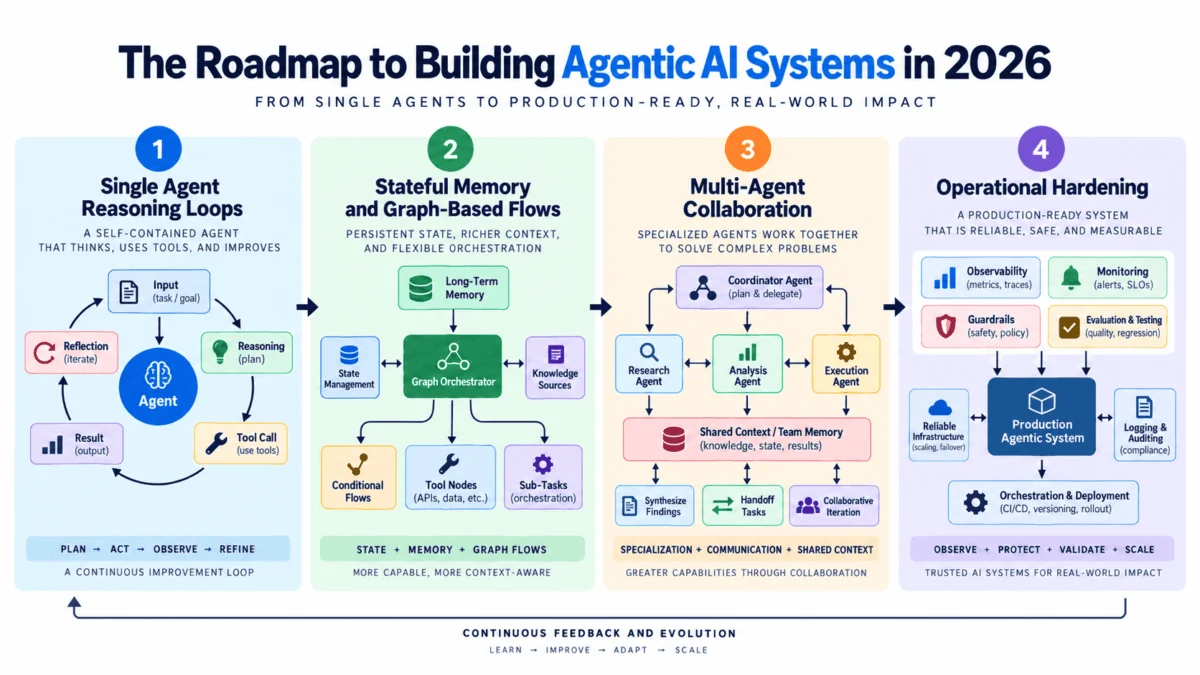
The landscape of artificial intelligence is undergoing a profound metamorphosis. We have moved rapidly past the era of the "static chatbot"—the simple, conversational interface that responds to prompts—into the age of "Agentic AI." These are systems designed not just to speak, but to act: to autonomously plan, leverage external tools, iterate through complex logic, and drive toward high-level goals without constant human intervention.
As these systems transition from speculative research papers into the backbone of production infrastructure, the industry is facing a reality check. While a convincing demo is relatively easy to construct, building agentic systems that operate with reliability, security, and coherence is a formidable engineering challenge. It requires a departure from traditional software development patterns toward a new discipline defined by state management, failure recovery, and multi-step trajectory evaluation.
The Evolution of Autonomy: Moving Beyond the Demo
The shift toward agentic systems is being fueled by their deployment in high-stakes environments: automated code review pipelines, sophisticated research assistants, and complex customer operations platforms. Unlike standard Large Language Models (LLMs), which process input and output in a linear fashion, agents operate in loops. They perceive their environment, select an action, execute it, observe the outcome, and adjust their strategy accordingly.
This iterative process is what separates the modern agent from its predecessors. However, this autonomy introduces significant volatility. When a system is empowered to make decisions and execute code, the margin for error shrinks. Engineering teams must now grapple with the "cascading failure" problem, where a single malformed tool call or an incorrect reasoning step can derail an entire multi-hour process.
Chronology of the Agentic Wave
- The Foundation (2022–2023): The publication of the seminal "ReAct" paper demonstrated that LLMs could perform reasoning and acting simultaneously. This sparked the first wave of experimental agents.
- The Framework Era (2023–2024): Libraries like LangChain, AutoGen, and CrewAI emerged, providing the scaffolding necessary to move agents beyond simple scripts into complex control flows.
- The Infrastructure Shift (2025–2026): We are currently in the "Hardening Phase." The focus has shifted from "can we make it work?" to "how do we keep it from breaking?" This includes the rise of Model Context Protocols (MCP), robust observability tools, and sandboxed execution environments.
Level 1: Anatomy and Cognitive Architectures
At the foundation of agentic design is the "Single Agent" architecture. To build complex systems, one must first master the atomic unit of the agent: the reasoning loop.
An agent is essentially a system that manages a cycle of perception and action. Modern architectures rely heavily on Structured Tool Interaction. By using protocols like Pydantic, developers can enforce strict schemas for tool calls (e.g., web searches or database queries). This prevents the "hallucination of syntax," where a model might output a malformed JSON object that crashes the downstream execution engine.
Essential Engineering Pillars:
- Structured Validation: Utilizing type-safe models ensures that every input into an agent’s tool-set is verified before execution.
- Dynamic Context Assembly: In long-running tasks, the context window is a finite, expensive resource. Effective agents must decide what to retain, what to summarize, and what to offload to vector-based memory.
Level 2: Stateful Memory and Graph-Based Control
As agents grow, linear chains of command become liabilities. A truly autonomous system requires memory that persists across steps and a control flow that can branch based on results.
The Power of Graphs
Linear execution (Step A $rightarrow$ Step B) is too brittle for the real world. If a research agent finds that a primary source is missing, it shouldn’t just fail; it should branch to a secondary search strategy. By adopting Graph-Based Control Flows—often implemented via tools like LangGraph—developers can treat agent execution as a state machine. This allows for cyclical loops, where the agent can return to a previous step if a validation check fails.
Checkpointing and State Persistence
Persistence is the hallmark of a production-grade system. By checkpointing the agent’s state at every transition, engineers gain three critical capabilities:
- Rollback: Reverting to a known-good state if the agent enters a logic loop.
- Human-in-the-Loop (HITL): Pausing the agent at sensitive junctures for human approval.
- Debugging: Replaying the exact state of a system to identify where a decision went awry.
Level 3: Multi-Agent Collaboration and Protocol Design
When a task is too complex for one agent, the solution is a "Team Topology." Multi-agent systems involve a group of specialized agents—a researcher, a coder, a writer, and a critic—that work in concert.
Designing the Protocol
The greatest challenge in multi-agent systems is communication. When agents communicate via unstructured text, errors accumulate. Implementing Structured Message Schemas for task handoffs is essential. A "contract" between agents—where one agent knows exactly what to expect from another—drastically reduces the coordination failures that plague unoptimized systems.
Conflict Resolution
Divergence is natural in a team. A critic agent might find a flaw in the coder’s logic, or a planner might disagree with a researcher’s findings. Robust systems require defined mechanisms for handling these disagreements:
- Voting mechanisms: Comparing multiple agents’ outputs.
- Escalation: Triggering a human review when agentic consensus cannot be reached.
- Model Context Protocol (MCP): Adopting standardized interfaces for tool integration ensures that all agents in a team interact with external data sources through a unified, secure, and vendor-agnostic layer.
Level 4: Operational Hardening and Observability
The final stage of the roadmap is the transition from "code that works" to "infrastructure that lasts." This is where most early-stage agentic deployments fail.
Operational Guardrails
- Runaway Loop Mitigation: Without circuit breakers, an agent stuck in a logic loop can exhaust an entire API budget in minutes. Hard limits on token usage and step counts are mandatory.
- Sandboxed Execution: Never allow an agent to run code directly on your host environment. Technologies like Docker containers, WebAssembly, or e2b cloud sandboxes provide the necessary isolation to prevent unauthorized system access.
The New Standard: Trajectory Evaluation
In the past, we evaluated AI based on the "final answer." In agentic systems, this is insufficient. We must evaluate the trajectory—the efficiency and correctness of the path taken to reach that answer. Using observability platforms like LangSmith or Arize Phoenix, developers can trace every step, tool call, and state transition. This allows for the identification of "silent failures" where an agent arrived at the correct answer through logically unsound steps.
Implications for the Future of Work
The rise of agentic AI implies a fundamental shift in the software development lifecycle. We are no longer just writing code; we are designing cognitive architectures.
The implications are two-fold:
- The Engineering Premium: The gap between a "prototype developer" and an "agentic systems engineer" is widening. The ability to manage state, debug graph-based logic, and design robust communication protocols will be the defining skill set of the next decade.
- The Reliability Imperative: As these systems take over critical business workflows, "move fast and break things" becomes a dangerous mantra. The future belongs to those who prioritize observational infrastructure and operational hardening over the sheer power of the underlying models.
Final Thoughts: Building with Intent
Vinod Chugani’s roadmap highlights a critical truth: the complexity of an agentic system is not merely in the AI itself, but in the infrastructure surrounding it. Agents without structured validation fail; agents without state management lose context; and agents without observability are black boxes that cannot be debugged.
As we look toward 2026, the most successful organizations will be those that treat agentic systems as high-reliability software. By building layer by layer—from the atomic reasoning loop to the complex, multi-agent collaborative swarm—engineers can transform the current chaos of agentic experimentation into a stable, scalable, and highly productive reality. The tools are available; the challenge now lies in the rigor with which we apply them.

 Nana Muazin
 Evan Lee Salim