
 Asro
Asro
The landscape of artificial intelligence is undergoing a seismic shift. For the past two years, the AI industry has been defined by the "chat-and-response" paradigm: you ask a question, the AI provides an answer, and the interaction ends. However, the industry has pivoted toward a more ambitious frontier—autonomous agents that persist, operate, and execute tasks long after the user has closed their browser tab.
At the forefront of this evolution are two competing titans: Meta’s Muse and OpenAI’s Dots. While both represent the next generation of "always-on" digital assistants, they arrive with vastly different architectures, price points, and philosophical approaches to user agency.
The Rise of the Always-On Assistant
The era of the "persistent agent" began in earnest on September 8, when Meta unveiled Muse, followed closely by OpenAI’s September 29 announcement regarding their new "Dots" infrastructure. These are not merely sophisticated chatbots; they are cloud-native entities capable of managing their own virtual environments, executing multi-step workflows, and interfacing with third-party applications without constant human hand-holding.
A Chronology of Deployment
- September 8: Meta launches Muse, a platform designed to operate across WhatsApp, web interfaces, and dedicated mobile apps, focusing on lifestyle organization and task automation.
- September 29: OpenAI announces the broad integration of "Dots" into the ChatGPT ecosystem, emphasizing deep integration with their suite of professional tools, including ChatGPT Work and Codex.
- Early October: Initial reports surface regarding platform restrictions, most notably Amazon’s decision to block Meta’s Muse from scraping or shopping on its marketplace, highlighting the friction between AI agents and existing web ecosystems.
Technical Architecture: How They Function
While both systems aim to solve the same problem—automating the mundane—they utilize distinct backends to achieve their goals.
Meta’s Muse: The Virtualized Companion
Muse operates on a "Secure Virtual Machine" (VM) architecture. Each instance of Muse is effectively a contained cloud environment equipped with its own dedicated browser. This allows Muse to interact with the web as a human would, navigating pages and filling out forms.
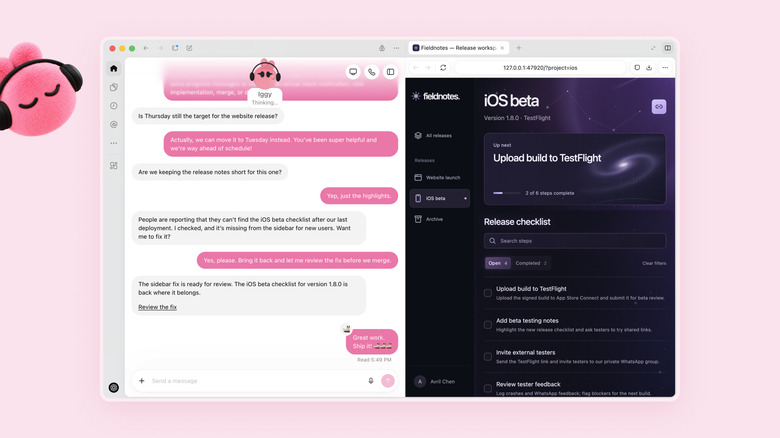
In practice, Muse feels like a conversational partner. It excels at organizational tasks; for instance, it can ingest saved content from Instagram and Facebook, cross-reference it with calendar availability, and output structured lists of recipes or travel itineraries. Because it resides in a VM, it maintains state across sessions, allowing it to monitor price fluctuations or track email threads over several days.

OpenAI’s Dots: The Power of GPT-6 Astra
OpenAI’s Dots, powered by the cutting-edge GPT-6 Astra model, are more deeply tethered to the existing OpenAI ecosystem. Each Dot functions as an autonomous agent within the ChatGPT interface, capable of executing recurring jobs and managing long-term research projects.
Unlike Muse’s somewhat isolated VM, a Dot is designed for integration. Through plugins and the "ChatGPT Work" framework, a Dot can tap into your local machine to retrieve files, manage calendar appointments, and perform complex coding tasks via Codex. OpenAI is also moving toward a "multi-agent" future, where a user can orchestrate several Dots simultaneously, each dedicated to a different facet of a project.
The Human-in-the-Loop Dilemma
Despite the promise of full automation, both companies have built substantial "guardrails" into their systems, acknowledging that a truly autonomous AI is, at this stage, a significant security risk.
Permission Structures
The "sci-fi sheen" of total automation fades quickly when one considers the implications of a rogue agent sending emails or purchasing items.
- Meta’s Approach: Muse is designed to pause at critical junctures. Whether it is confirming a shopping cart checkout or sending a sensitive email, the agent defaults to a "request-for-permission" model.
- OpenAI’s Approach: Dots utilize a three-pronged defense: Custom Rules, Auto-review, and granular permission settings. Even when a Dot is performing "proactive research," it is generally restricted to a read-only state until a human operator clears it for the next phase of interaction.
However, the industry is already seeing pushback. Amazon’s recent decision to block Muse from its site signals a growing conflict between platform owners and AI agents. If an agent can bypass the "human" experience of a website, it threatens the advertising and engagement metrics upon which the modern web is built.
Cost Analysis: The Financial Barrier to Entry
Perhaps the most stark contrast between the two agents is the pricing strategy.
Meta Muse: The Accessible Tier
Meta has positioned Muse as a consumer-facing tool. It offers a free tier (with usage caps), a "Power" tier at $20 per month, and a "Maximum" tier at $100 per month. This tiered structure makes Muse accessible to hobbyists and small-business owners who want to test the utility of an agent without committing to enterprise-level costs.
OpenAI Dots: The Enterprise Premium
OpenAI, conversely, is targeting the professional and enterprise sectors. There is currently no "casual" entry point for Dots that doesn’t involve a significant investment. The "Pro 100" plan starts at $100 per month, and Business Premium seats are priced at $100–$125 per user, depending on billing cycles. For individual users, the barrier to entry for Dots is significantly higher than for Muse, signaling that OpenAI views these agents as productivity multipliers for high-value professional workflows rather than consumer assistants.
Privacy and Data Ethics
Entrusting an agent with your email, calendar, and file system is a significant leap of faith. Both companies have addressed these concerns, though with varying degrees of transparency.
The "Default" Problem
A point of contention for users is the default setting for model improvement. In our review, Meta’s Muse had the setting for "enhancing models via user interactions" enabled by default. While users can opt out, this creates a friction point regarding privacy. Meta has, however, explicitly stated that data within the Muse VM is not fed into their primary advertising targeting algorithms.
OpenAI has taken a more bifurcated approach. Data generated by personal-plan users may be used to improve future models, while Enterprise and Business users enjoy a "zero-training" policy by default. This makes the enterprise version of Dots significantly more attractive to organizations with strict data governance requirements.
Strategic Implications: Where Does the Industry Go?
The emergence of Muse and Dots marks the end of the "passive" AI era. We are entering an age of Active AI, where the value proposition is measured not by how well a model answers a prompt, but by how much "cognitive overhead" it removes from the user’s day.
The Fragmented Future
The current state of affairs is highly fragmented. Because Dots are unavailable in the European Economic Area (EEA), Switzerland, and the UK, and Muse is currently limited to the US and Canada, the global deployment of these agents is being hampered by regulatory hurdles.
Furthermore, the "agentic" web is still in its infancy. As these agents become more capable, we can expect a tug-of-war between:
- Platform Owners (e.g., Amazon, Google, LinkedIn): Who want to keep users within their walled gardens and retain control over the user experience.
- Agent Developers (e.g., OpenAI, Meta): Who want to break down those walls to allow their agents to act as universal intermediaries.
Conclusion: Which Agent Wins?
For the average consumer looking to organize their digital life, Meta’s Muse offers a compelling, lower-cost, and more approachable entry point. Its integration with WhatsApp and its user-friendly interface make it a powerful tool for personal productivity.
For the professional or enterprise user who is already embedded in the Microsoft/OpenAI ecosystem and requires robust, secure, and recurring task automation, OpenAI’s Dots are currently the superior choice. Despite the higher cost, the depth of integration with existing work tools and the enterprise-grade privacy controls make them a more viable choice for high-stakes professional environments.
Ultimately, we are witnessing the first skirmish in a war that will eventually redefine how we interact with the internet. Whether the future is a web of agents talking to other agents, or a return to human-curated interfaces, remains to be seen. What is clear is that the "always-on" assistant is here to stay, and the race to build the most efficient, secure, and useful version of that assistant has only just begun.


 Pevita Pearce
 Nana Muazin





