
 Muslim
For over two centuries, the Theresienwiese in Munich has served as the global epicenter of Bavarian culture. Each year, from mid-September to early October, the world’s largest folk festival—Oktoberfest—transforms the city into a vibrant tapestry of traditional dress, brass music, and the celebrated ales of the “Big Six” Munich breweries. Yet, while the traditions of the festival remain rooted in history, the demographics and habits of the people who flock to witness them are shifting in ways that challenge long-held assumptions.
Recent data insights from Amadeus Travel Intelligence suggest that the “typical” Oktoberfest traveler is evolving. As the festival prepares to welcome an estimated 6 million attendees this year—a figure that remains robust despite the record-breaking 7.5 million seen in 2023—the travel industry is observing a distinct transformation in how, when, and from where the world is arriving in Bavaria.
The Shifting Landscape: A Chronology of the 2026 Season
The 2026 Oktoberfest season, spanning from September 19th to October 4th, serves as a vital case study for the travel and hospitality sectors. Understanding the ebb and flow of this period requires a granular look at the data collected in the lead-up to the event.
- The Planning Phase (August 2026): By mid-August, booking trends had already begun to solidify. Analysis of air data (covering September 18th to October 4th) and hotel data (covering the weeks of September 13th through September 27th) provided a snapshot of shifting global interest.
- The Early Arrivals (September 13th – 19th): As the festival gates prepared to open, early-season hotel occupancy began to climb, setting the stage for the peak mid-festival surge.
- The Mid-Festival Peak (September 20th – 27th): Data indicates this remains the most sought-after window for visitors, with hotel occupancy rates hitting 78% and prices peaking as demand reaches its crescendo.
- The Post-Festival Tail (Late September – Early October): The trend toward longer stays suggests that the festival’s impact now extends well beyond the final keg-tapping, with a growing cohort of travelers opting to extend their European journey into early October.
Solo Travel: The New Face of the Festival
Perhaps the most striking revelation in current travel trends is the prevalence of the solo traveler. Contrary to the traditional image of Oktoberfest as a destination for boisterous groups of friends or extended families, the reality is far more individualized.
Large groups—those consisting of six or more people—now account for a mere 7% of air bookings, making them the smallest demographic segment. Instead, the festival has become a magnet for the independent traveler. Solo visitors now represent a commanding 47% of all air bookings, a figure that has seen a 2.2% growth compared to the 2025 season.
This demographic shift carries significant implications for the hospitality industry. Solo travelers often seek different amenities—such as social-centric boutique hotels, centrally located transit hubs, and activities that facilitate meeting others—compared to large groups who might prioritize shared vacation rentals or large-capacity dining reservations.
The “Long-Stay” Phenomenon: Beyond the Beer Tent
For years, the standard Oktoberfest pilgrimage was viewed as a “short-haul” experience—a long weekend of festivities followed by a quick departure. However, the data reveals a marked pivot toward extended travel.
While short stays of one to five nights remain the dominant choice for 65% of visitors, this segment has seen a slight 2% decline. Simultaneously, the trend for long-term immersion is surging. Trips spanning 14 nights or more have jumped by 13% year-on-year, now accounting for over 6% of total bookings.
This is a critical development for local tourism boards and regional operators. These “long-stayers” are not merely looking for a seat in a tent; they are prime candidates for city tours, excursions to the Bavarian Alps, visits to Neuschwanstein Castle, and cultural deep dives into Munich’s history. This shift invites the industry to move beyond “beer-only” packages and toward holistic, multi-week itinerary planning.
A Global Pivot: Emerging Markets vs. Established Powerhouses
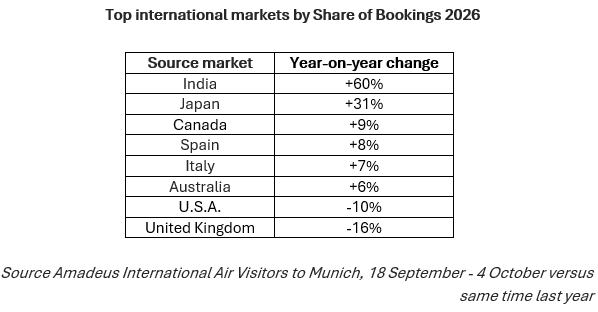
The geography of the Oktoberfest audience is also undergoing a quiet revolution. While the United States remains the largest source market for air bookings at 37%, it has experienced a 10% year-on-year decline.
This gap, however, is not creating a vacuum. Instead, it is being filled by a surge in demand from diverse international markets that are rapidly discovering the Bavarian tradition. Notable growth figures include:
- India: A massive 59.7% increase in bookings.
- Japan: A 30.7% rise, signaling a renewed interest in European cultural tourism.
- Canada: A 9.1% growth, cementing its status as a key North American feeder market.
- Australia: A 5.7% uptick, proving that the distance from Munich is no longer a deterrent for travelers seeking the “folk festival” experience.
Domestic travel within Germany also reflects these shifting patterns. Air bookings from within Germany have risen by 2.4%. Interestingly, the north of the country is showing increased enthusiasm: Hamburg remains the top domestic origin, while Bremen has emerged as the fastest-growing source market, boasting a staggering 41% year-on-year increase.
Hospitality Metrics: Occupancy and ADR
Despite the diversification of the visitor base, the hospitality industry in Munich remains robust. The average occupancy across the three weeks of the festival sits at 70.9%. While this is slightly down from the 76.2% recorded in 2025, it must be viewed in the context of shifting booking behaviors and the ongoing adjustment of global travel patterns.
Average Daily Rates (ADR) have remained resilient, showing a slight increase of 0.8% to reach €326. During the peak week (September 20th–27th), the economic impact is even more pronounced, with ADR climbing to €368—a 3.9% increase over the previous year. This suggests that while the volume of hotel bookings may fluctuate, the premium nature of the Oktoberfest experience remains a high-value commodity for the city’s hotel sector.
Official Perspectives: Demystifying the Future
Jan Kamenicek, Regional Vice President for Central & Eastern Europe at Amadeus, notes that the festival’s endurance is predicated on an ability to read the signs of the times.
“The Oktoberfest tradition is more than 200 years old,” Kamenicek explains. “It has grown into the world’s largest folk festival, drawing in vast, international crowds. But with long-standing events and traditions, it’s important to look at the data rather than assume that old trends and patterns still hold true.”
Kamenicek points to the declining US interest alongside the explosion of interest from India, Japan, and Australia as a masterclass in why travel intelligence is essential. “The changing traveler mix is a great example of why we cannot rely on legacy assumptions. The growth of these new origin markets highlights diverse audiences and entirely new opportunities to target. Simultaneously, the trend toward longer trips opens up doors for destinations far beyond Munich to capture interest.”
Implications for the Future of Travel
The data regarding the 2026 Oktoberfest season provides a clear roadmap for stakeholders in the travel industry.
- Tailored Marketing: Destination organizations and hotels must pivot their marketing to appeal to the solo traveler. Packages that emphasize safety, social connectivity, and ease of transit will likely outperform traditional group-oriented offerings.
- Extended Itinerary Development: With 14-night stays on the rise, there is a clear demand for "Oktoberfest-plus" products. Partnerships between Munich-based hotels and regional travel providers in nearby cities or scenic rural areas could capitalize on this trend, encouraging guests to extend their stay and explore more of Germany.
- Market Agility: The rapid rise of interest from markets like India and Japan necessitates a shift in promotional strategies. Travel brands that adapt their service models—such as offering multi-lingual resources or catering to the specific travel preferences of these emerging demographics—will be best positioned to capture the shifting market share.
In conclusion, while the beer, the brass bands, and the traditional costumes of Oktoberfest remain immutable symbols of the festival, the ecosystem surrounding the event is in a state of dynamic flux. By leveraging travel intelligence, the industry is not just watching the festival unfold—it is actively participating in its evolution, ensuring that this historic celebration remains relevant, accessible, and prosperous for generations to come.


 Azzam Bilal Chamdy
 Ali Ikhwan




