
 Layla Zulfa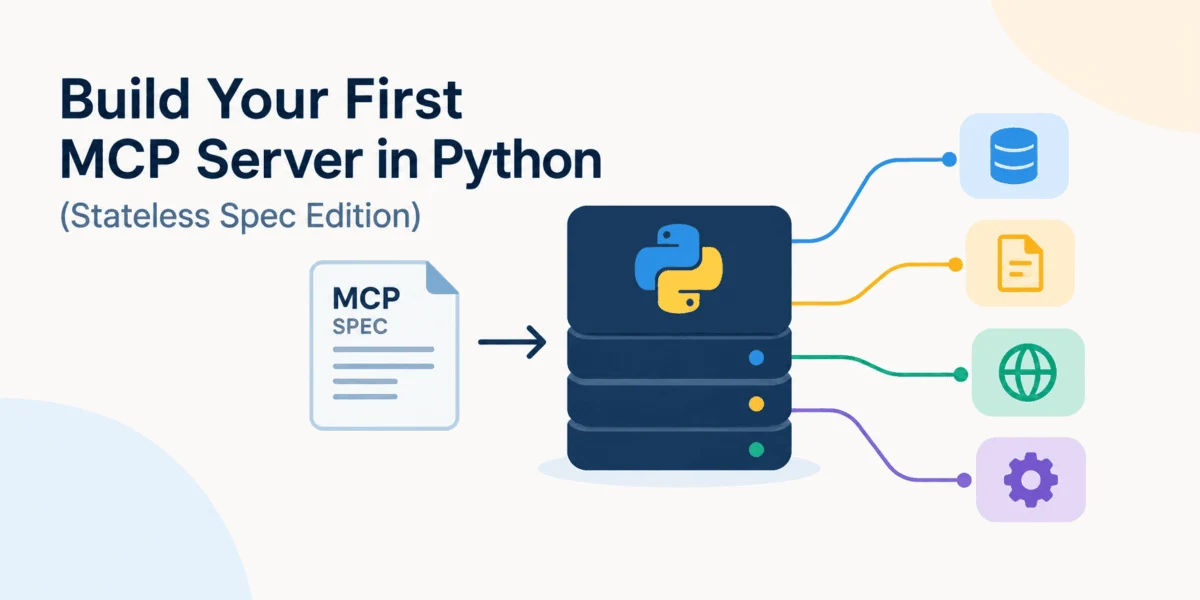
The architecture of AI integration reached a pivotal milestone this summer. With the release of the July 28, 2026, Model Context Protocol (MCP) specification, the industry has shifted away from stateful session management toward a robust, stateless request-response model. This evolution marks a significant departure from previous versions of the protocol, simplifying how developers build, deploy, and scale AI-connected servers. By eliminating the reliance on persistent session identifiers (Mcp-Session-Id), the new MCP spec aligns perfectly with modern, cloud-native HTTP infrastructure, enabling seamless load balancing and horizontal scaling.
For developers working with the Python SDK, this transition is accompanied by the stabilization of version 2.0, which introduces a high-level MCPServer API. This API streamlines the definition of tools, resources, and prompts, allowing developers to build sophisticated AI interfaces using standard Python functions rather than complex boilerplate.
The Evolution of MCP: From Session-Bound to Stateless
To understand the magnitude of this change, one must look at the traditional limitations of AI protocol design. Under older specifications, an MCP server functioned like a legacy web application requiring "sticky sessions." A client would initiate a handshake, receive a session ID, and ensure that all subsequent requests were routed to the specific server instance holding that session state.
This model created significant bottlenecks in production environments. Developers had to manage shared session infrastructure or force sticky routing at the load balancer level. If a worker process crashed or a scaling event occurred, the loss of that session state often resulted in a broken connection or the need for a full re-initialization.
The 2026-07-28 specification effectively obsoletes this friction. Modern MCP requests are designed to be entirely self-contained. Whether a request hits "Server A" or "Server B," the outcome remains identical because the server no longer needs to "remember" the client’s previous interactions to process the current command. This transition represents a shift from "session-oriented" communication to "stateless utility" communication, mirroring the success of RESTful API design.
Chronology: Implementing the Modern MCP Stack
Implementing this new architecture is remarkably efficient, thanks to the maturation of the official Python SDK. Below is the technical roadmap for building a production-ready, stateless MCP server.
1. Project Scaffolding
The current MCP ecosystem favors simplicity. Developers can utilize uv—the modern Python package and project manager—to initialize a project without the need for extensive framework boilerplate.
mkdir first-mcp-server
cd first-mcp-server
uv init
uv add "mcp[cli]"
This setup provides the essential tools, including the MCP Inspector, which is critical for local development and debugging.
2. Defining the Server Logic
The MCPServer class serves as the primary interface. Unlike older iterations, which required manual JSON Schema definitions or complex manifest files, the v2 SDK derives interface definitions directly from Python type hints and docstrings.
When a developer writes a function, the SDK automatically parses the arguments, types, and default values to generate the underlying MCP schema. This "code-as-contract" approach reduces the surface area for bugs and keeps the codebase readable.
3. Exposing Tools, Resources, and Prompts
The power of the new SDK lies in its decorator-based architecture:
- Tools: Functions decorated with
@mcp.tool()allow the LLM to perform actions. Because the protocol is now stateless, these tools are inherently atomic. - Resources: Using
@mcp.resource(), developers can expose static or dynamic data that the host application can load into context, effectively functioning as aGETrequest. - Prompts: The
@mcp.prompt()decorator allows developers to package complex system instructions or user-facing templates into reusable units.
Supporting Data: Why Statelessness Matters for Performance
The implications of this architectural shift extend far beyond convenience; they are essential for high-availability AI services. In a traditional stateful environment, scaling an MCP server required complex orchestration. In the new stateless model, developers can leverage standard Uvicorn workers:
uvicorn server:app --workers 4Because each request carries its own context, any of the four workers can handle any incoming request. This eliminates the "cold start" or "session synchronization" issues that previously plagued high-traffic MCP implementations.
Furthermore, the "explicit-handle" pattern replaces implicit session state. For instance, in a shopping application, rather than letting the protocol track a "basket," the server now requires the client to pass a basket_id. This explicit passing of identifiers is a cornerstone of robust, distributed systems design. It forces the developer to be intentional about state management, which in turn makes the system easier to audit and debug.
Official Perspectives and Industry Implications
The transition to a stateless specification was not merely a cosmetic update; it was a strategic move by the MCP maintainers to ensure the protocol’s longevity in enterprise environments. By decoupling the protocol from session state, the maintainers have effectively enabled MCP to run on serverless platforms like AWS Lambda or Google Cloud Functions, where execution environments are ephemeral and short-lived.
In these environments, a server instance might only exist for the duration of a single request. A stateful protocol would be fundamentally incompatible with such infrastructure. By embracing statelessness, the MCP community has opened the door to massive, event-driven AI architectures that were previously impossible to implement without heavy custom middleware.
The Developer Workflow: An Integrated Experience
The introduction of the MCP Inspector has standardized the development loop. By running uv run mcp dev server.py, developers gain immediate insight into how their Python code maps to the MCP schema.
This tight feedback loop is particularly beneficial for AI agents that rely on dynamic tool discovery. When a developer modifies a function’s type hint, the tool’s schema is updated instantly. This ensures that the AI model is always operating with the most accurate representation of the server’s capabilities.
Moreover, the ability to wrap the server in a standard streamable_http_app() means that an MCP server can now coexist within a FastAPI or Starlette application. This allows organizations to build "AI-first" APIs where the same code base serves both standard REST endpoints for human users and MCP endpoints for autonomous AI agents.
Future-Proofing AI Infrastructure
As we look toward the future, the stateless nature of the 2026-07-28 specification will likely serve as the foundation for multi-agent systems. When agents interact with other agents through a stateless interface, the complexity of orchestrating multiple "sessions" disappears.
The shift also simplifies security and authorization. In a stateful model, securing a session means protecting a token or a persistent identifier across the entire lifecycle of a connection. In a stateless model, authorization can be validated at the request level—often using standard HTTP headers—which is far easier to integrate with modern identity providers (OIDC, OAuth2).
Conclusion: A New Standard for AI Interoperability
The transition to a stateless MCP model represents a coming-of-age for AI infrastructure. By removing the burden of session management from the protocol, the developers of MCP have moved the industry toward a more reliable, scalable, and modular future.
For the Python developer, this means less time spent managing protocol overhead and more time focusing on the core logic of their AI agents. The use of decorators, type hints, and standard HTTP primitives ensures that building an MCP server is now as intuitive as writing a standard Python web service.
As AI agents move from experimental sandboxes to enterprise production environments, the stability provided by the stateless MCP specification will prove invaluable. It is a clear signal that the ecosystem is ready for high-scale, high-reliability deployment, ensuring that the next generation of AI-connected applications will be both powerful and architecturally sound.


 Evan Lee Salim
 Ammar Sabilarrohman




