
 Layla Zulfa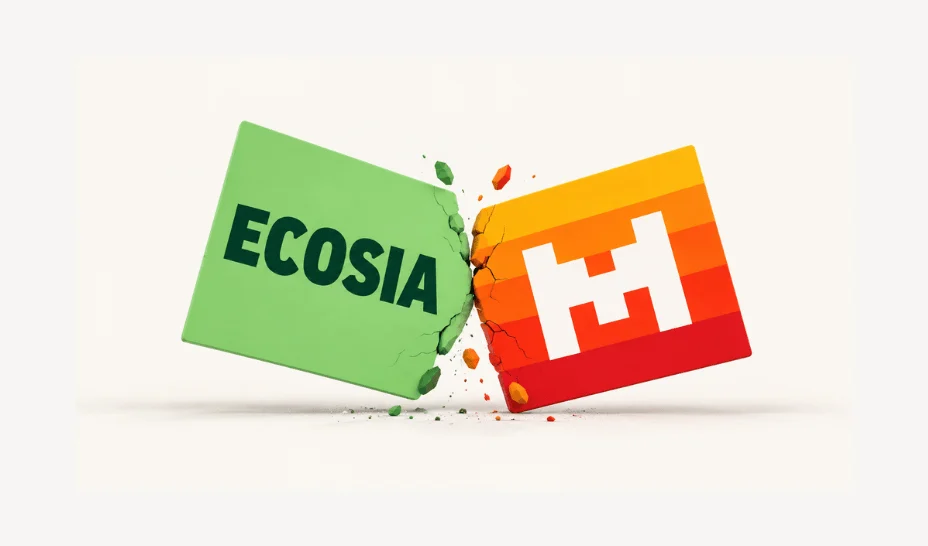
In the high-stakes world of European artificial intelligence, a quiet but profound realignment is underway. Ecosia, the Berlin-based search engine renowned for its environmental mission, has officially pivoted away from French AI champion Mistral, opting instead for a decentralized, model-agnostic approach. While early reports suggested this move was a strategic shift toward Chinese-developed models, Ecosia’s leadership is painting a more nuanced picture: one that prioritizes energy efficiency, financial sustainability, and true technological sovereignty.
The Core Conflict: Sovereign Values vs. Corporate Reality
For years, Mistral AI was hailed as the "last best hope" for a European-led AI revolution. However, Ecosia’s decision to drop the Parisian startup has sparked a debate about what it actually means to be a "European" technology company.
In an exclusive conversation with EU-Startups, Ecosia founder and CEO Christian Kroll clarified that the company’s recent integration of open models—some of which originated in China, such as Alibaba’s Qwen, Z.ai’s GLM, and Moonshot AI’s Kimi—was not a geopolitical alignment. Instead, it was a practical response to the soaring costs and rigid architecture of proprietary or semi-proprietary models.
"We will probably be using Melious.ai in the future," Kroll stated. "Unlike Mistral, this is a European company that offers high-quality, affordable AI inference powered by green electricity."
The move highlights a growing rift in the European tech ecosystem: the tension between companies that scale through massive venture capital injections from US giants and those, like Ecosia, that prioritize steward-ownership and operational independence.
Chronology of a Shifting Landscape
The relationship between Ecosia and the broader AI market has evolved rapidly, mirroring the explosive growth of the sector since 2025.
- September 2025: Mistral AI secures a massive €1.7 billion Series C funding round, led by Dutch semiconductor powerhouse ASML, solidifying its status as a European unicorn.
- March 2026: Mistral continues its aggressive expansion, raising €722 million in debt financing to develop its first large-scale data center near Paris, aiming to localize compute power.
- July 2026: Ecosia’s leadership, including long-term partner Tim Schumacher, reaffirms their commitment to an independent, profit-restricted corporate structure.
- September 2026: Mistral hits a valuation of over €21 billion following a €3 billion Series D round led by Samsung Electronics. The round includes significant participation from US venture heavyweights like Andreessen Horowitz, Nvidia, and Salesforce Ventures.
- Late 2026 (Present): Ecosia officially pivots away from Mistral, citing concerns over the French company’s reliance on non-European capital and the operational benefits of more flexible, open-weight models.
Supporting Data: The Cost of Sovereignty
The economic disparity between the two approaches is stark. Mistral’s growth has been fueled by record-breaking capital inflows. In 2026 alone, the investment landscape for European AI infrastructure was characterized by approximately €6.2 billion in financing, a significant portion of which flowed into Mistral’s coffers to support its capital-intensive data center ambitions.
In contrast, Ecosia’s model is built on long-term sustainability. Having grown largely without external venture capital, the company adopted a "steward-ownership" structure in 2018. This legal framework prevents the company from being sold or distributing dividends to shareholders, ensuring that all profits are reinvested into the company’s mission—reforestation and, more recently, ethical digital infrastructure.
By switching to models facilitated by the German platform Melious, Ecosia is leveraging European infrastructure that runs on low-carbon energy. This allows the search engine to maintain its core promise: that every search is carbon-negative. While the models themselves may be developed internationally, the inference and processing remain within a European, green-powered framework.
Official Responses and Strategic Clarifications
When pressed on the controversy surrounding the use of Chinese-developed models, Kroll remained steadfast. He argued that the origin of the model is secondary to its utility and the ethics of its deployment.
"Our focus is on open models rather than their country of origin," Kroll explained. "These models offer lower costs, greater flexibility, and significantly reduced energy consumption. This aligns perfectly with our environmental mission."
Regarding concerns about potential political censorship or bias—a common criticism leveled against models developed in authoritarian regimes—Kroll noted that Ecosia is not a passive user. The company actively manages its AI pipeline. "We can switch to alternative models when dealing with sensitive subjects, such as questions about Taiwan. We are also working internally to eliminate political biases from our AI-generated answers to ensure we provide neutral, objective information to our users."
Kroll further challenged the notion of Mistral as the pinnacle of European sovereignty. He argued that Mistral’s heavy reliance on foreign investors—particularly US-based venture capital firms and global tech giants like Nvidia and Samsung—undermines the very independence that European regulators often champion. To Kroll, "European sovereignty" is not just about where the headquarters is located, but who controls the direction of the technology.
Implications: The Future of European AI
Ecosia’s pivot is a harbinger of a broader trend: the "commoditization of intelligence." As open-weight models become increasingly capable, the competitive advantage of proprietary, high-cost AI providers like Mistral may be challenged by leaner, more agile players.
1. The Rise of Model-Agnostic Infrastructure
Companies are realizing that tying their entire stack to a single AI provider is a strategic liability. By using platforms like Melious, which act as a bridge to various open models, businesses can avoid "vendor lock-in" and negotiate better pricing, while maintaining data sovereignty.
2. The Sovereignty Paradox
The debate reveals a fundamental divide in the European tech strategy. One camp, led by firms like Mistral, believes that Europe must compete by building "national champions" that can raise billions to challenge Silicon Valley head-on. The other camp, represented by Ecosia, believes that true sovereignty lies in utilizing open, transparent technology that is locally hosted and managed, rather than relying on a new generation of "AI giants" that are ultimately beholden to global capital.
3. Energy as the Final Frontier
As AI energy consumption becomes a top-tier environmental issue, Ecosia’s shift toward green-powered inference serves as a blueprint for the industry. If AI is to be sustainable, it must be decoupled from the massive, carbon-heavy data centers that currently power the largest models. By prioritizing energy-efficient inference, Ecosia is forcing a conversation about the true environmental cost of the "AI boom."
Conclusion: A New Direction
For Mistral, the loss of a prominent, ethics-focused partner like Ecosia is a reputational blow. It suggests that even within the European tech ecosystem, there is significant pushback against the "big-money, big-compute" model of development.
For Ecosia, the path forward is clear: they are doubling down on their mission-driven roots. By eschewing the hype surrounding high-valuation AI startups and focusing on the practical, ethical, and environmental aspects of model deployment, they are carving out a distinct space in the digital landscape. As the dust settles, the industry may find that the future of European AI is not found in the boardrooms of multi-billion dollar unicorns, but in the distributed, open, and environmentally conscious infrastructure being built by those who prioritize the planet over the stock price.


 Siti Muinah
 Reynand Wu





