
 Dwi Wanna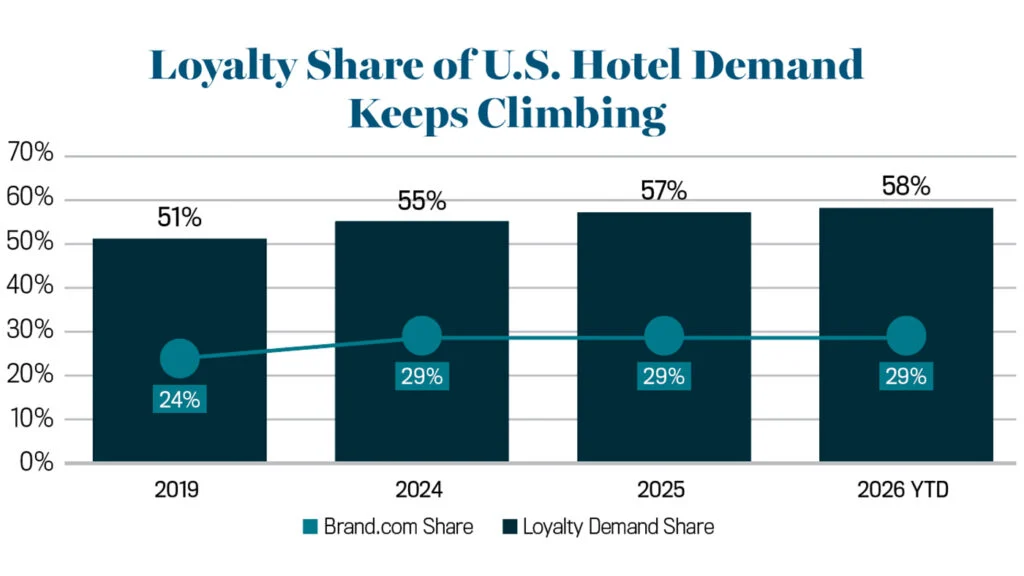
The hospitality industry is currently undergoing a structural transformation, one characterized by a strategic retreat from third-party reliance in favor of proprietary, loyalty-driven ecosystems. According to recent data from Kalibri, the U.S. hotel sector has reached a tipping point: 58 percent of all room nights booked through the first half of 2026 were attributed to loyalty program members. This figure represents a staggering seven-point increase from 2019 levels, signaling that the decade-long investment in direct booking infrastructure is finally yielding tangible dividends in the industry’s demand mix.
As the industry moves into the planning cycles for 2027, this shift toward direct engagement—powered by Brand.com sites and Loyalty Member Rates (LMR)—has become the primary defense against the eroding margins associated with Online Travel Agencies (OTAs).
Main Facts: The Rise of the Direct Ecosystem
The core trend defining the 2026 travel season is the transition from "transactional" booking to "relational" booking. While total U.S. room night demand has seen a modest year-to-date increase of only 2 percent, the composition of that demand has shifted significantly.
Key metrics from the first half of 2026 include:
- Loyalty Demand Share: 58 percent of all bookings are now tied to loyalty programs.
- Brand.com Dominance: Direct website bookings now account for 29 percent of total demand, up from 24 percent in 2019, maintaining a stable plateau for three consecutive years.
- The LMR Surge: Promotional and Loyalty Member Rate (LMR) bookings have spiked 19 percent year-over-year, making them the fastest-growing segment in the hospitality industry.
- Declining Segments: Conversely, the "Rack/BAR" (Best Available Rate) segment has contracted by 5 percent, and group bookings have slipped by 2 percent.
The economic rationale is transparent: a booking made through a brand’s own portal, tethered to a loyalty account, carries a significantly lower acquisition cost than an OTA-sourced booking. By eliminating intermediary commissions and channel fees, hotels are not only retaining more revenue but are also securing high-value customer data that informs future personalization efforts.
Chronology: A Decade of Digital Infrastructure Investment
To understand the current dominance of loyalty programs, one must look back at the industry’s strategic evolution over the last ten years.

- 2016–2018 (The Awakening): Following years of OTA market-share dominance, major hotel chains launched "Book Direct" campaigns. These initiatives were initially marketing-heavy, focusing on educating consumers about the "best price guarantee" available through brand websites.
- 2019 (The Benchmark): By the end of 2019, loyalty demand had solidified at 51 percent. This period served as the baseline for the current structural shift, proving that consumers were willing to bypass aggregators if the value proposition (points, perks, and status) was clear.
- 2020–2022 (The Resilience Test): The global pandemic forced a lean operational model. With reduced marketing budgets, brands doubled down on their existing loyalty databases, relying on "known" guests to fill rooms during periods of extreme volatility.
- 2023–2025 (The Data Integration Phase): Hotels began integrating their Customer Relationship Management (CRM) tools with their Property Management Systems (PMS). This ensured that loyalty data wasn’t just stored in a marketing silo but was actionable at the front desk.
- 2026 (The Maturity Phase): The current year marks the consolidation of these efforts. Loyalty is no longer a peripheral marketing tactic; it is the central pillar of the industry’s demand strategy.
Supporting Data: Dissecting the Booking Mix
While loyalty bookings are trending upward, the broader booking mix reveals a nuanced story of industry bifurcation. The 19 percent growth in LMR bookings suggests that travelers are increasingly seeking value-added pricing rather than generic, non-member discounts.
The Contrast in Channel Performance
The industry is currently seeing a divergence in growth patterns across channels:
- OTA & Government: Each grew by a marginal 2 percent, indicating that while these channels remain vital for base occupancy, they are no longer the primary drivers of growth.
- Corporate: Up by a mere 1 percent, reflecting the stabilization of business travel post-pandemic.
- Rack/BAR: The decline of 5 percent suggests that consumers are increasingly reluctant to book "at the door" or at full public rates without the perceived benefit of a loyalty member discount.
This data underscores a critical insight: The growth of LMR bookings is not a race to the bottom in terms of rate integrity. Instead, it is a targeted approach that incentivizes repeat behavior. When a guest books via LMR, the hotel is trading a minor discount for a long-term data footprint, whereas an OTA discount often represents a "blind" transaction that provides no future marketing leverage.
Implications: The Strategic Mandate for 2027
As we look toward 2027, the hospitality industry faces a clear strategic choice: continue investing in proprietary recognition systems or risk being relegated to a commodity product sold through third-party platforms.
The Death of the "Scripted" Guest Experience
The data indicates that loyalty is not merely about points or tiered status; it is about operational recognition. Many hotels fail to capitalize on their loyalty data because they rely on scripts rather than integrated systems.
True loyalty is achieved when a guest’s history—whether it’s a preference for a corner room or a documented issue with a previous stay—is available to every staff member on every shift. Properties that succeed in the next phase of the loyalty war will be those that empower front-line employees to solve problems and customize stays without seeking executive approval. The "authority to delight" is becoming a greater competitive advantage than the "capacity to discount."

Technology as the Great Equalizer
For independent hotels and smaller groups lacking the multi-billion-dollar marketing budgets of major flags, the barrier to entry for loyalty is lower than ever. The rise of:
- Consortia Networks: Platforms like Stash Rewards provide independent properties with the scale of a loyalty program without sacrificing brand identity.
- Advanced PMS Integration: Modern systems (like Mews) allow for seamless guest data flow, ensuring that "recognition" is an automated part of the check-in process.
- AI-Driven Perks: Platforms such as Laasie offer instant gratification, providing guests with immediate, tangible rewards rather than abstract point balances.
The Plateau Warning
Industry experts note that Brand.com bookings have held steady at 29 percent for three years. This stagnation suggests that while the "low-hanging fruit" of direct booking has been harvested, the next phase of growth will be significantly harder.
To break through this ceiling in 2027, hoteliers must transition from simple "recognition" to "predictive service." The hotels that will outperform their competitors are those that treat loyalty data as a roadmap for guest experience, using information to anticipate needs before the guest even checks in.
Conclusion
The data from 2026 provides a clear directive: the era of reliance on third-party aggregators is fading. In its place, a more efficient, loyalty-centric model is emerging. For hotel owners and operators, the challenge of 2027 will not be about finding more customers, but about deepening the relationship with the ones they already have. Those who prioritize guest recognition and invest in the technical infrastructure to support it will find themselves in a much stronger position to navigate the inevitable fluctuations of the market.


 Azzam Bilal Chamdy
 Ali Ikhwan




