Rifan Muazin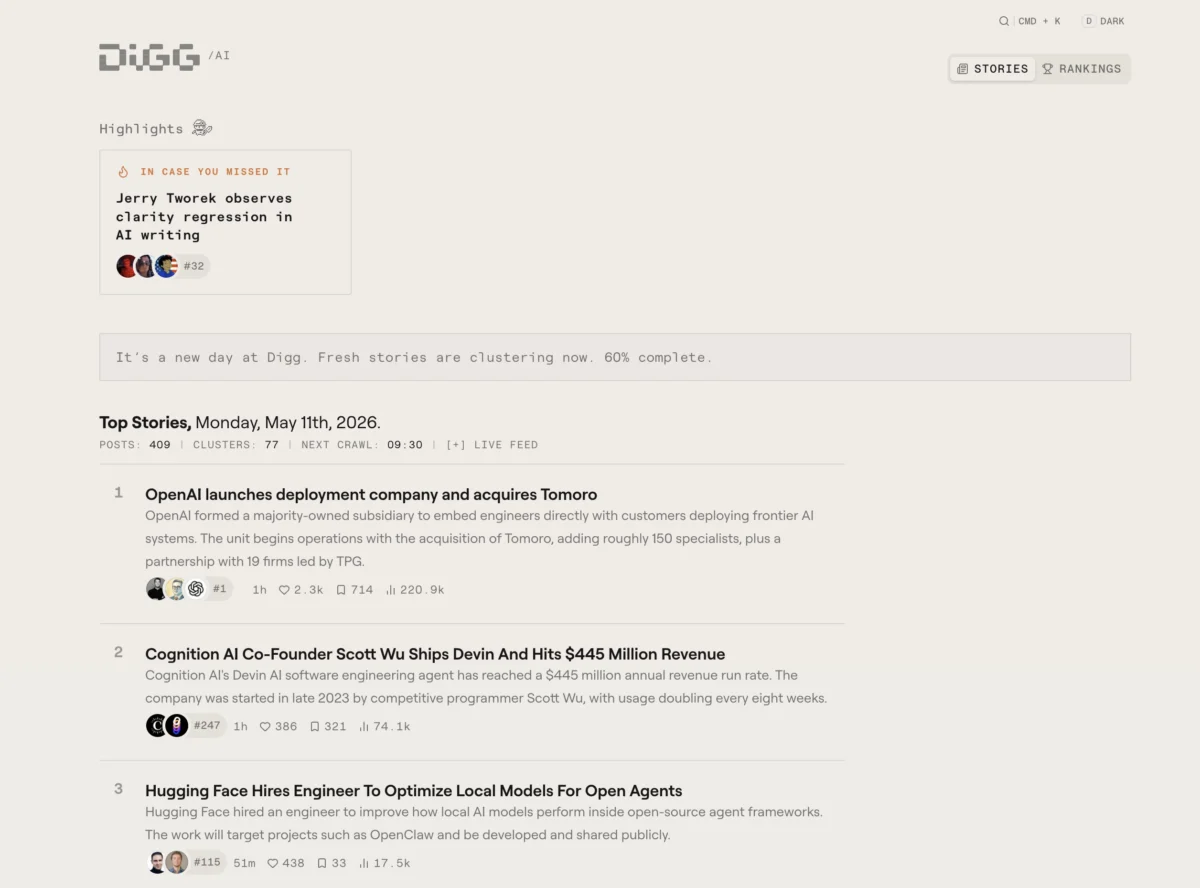
Introduction: The Perpetual Resurrection of a Digital Icon
In the volatile landscape of digital media, few brands carry the historical baggage and persistent survival instinct of Digg. Once the undisputed king of the social web, the platform has spent the better part of two decades oscillating between relevance and obsolescence. Now, just months after a high-profile shuttering of its most recent iteration, Digg is back.
This latest reincarnation marks a significant departure from its previous, failed attempt to serve as a direct competitor to Reddit. Instead of fostering a community-driven forum environment, the new Digg—spearheaded once again by founder Kevin Rose—is returning to its roots as a sophisticated news aggregator, albeit one heavily infused with artificial intelligence and real-time data analysis.
A Chronology of Instability: From Tech Darling to Pivot Machine
To understand the current state of Digg, one must look at the turbulent history of the past eighteen months. In mid-2025, the platform launched with much fanfare, positioning itself as a modern alternative to Reddit. It was an ambitious play intended to capture users disillusioned with the administrative and cultural shifts occurring on larger community platforms.
However, the reality of the market proved unforgiving. By March 2026, the company was forced to concede defeat. The “Reddit-rival” experiment failed to gain traction, plagued by an inability to manage the flood of automated bot traffic and a lack of clear differentiation. The subsequent layoffs and the complete shutdown of its mobile application signaled a desperate need for a change in strategy.
Kevin Rose, a partner at True Ventures and the original architect of the Digg phenomenon, stepped back into the fray in April 2026. Rather than folding the company, Rose chose to go back to the drawing board. On a Friday evening in May, he provided the public with a first glimpse of the redesigned platform. The current iteration, while technically in a “raw and buggy” beta phase, suggests that the leadership has realized that chasing the ghost of Reddit was a strategic error.
Decoding the New Digg: AI and the Architecture of Attention
The new Digg is not attempting to build a social network; it is attempting to build a barometer for the internet’s collective focus. The site’s primary objective is to “track the most influential voices in a space” and curate content that is truly worth a reader’s time.
For its pilot program, the platform is hyper-focusing on the rapidly evolving field of Artificial Intelligence. By limiting its scope to AI, Digg hopes to prove that its algorithms can effectively filter the "signal" from the "noise" that currently saturates social media platforms like X (formerly Twitter).

The Mechanics of Engagement
The core innovation of the new Digg lies in how it surfaces content. Unlike traditional aggregators that rely on user upvotes—a system historically prone to manipulation—Digg is now ingesting data from X in real-time. It employs a suite of advanced tools, including sentiment analysis, content clustering, and sophisticated signal detection, to determine what is truly gaining traction.
The homepage is structured to provide an immediate snapshot of the discourse:
- Most Viewed: The story commanding the highest level of attention.
- Rising Discussion: Content that is currently gaining momentum.
- Fastest-Climbing: Topics seeing the most rapid surge in interest.
- In Case You Missed It: A curated look at significant news that may have been buried by the rapid pace of the news cycle.
As Kevin Rose noted on X, the platform is designed to track the "chain reaction" of information. When an influential figure like OpenAI CEO Sam Altman interacts with a piece of content, it often triggers a predictable cascade of discussion. The new Digg aims to quantify this, providing a dashboard that tracks the ripple effects of high-profile engagement.
Supporting Data: Why AI?
The focus on AI is not accidental. It is currently one of the few remaining sectors where high-level, real-time discussion remains concentrated on X. By targeting this niche, Digg is leveraging the platform’s existing data infrastructure to provide value to "data nerds" and industry professionals who need to keep a finger on the pulse of innovation.
Beyond the headlines, the platform provides deeper analytical layers:
- Influencer Ranking: A leaderboard tracking the top 1,000 individuals influencing the AI space.
- Corporate Mapping: Identifying which companies are driving the most conversation.
- Policy Watch: A tracker for politicians and legislative bodies shaping the regulatory landscape for AI.
The Skeptic’s Perspective: A Solution in Search of a Problem?
Despite the technological sophistication behind the new interface, the road ahead for Digg is fraught with structural challenges. Industry analysts remain cautious, questioning whether there is enough inherent value for the "everyday user" to switch their habitual news consumption patterns.
The Competition for Eyeballs
Users are currently spoiled for choice when it comes to news consumption. From personalized "For You" feeds on X to highly efficient RSS readers and curated newsletters, the battle for the user’s morning scroll is intense. Digg currently lacks a native discussion component—a feature that arguably sustained its predecessor—which makes it a passive experience in an ecosystem that increasingly favors active participation.

The Fragmentation of the Social Web
Furthermore, the reliance on X as a primary data source may prove to be a long-term liability. Since Elon Musk’s acquisition of the platform, the digital landscape has fragmented. Competitors like Meta’s Threads and decentralized alternatives have siphoned off large swaths of users. If the "AI discourse" moves away from X, or if the quality of public debate on that platform continues to degrade, Digg’s primary engine for discovery could be severely compromised.
Implications for the Publishing Industry
Perhaps the most significant, yet overlooked, implication of the new Digg is its potential impact on the broader media ecosystem. For years, publishers have struggled with declining referral traffic. The rise of Google’s AI Overviews—which summarize search results at the top of the page, often eliminating the need for a user to click through to the source—has been particularly devastating to the bottom line of independent news organizations.
If Digg manages to gain meaningful traffic, it could serve as a much-needed bridge for publishers. By acting as a sophisticated, signal-focused curator, it has the potential to direct high-intent traffic to original reporting. In an era where search engines are increasingly cannibalizing publisher traffic, a resurgence of high-quality, human-curated, or AI-assisted aggregation could be a vital lifeline for journalists and content creators.
Conclusion: A High-Stakes Final Stand
The return of Digg is a reminder of the cyclical nature of tech trends, but it is also a testament to the persistent allure of the "link-sharing" model. Whether the site can evolve beyond its "buggy" beta and convince a cynical, fragmented audience to trust its curation remains to be seen.
By pivoting to data-driven AI curation, Digg has found a legitimate use case that differentiates it from the swarm of generic news aggregators. However, the company must now prove that its model can scale beyond a single vertical and provide enough utility to break the habits of a modern, distracted internet user. For Kevin Rose, this is not just another attempt to launch a site—it is a high-stakes effort to restore a legacy brand by aligning it with the most important technological shift of our time. Whether this iteration of Digg finds its footing or becomes another footnote in the history of the web, its progress will be closely watched by those who remember—and still miss—the original, chaotic, and essential spirit of the social web.


 Ammar Sabilarrohman
 Pevita Pearce