Basiran
In a high-stakes operation that strikes at the heart of Russian hybrid warfare infrastructure, Dutch financial crime investigators have arrested two prominent tech entrepreneurs on charges of violating international sanctions. The operation, executed by the Tax Intelligence and Investigation Service (FIOD), resulted in the seizure of over 800 servers, effectively pulling the plug on a sprawling digital ecosystem that had become a primary staging ground for pro-Russian cyberattacks, disinformation campaigns, and state-sponsored espionage within the European Union.
The arrested individuals—a 57-year-old Amsterdam resident and a 39-year-old native of The Hague—are accused of facilitating illegal economic activity by providing critical IT infrastructure to entities already sanctioned by the EU. These arrests mark a significant escalation in the European Union’s efforts to hold private-sector actors accountable for their role in enabling hostile foreign state operations.
The Nexus of Infrastructure: From Stark to WorkTitans
The investigation centers on the complex relationship between various hosting providers and their alleged misuse by Russian intelligence agencies. At the center of the web is Stark Industries Solutions, an entity that emerged with suspicious timing just two weeks before the Russian invasion of Ukraine in February 2022.
Stark Industries quickly garnered a reputation in the cybersecurity community as a "bulletproof" host. It provided the necessary bandwidth and anonymity for massive Distributed Denial-of-Service (DDoS) attacks against European government institutions and critical infrastructure. Investigations revealed that Stark functioned as an "iron hammer in the cloud," acting as a primary supplier of proxy services for hacking groups operating under the umbrella of Russian intelligence.
The network’s survival strategy relied on constant obfuscation. When the European Union moved to sanction the Moldovan brothers Ivan and Yuri Neculiti and their company, PQHosting, in May 2025, the infrastructure associated with Stark did not disappear. Instead, it migrated. As reported by KrebsOnSecurity, the network’s assets were surreptitiously transferred to a new entity, the[.]hosting, which operated under the control of the Dutch firm WorkTitans BV.
A Chronology of Evasion
The timeline of this digital shell game reveals a calculated effort to bypass international scrutiny:
- February 2022: Stark Industries Solutions is established, quickly becoming a hub for malicious cyber activities linked to Russian intelligence.
- May 2024: Security researchers identify the critical role of PQHosting and the Neculiti brothers in providing connectivity to Stark’s operations.
- May 2025: The EU officially sanctions PQHosting and the Neculiti brothers for their contributions to Russia’s hybrid warfare.
- Two weeks prior to May 2025 sanctions: Anticipating the move, administrators migrate Stark network assets to the[.]hosting, controlled by the Dutch entity WorkTitans BV.
- September 2025: Investigative reporting exposes that WorkTitans, despite the sanctions, maintained a lifeline to the broader internet via the Dutch provider MIRhosting.
- November 2025: During the week of Denmark’s municipal elections, data confirms that WorkTitans and MIRhosting were the most-used networks in pro-Russian cyberattacks targeting Danish government bodies.
- May 18, 2026: FIOD conducts coordinated raids in Enschede, Almere, Dronten, and Schiphol-Rijk, resulting in the arrests of Andrey Nesterenko and Youssef Zinad and the seizure of hardware.
The Players: A Piano Prodigy and an Elusive Consultant
The individuals at the center of the controversy present a study in contrast. Andrey Nesterenko, a 39-year-old Russian native operating MIRhosting out of the Netherlands, has a history in the tech space dating back to the mid-2000s. A former piano prodigy, Nesterenko founded Innovation IT Solutions Corp in 2004. Notably, his company was linked to the hosting of stopgeorgia[.]ru in 2008—a site used to organize cyberattacks during the Russian-Georgian conflict. This event is widely cited by historians as one of the first instances of a military engagement occurring simultaneously with coordinated cyber-aggression.
Conversely, 57-year-old Youssef Zinad has maintained a shadowy presence. Following initial reporting on his involvement in 2025, Zinad adopted a reclusive lifestyle. He shuttered his digital footprint, deleted his LinkedIn account, and avoided all contact with media outlets. His eventual arrest at an Amsterdam residence brought an end to months of speculation regarding his whereabouts and his exact role within the MIRhosting ecosystem.
While Nesterenko has attempted to distance himself from Zinad, claiming their relationship was a "normal business-to-business arrangement," evidence suggests otherwise. Records indicate that Zinad possessed an official @mirhosting.com email address and was listed as a primary contact for the company’s offices in Almere.
Data and Disruption
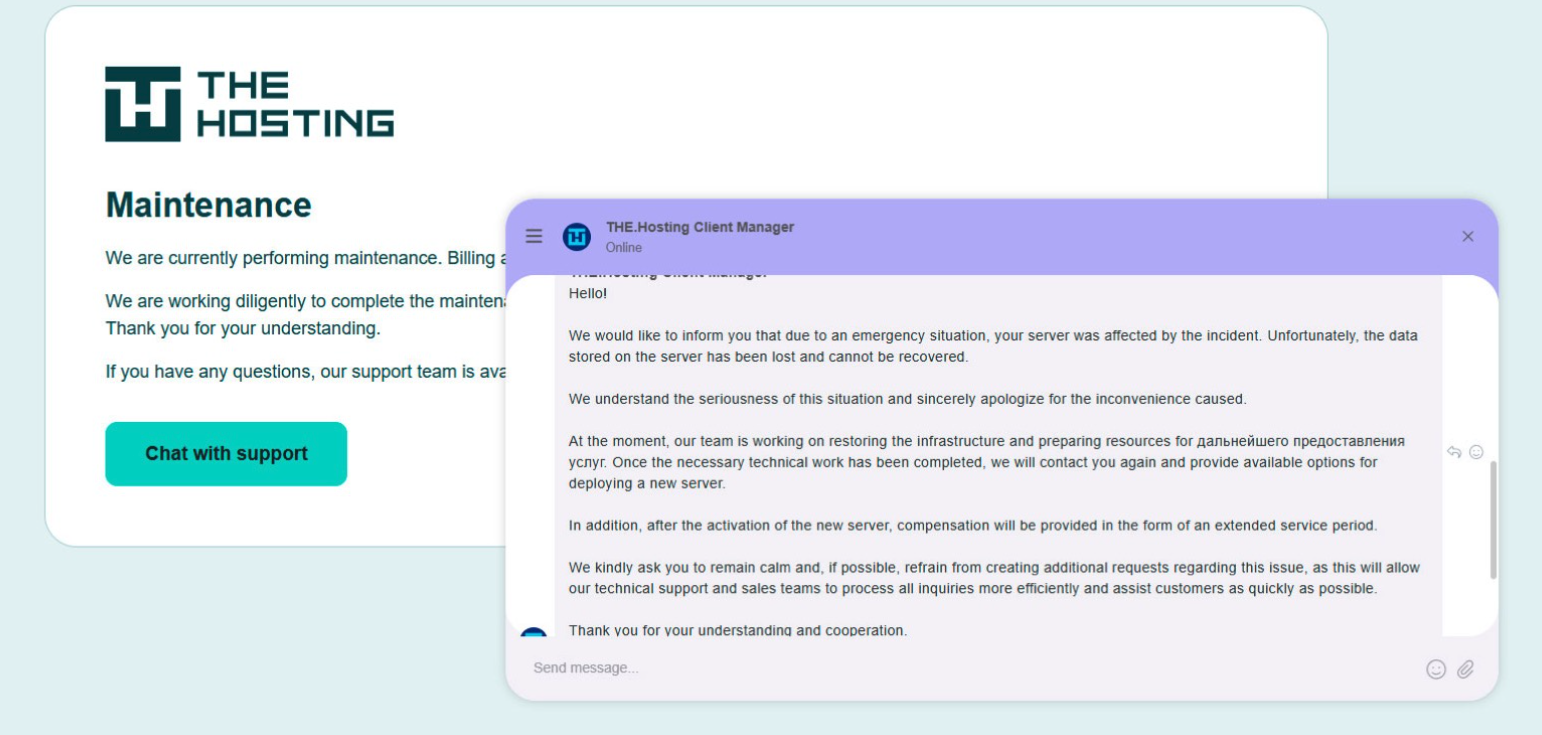
The sheer scale of the disruption caused by the FIOD raid is unprecedented. By seizing over 800 servers, authorities have effectively rendered the[.]hosting and its associated infrastructure inert. For many customers, the impact was immediate: a notice posted to the company’s website shortly after the raid confirmed that all data stored on the seized servers had been lost and was unrecoverable.
The evidentiary trail is damning. De Volkskrant reviewed internal data suggesting that the infrastructure under the control of WorkTitans and MIRhosting was instrumental in the wave of attacks that plagued Danish government bodies during their November 2025 municipal elections. These attacks were characterized by high-volume DDoS traffic that specifically targeted the digital portals used by Danish citizens to engage with the democratic process.
Official Responses and Defenses
In the wake of the arrests, MIRhosting issued a formal statement defending its operational integrity. The company claimed it had initiated an internal investigation into the allegations surrounding the Danish elections and noted that it had suspended services to WorkTitans as a "precautionary measure."

"Based on our preliminary findings, there are no indications that the services over which we exercise control were actually used to influence the Danish elections," the statement read. "No anomalies or spikes were observed in our network traffic… had large-scale DDoS attacks occurred, such activity would have been evident."
Nesterenko, in email communications, further argued that he was being scapegoated. "The transition to the[.]hosting was not intended to evade sanctions," he stated. "The hardware and customer portfolio had already been transferred to WorkTitans before the sanctions appeared. Closing or damaging a legitimate Dutch infrastructure company will not stop cybercrime, but it will harm many people who have done nothing wrong."
Despite these denials, the Dutch authorities maintain that the legal violation is clear: by providing infrastructure to sanctioned entities, the defendants directly violated the EU Sanctions Law, which prohibits making economic resources available to entities that threaten the stability and security of the Union.
Implications for the Future of Cyber-Governance
The case of MIRhosting and WorkTitans serves as a cautionary tale regarding the "bulletproof hosting" industry. These providers often exploit jurisdictional gaps and the anonymity afforded by the global nature of the internet to provide services to bad actors.
By targeting the providers themselves—rather than just the nebulous hacking groups they host—the Dutch authorities have signaled a new strategy in the fight against hybrid warfare. The seizure of physical assets and the detention of executives create a direct deterrent for those who might profit from hosting state-sponsored cyber operations.
As European nations continue to grapple with the reality of persistent cyber-interference, the legal fallout from this case will likely set a precedent for how the EU handles private hosting companies that knowingly or negligently provide "digital cover" to foreign intelligence services. For now, the silence of the 800 servers in Dutch data centers serves as a stark reminder of the fragile balance between the freedom of the internet and the security of the democratic institutions that rely upon it.


 Sagoh
Sagoh
 Nana Wu